
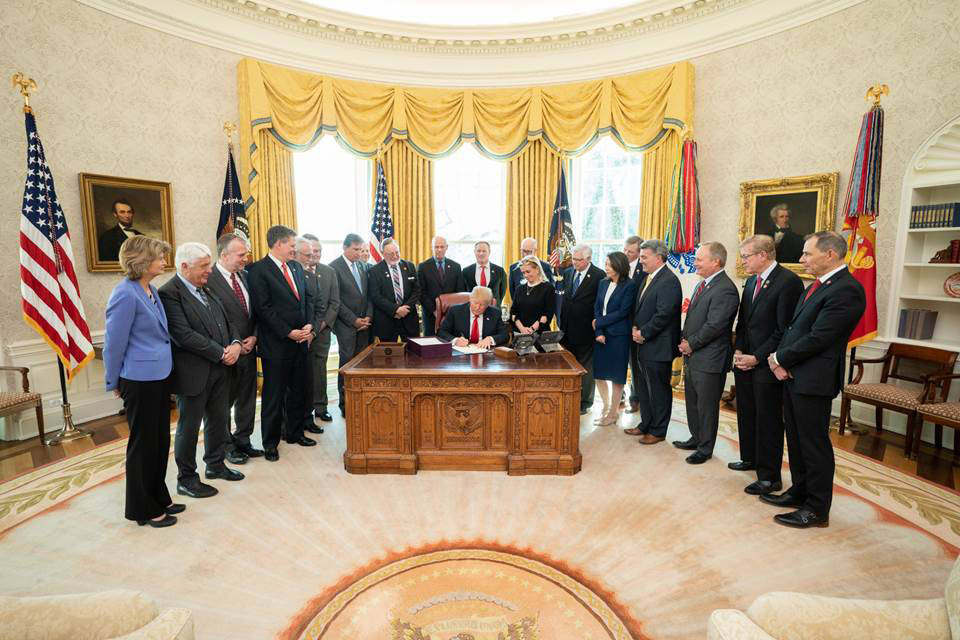
WASHINGTON — President Donald Trump signed a wide-ranging public lands bill Tuesday that creates five new national monuments and expands several national parks.
The new law also adds 1.3 million acres of new wilderness and permanently reauthorizes the Land and Water Conservation Fund, which supports conservation and outdoor recreation projects nationwide. It’s the largest public lands bill Congress has considered in a decade, and it won large bipartisan majorities in the House and Senate.
More than 100 land and water conservation bills were combined to designate more than 350 miles of river as wild and scenic, and to create nearly 700,000 acres of new recreation and conservation areas.
The new law also withdraws 370,000 acres in Montana and Washington state from mineral development.
Trump signed the bill in the Oval Office during a private ceremony with acting Interior Secretary David Bernhardt and a bipartisan group of lawmakers, the White House said.
Bernhardt, who is awaiting Senate confirmation to become the department’s permanent leader, issued a written statement calling the law “extremely beneficial” to the American public.
The Land and Water Conservation Fund expired last fall after Congress failed to agree on language to extend it. Lawmakers ultimately voted to make the fund permanent, though its yearly funding will be subject to the annual appropriations process. The fund is one of the most popular and effective programs created by Congress, and it has supported more than 42,000 state and local projects nationwide since it began in 1964, using royalties from offshore oil and gas drilling to fund conservation and recreation projects.
Trump has said he wants clean air and clean water, but his administration has rolled back numerous environmental regulations, deeming them burdensome for business. The president has publicly doubted climate change and pulled the U.S. out of a multinational pact that aims to slow the rate of global warming.
He installed a former coal lobbyist to lead the Environmental Protection Agency, while Bernhardt is a former energy industry lobbyist. Meanwhile, the budget proposal Trump released Monday would cut the Interior Department’s permanent and discretionary funding for the conservation fund by three-fourths.
The law is named for Rep. John Dingell, who died in February. The Michigan Democrat was the longtime chairman of the powerful House Energy and Commerce Committee and played a leading role in laws dealing with health care, the environment, civil rights and the auto industry.
Three new national monuments to be administered by the National Park Service and two others to be overseen by the Forest Service and Bureau of Land Management will be created under the law.
The new monuments are the Medgar and Myrlie Evers Home National Monument in Mississippi; the Mill Springs and Camp Nelson national monuments in Kentucky; the former Saint Francis Dam site in Southern California; and the Jurassic National Monument in Utah.
In December 2017, Trump took the rare step of scaling back the sprawling Bears Ears and Grand Staircase-Escalante national monuments in Utah, which were created by Democratic Presidents Barack Obama and Bill Clinton, respectively. Trump had accused Obama and Clinton of exceeding their executive authority by creating both monuments, each of which had encompassed millions of acres of land.
Republicans say the new monuments were created the right way, through the legislative process and not by a president wielding his executive powers.
Trump’s move marked the first time in a half century that a president had undone these types of land protections.
• This is an Associated Press report by Darlene Superville.
