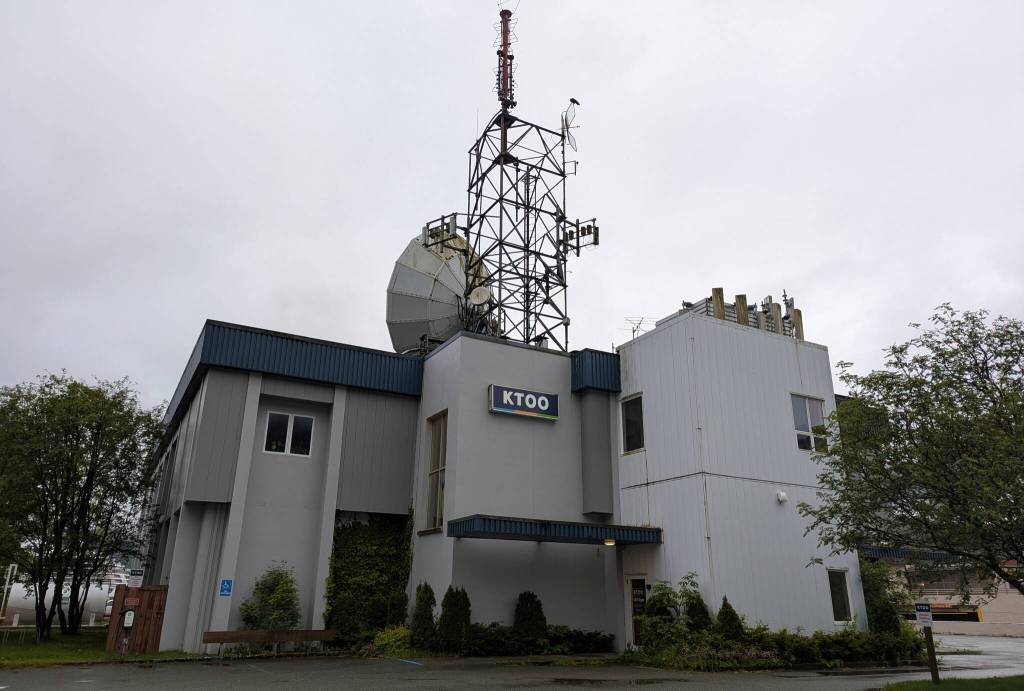
KTOO, Juneau’s public radio station, is photographed in Juneau, Alaska, on Friday, July 11, 2025. (Photo by Erin Thompson/Peninsula Clarion)

KTOO, Juneau’s public radio station, is photographed in Juneau, Alaska, on Friday, July 11, 2025. (Photo by Erin Thompson/Peninsula Clarion)

Trump signs law yanking $9B from NPR, PBS, foreign aid

The law rescinds $1.1 billion for the Corporation for Public Broadcasting

President Donald Trump signed into law Thursday the bill Congress passed earlier this month to revoke $9 billion in previously approved spending for public broadcasting and foreign aid.

Trump’s signature was expected after his Office of Management and Budget compiled the list of requested rescissions.

Congressional Republicans approved a small slice of what the White House initially wanted, but the effort still represents a win for Trump, who used small majorities in both chambers of Congress to claw back money approved in bipartisan spending laws.

The law rescinds $1.1 billion for the Corporation for Public Broadcasting, a congressionally chartered nonprofit that provides a small share of funding for National Public Radio and the Public Broadcasting Service but accounts for much larger portions of local public broadcasters’ revenue. The funding had been approved to cover the next two fiscal years.

The law also cancels about $8 billion in foreign aid accounts, including global health initiatives.

Republicans have long criticized NPR and PBS news programs as biased toward politically liberal points of view, while Trump’s America First movement has consistently called for reducing foreign aid.

The law does not touch the President’s Emergency Plan for AIDS Relief, or PEPFAR, after Senate Republicans removed a provision to defund the program created during Republican George W. Bush’s presidency.

No Democrats voted for the law. Two Republicans in each chamber — Sens. Susan Collins of Maine and Lisa Murkowski of Alaska and Reps. Brian Fitzpatrick of Pennsylvania and Mike Turner of Ohio — voted against it.

It passed 51-48 in the Senate and 216-213 in the House. Each chamber took votes in the wee hours as Republicans raced to meet a July 18 deadline.

Senate Appropriations Vice Chair Patty Murray, a Washington Democrat, warned the move undermined the annual appropriations process, which typically involves consideration of rescissions requests during bipartisan negotiations over government spending.

Congress last approved a stand-alone rescissions bill in 1992, following a series of requests from President George H.W. Bush, according to a report from the nonpartisan Congressional Research Service.

Jacob Fischler covers federal policy and helps direct national coverage as deputy Washington bureau chief for States Newsroom. Based in Oregon, he focuses on Western issues. His coverage areas include climate, energy development, public lands and infrastructure. This article originally appeared on the alaskabeacon.com. Alaska Beacon is part of States Newsroom, the nation’s largest state-focused nonprofit news organization.


More in News

The Juneau road system ends at Cascade Point in Berners Bay, as shown in a May 2006 photo. (Michael Penn / Juneau Empire file)
State starts engineering for power at proposed Cascade Point ferry terminal

DOT says the contract for electrical planning is not a commitment to construct the terminal.

Members of the Alaska Air and Army National Guard, Alaska Naval Militia, and Alaska State Defense Force work together to load plywood onto a CH-47 Chinook helicopter, in Bethel, Alaska, Nov. 2, 2025, bound for the villages of Napaskiak, Tuntutuliak, and Napakiak. The materials will help residents rebuild homes and restore community spaces damaged by past storms. (U.S. Army National Guard photo by Spc. Ericka Gillespie)
Gov. Dunleavy approves Alaska National Guard assisting ICE in Anchorage

The National Guard said five service members will assist with administrative support; lawmakers and civil rights advocates worry that the move signals a ramping up of immigration enforcement operations in Alaska

A cruise ship, with several orange lifeboats visible, is docked in downtown Juneau. (Laurie Craig / Juneau Empire file photo)
CBJ seeks input on uses for marine passenger fees

Public comment period is open for the month of December.

Browsers crowd into Annie Kaill’s gallery and gift shop during the 2024 Gallery Walk. (Juneau Empire file photo)
Gallery Walk guide for Friday, Dec. 5

The Juneau Arts & Humanities Council announced community events taking place during… Continue reading

The Alaska State Capitol is seen on Tuesday, Nov. 25, 2025. (Photo by James Brooks/Alaska Beacon)
Alaska Senate Republicans confirm Rauscher, Tilton and open two vacancies in state House

The Alaska Republican Party is moving quickly after Republicans in the Alaska… Continue reading

Downtown Skagway, with snow dusting its streets, is seen in this undated photo. (Photo by C. Anderson/National Park Service)
Skagway’s lone paramedic is suing the city, alleging retaliation by fire department officials

This article was reported and published in collaboration between the Chilkat Valley… Continue reading

A spruce tree grows along Rainforest Trail on Douglas Island. (Mari Kanagy / Juneau Empire)
Where to cut your Christmas tree in Juneau

CBJ and Tongass National Forest outline where and how residents can harvest.

Winter dining has always carried more weight than the menu might suggest. In the off-season, eating out isn’t just about comfort food or convenience; it’s a way of supporting local businesses as they hold steady through the slower months. Photo credit: Canva.
Savoring local in Juneau: How a simple meal helps the whole community

Independent cafés and neighborhood restaurants keep Juneau strong through the slow season

Kaskanak Creek in the Bristol Bay’s Kvichak watershed is seen from the air on Sept. 27, 2011. The Kvichak watershed would be damaged by the Pebble mine project, the Environmental Protection Agency has determined. (Photo provided by Environmental Protection Agency)
Pebble Mine, halted by EPA order, gets support from national development groups

In 2023, the EPA invoked a rarely used “veto” clause of the Clean Water Act to say that there was no way that the proposed Pebble Mine could be developed without significant harm to the environment.

Most Read