

Actions described as either “very positive” or “insidious” at the University of Alaska to comply with Title IX regulations were among the most notable items discussed at the Board of Regents meeting in Juneau on Friday, with officials saying they’re preparing for yet more alterations as Monday’s federal deadline to comment on proposed changes approaches.
The discussion generated some of the most politically controversial comments of the board’s two-day meeting that began Thursday, the first in Juneau since 2018. Leaders during the two days also began reviewing next year’s budget, including a tuition policy freezing rates at most campuses next year (and the possibility of allowing for more variances between campuses).
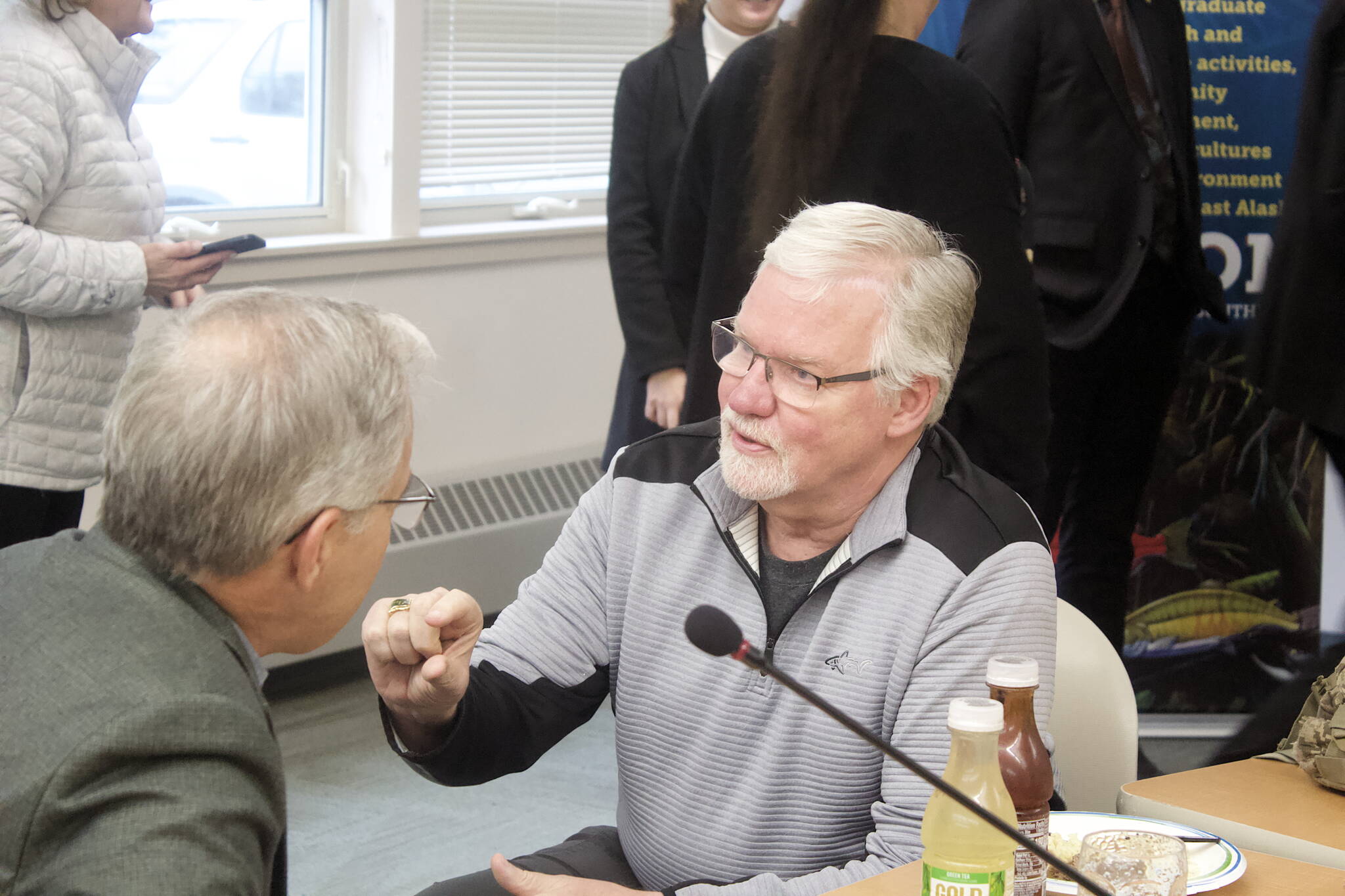
Dale Anderson, a member of the University of Alaska’s Board of Regents, talks with fellow member Ralph Seekins after the conclusion of the board’s two-day meeting at the University of Alaska Southeast on Friday. Anderson was harshly critical during Friday’s meetings of changes to Title IX, which is again being revised in anticipation of pending changes at the federal level, saying it’s being expanded in “insidious” ways beyond its original intent. (Mark Sabbatini / Juneau Empire)
Plus the board and university administrators were confronted for a second day by faculty members in the audience holding up protest signs as a stalemate in union contract negotiations that’s lasted more than a year gets increasingly contentious.
The evolution of Title IX, which prohibits sex-based discrimination in any educational program receiving funding from the federal government, was described in largely positive terms by the chancellors at the university’s three largest campuses. Karen Carey, chancellor at the University of Alaska Southeast, said staff are getting “safe zone” training and met with students at the start of the school year to acquaint them with related guidelines and programs.
“We have a complaint office,” she said. “We have a number of events coming up. We started a Title IX book club reading the book ‘Missoula,’ which is about rape in a college town. We believe students benefit from those conversations.”
While the university is struggling with the same staff shortages as employers nationwide, the Title IX program in Anchorage is fully staffed, said Sean Parnell, chancellor of that campus. At the Fairbanks campus, Chancellor Daniel White said extra emphasis on preventative efforts that in part are due to students readjusting to a return to campus after the COVID-19 pandemic are showing signs of success.
“We continue to see increases in numbers of reports, but decreases in numbers of situations that go to investigation,” he said. “We attribute that to increasing reports of lower-level behaviors.”
But the scope of changes to the federal civil rights law enacted in 1972 troubled Dale Anderson, a university board member, who said among its original intent was “to protect athletics in the female realm.”
“Now the areas that they are pushing at this point is there is no sanctity of women’s athletics any more,” he said.
Furthermore, Anderson said the law is expanding beyond “protecting the environment around our university” from harassment to “new rules coming out that are really insidious.”
“We are talking about protection of minors,” he said. “It’s extending out into the preschools. It’s extending into elementary schools, high schools. It’s going to a point to where it goes beyond what I can support as the values I carry in my back pocket.”
None of the other board members or regents responded directly to Anderson’s comments, but Board Chair Sheri Buretta wrapped up the discussion by expressing support for the ongoing implementation of the law.
“I appreciate the memories and where we are,” she said. “Where we’ve come is important with the role of protecting our students.”
Budget and tuition
Initial work on next year’s budget suggests the process may not be as contentious as the past few years when significant cuts occurred, as budget officials working for Gov. Mike Dunleavy said Thursday they are seeking to maintain current spending levels due to high oil prices, which along with federal infrastructure funds will also allow consideration of one-time projects. University officials noted there is currently a $1.3 billion backlog in deferred maintenance and related projects that will likely be a major focus during upcoming discussions about such spending.
More disputed was proposed tuition, which in draft form states rates will remain the same at the Anchorage, Juneau and community campuses, while adjusting rates at the main UAF’s Troth Yeddha’ campus to align it with other upper-division programs. It also includes the possibility of allowing a greater number of variances in tuition at different campuses, which was criticized by board members who said it will encourage students to “shop” for classes.
“I think if we get started setting this with different campuses around the state, it’s just going to get out of hand,” Board Member Darroll Hargraves said. “How would a student feel about taking an English 101 class and paying one tuition for it, the students in Juneau paying a different rate?”
Board Member Karen Perdue said she shares the concern about potential problems, but “I’m actually comfortable with this tentative proposal” because there is only one exception with clearly defined rationale.
“In the future I would say we need more discussion for it,” she said.
Not discussed at any length was the union contract standoff, but that didn’t keep it from being a foremost presence to both people at the meeting and anyone watching the live webcast due to the protest signs employees were holding in the backdrop. Abel Bult-Ito, a UAF professor and the union’s president, acknowledged the employees’ presence and signs were providing any information about the facts and feelings involved in the dispute to university leaders, but being there nonetheless was an act of substance.
“It’s putting pressure on them, showing up in person,” he said. “They’re actually upset every time the chancellors talk our signs are in the background.”
Juneau Empire reporter Mark Sabbatini can be reached at mark.sabbatini@juneauempire.com
