
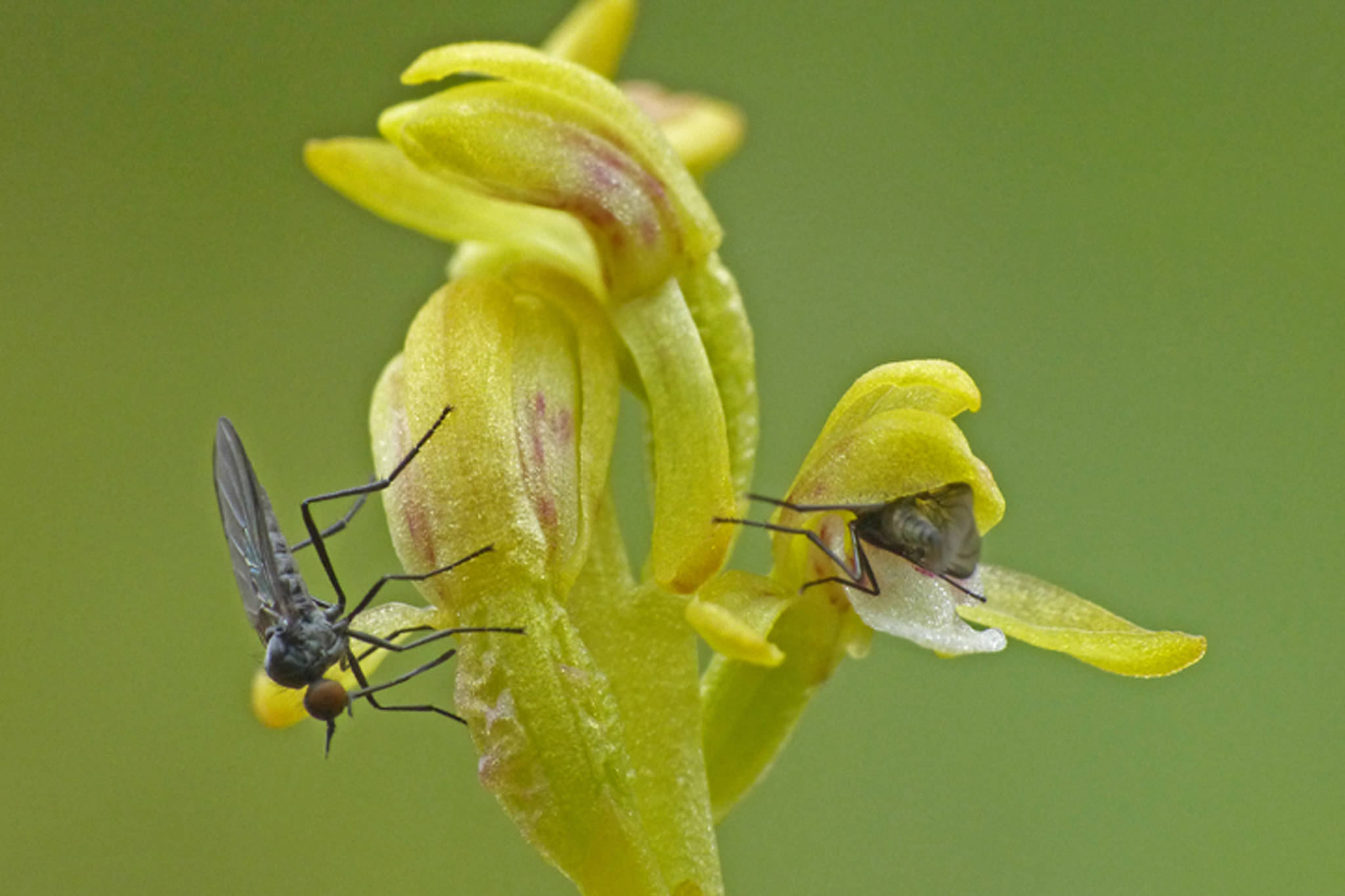
The “true flies” belong to the large taxonomic group (Diptera) that may encompass at least as much diversity as the beetles. Their ecological roles include external and internal parasites of vertebrates, gall makers, predators, leaf miners, pollinators, fungus and detritus eaters, tenants in bee nests and wood borers. In addition, they are famous for the many species that feed on blood, a fine source of protein.
Indeed, the flies are a blood-thirsty lot. Thousands of species feed on blood, some on vertebrates, others on invertebrates, especially insects. Blood-feeding has evolved independently in about fifteen separate lineages of flies, sometimes from ancestors that were predatory, or ones that fed on bird or bat waste products, or those that were flower-feeders.
[These small insects do big things for the environment]
Flies have two different ways of obtaining blood. Some species (e.g., mosquitoes) pierce directly into the host’s circulatory system, while others (e.g., horse flies) slice and shred an opening and then lap up the pooled blood. Either way, the liquid diet is sucked up by a variety of suction pumps. Dependence on a liquid diet clearly requires that the food supply stays liquid; accordingly, the blood-feeding flies secrete anticoagulants that keep the blood at the feeding site from clotting.
In addition to their well-known nuisance effects, the blood-feeding flies have a (from our perspective) a more nefarious role. Heavy attacks can drain enough blood, even from a large animal such as a cow, to cause anemia or even death. More famously, the blood-feeders are vectors for the bacteria, viruses, and other micro-organisms that cause lots of nasty diseases — malaria, dengue fever, encephalitis, sleeping sickness, zika, yellow fever and many others. So flies tend to have a bad name among humans, who often make war on flies.
[When Alaska salmon ‘go viral’]
Historically, control of vectoring flies has allowed some prodigious ecological changes. Perhaps the most famous is the building of the Panama Canal in the early 1900s; malaria and yellow fever had greatly hampered work on the big ditch. But opening the canal allowed some Pacific species to move to the Atlantic side and vice versa, and changed the forest and freshwater systems associated with the Chagres River, which was dammed to make part of the waterway. Much less well-known is the draining of the biologically diverse, expansive marshes of central Illinois. That reduced the mosquito populations and the risk of malaria, but also led to the black-soil ecological monotony of seemingly endless corn and soybean fields.
Nevertheless, many flies have ecologically useful activities. Prominent among them is pollination of many flowering plants. Although female blood-feeding flies require a blood meal to produce their eggs, they may also pollinate flowers. Males, on the other hand, sometimes feed on blood but more typically obtain food from the flowers they pollinate (or, in some cases, they don’t feed at all).
[Juneau composting business wins $25K for sustainability]
Flies of several kinds are some of the most important pollinators of Arctic flowers, including purple mountain saxifrage. Mosquitoes and tiny flies pollinate several species of orchid, including species that grow here in Southeast. Hoverflies are said to be the second-most important (after bees) pollinators of commercial crops. Certain species of the hated-by-humans biting midges (such as no-see-ums) are the only pollinators of the cacao tree that is the source of the generally loved-by-humans chocolate.
Then there are the many flies that help clean things up and recycle nutrients: those that eat detritus, dung and dead bodies. The larvae of these species are generally the ones that do this work, after a female fly has laid her eggs in suitable habitat. The adults may do other things, such as pollinate flowers. Detritus feeders work on decaying wood, rotting algae and other old plant material, as well as drain-pipe slime. The dung-eaters are many, and some are very specialized to certain sources of their favorite food. For instance, some specialize on bat dung or seabird guano; one group concentrates on the dry dung of wombats, and one species eats the feces of millipedes, staying closed to the source by riding on the back of the provider.
[Buzz, chirp, squeak: How and why insects make sound]
Carrion feeders include the beautiful (“blue-bottle”) blowflies that we often see on salmon carcasses when the females are laying their eggs on the larval dinner. Numerous kinds of carrion flies have been cleaning up the world for millions of years (but they were not yet present in the age of dinosaurs; maybe beetles did the job?). They often arrive at a corpse in a predictable order, which has been useful in criminal investigations, by helping to determine the time of death. Less well-known is the role of the larvae (maggots) in cleaning wounds, by consuming just the dead tissue and secreting a “magical” substance that actually promotes healing.
A beneficial role for various flies, not to be ignored, is their value as food for fish and birds. Birds feed on maggots in carcasses and dead wood. Both fish and birds feed on aquatic fly larvae (think of juvenile salmon and dippers in our streams). Flying adult flies help feed swallows, such as those that grace our local visitor center in summer, as well as other birds.
We often view flies just as troublesome, sometimes serious, pests. But many of them are useful in a variety of ways, and some types are both bothersome and useful. The world would be a poorer and filthier place without them.
• Mary F. Willson is a retired professor of ecology. “On The Trails” is a weekly column that appears every Friday. Her essays can be found online at onthetrailsjuneau.wordpress.com.
