
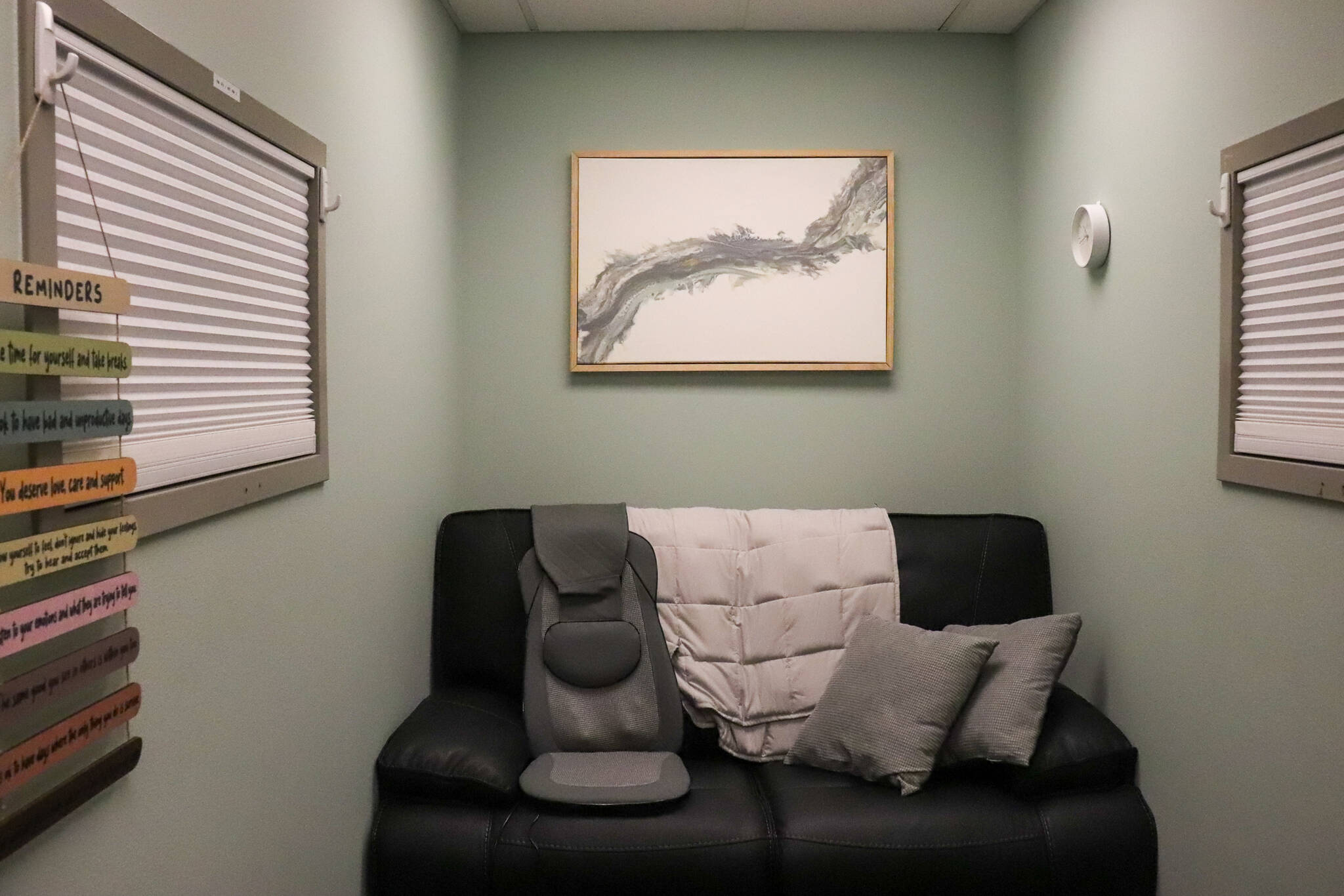
After the fatal police shooting of Steven Kissack on July 15, the Juneau Police Department held a critical stress debrief for the affected officers through its Wellness Program.
JPD separates calls into three degrees. Kissack’s call was a Category Three, the most serious. Patrol commander and wellness coordinator Jeremy Weske leads the station’s Wellness Program, which began two years ago.
“We lost Detective Daniel Darbonne. He died suddenly,” Weske said. “That was the first time that the wellness program got to be utilized on a large-scale event.” That was in May 2023.
Kissack was killed when he confronted several officers at knifepoint in downtown Juneau. The matter is under state investigation, which is standard procedure for all officer-involved shootings. Weske was not involved in the shooting.
During an interview on Friday at the JPD station, Weske focused on the overall curriculum and goals of the wellness program and de-escalation training.
Officers’ families are encouraged to participate in counseling services and peer support. The peer support team helps lead critical incident stress debriefs.
“When we have a really big event, we’ll do a debrief, where we bring affected employees in, have a conversation about what happened, how they’re feeling,” Weske said, “talking about what they can expect, what things they should do, and what things they should avoid. The peer support team is a big part of that, whether that’s sitting in on debriefs, or making sure people are getting to them or checking in with them after the fact.”
Along with a stress debrief, officers involved in a shooting are placed on three days of administrative leave per JPD’s policy.
The wellness program includes counseling, training, and a 16-person peer support team. Weske is a part of that team.
“You have day-to-day peer support for your employees,” he said. “Someone that somebody can go talk to, get resources, just have a conversation with someone that they know is confidential and can help guide them through whatever it is that they’re dealing with.”
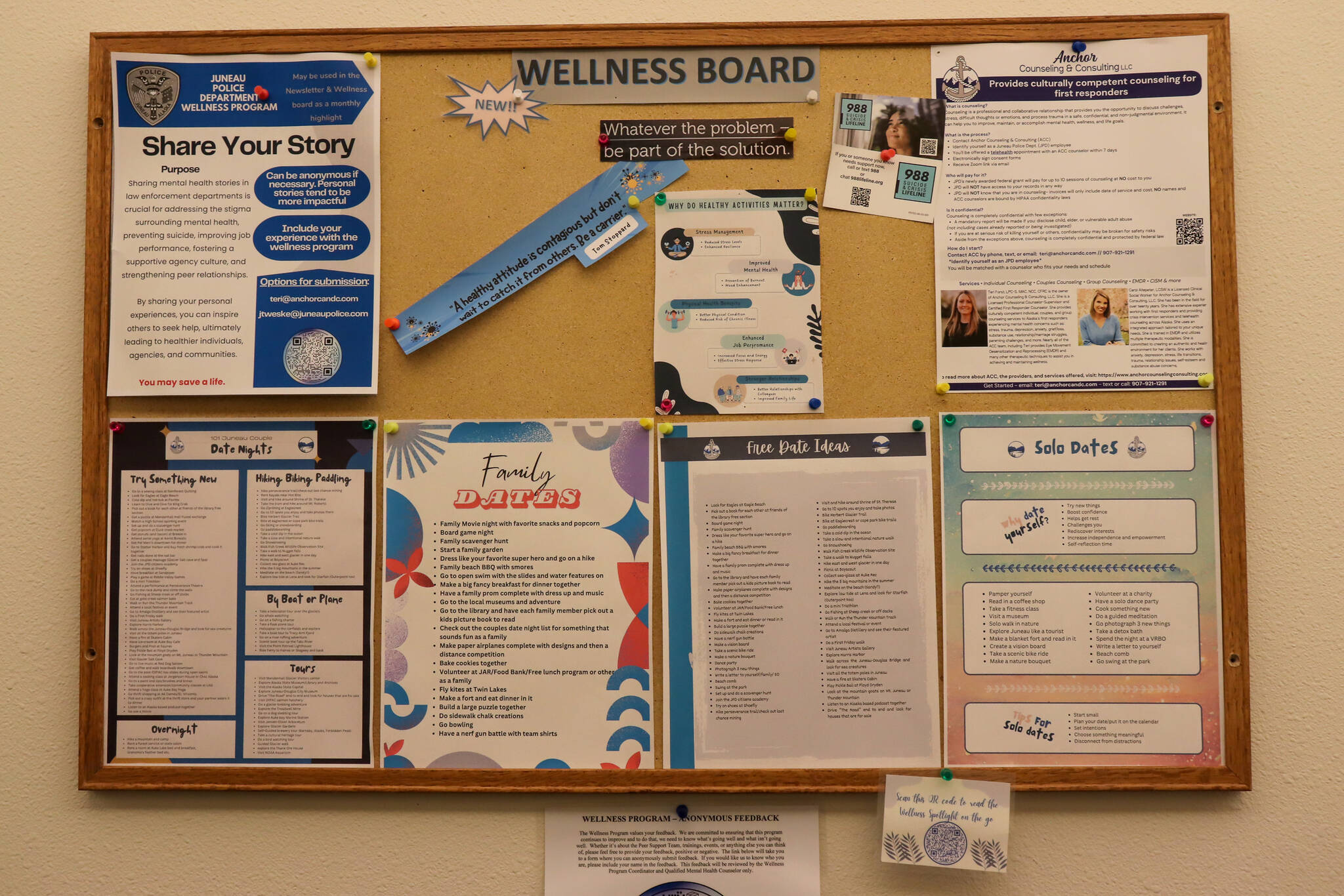
The Juneau Police Department’s wellness boards are found throughout the police station with mental health resources and posters encouraging family quality time. (Jasz Garrett / Juneau Empire)
The wellness program started with a federal Law Enforcement Mental Health and Wellness Act grant. Weske said JPD had been working toward a program for years and the grant allowed the department to offer free counseling for all employees. Then JPD began working with Teri Forst, who owns Anchor Counseling and Consulting. Now, it also offers other counselors for employees.
From dispatchers to administrators, everyone is affected by what they see and hear at the police department, Weske said, so the program is available to everybody.
“We wanted to have a training component so that people coming in are trained from the get-go on resiliency in mental health and wellness. We just wanted to make sure that the culture surrounding mental health was changing, and being able to incorporate everybody is a big part of that,” he said.
Resiliency training begins when an employee is hired; they and their significant other meet with Forst.
“In another 10 or 15 years, there won’t be anybody around that remembers that this didn’t exist,” Weske said. “This is just going to be the way the police department operates.”
Weske said not everyone uses counseling services, so JPD also conducts annual wellness checks to educate employees about nutrition, sleep, health, and stress reduction.
The next step in the station’s wellness program is to add a chaplaincy program. He said the station is almost ready to announce a call for police department chaplains.
The police station wellness programs direct employees to resources and phone numbers to call if they need support. If an employee needs the wellness program, they simply have to text the phone number provided. Everything is confidential, just like it would be for any other person seeking mental health services.
Weske has been working at JPD for 18 years. He said his generation of officers knew that mental health was an issue and awareness around post-traumatic stress disorder was beginning. He and other officers would discuss difficult calls with each other.
“But culturally, big picture, police departments weren’t really doing a lot to help their employees through those, so there was still a lot of the old mentality of, ‘Suck it up,’” he said. “You’re not going to show emotion. That was still pretty pervasive. But the guys and gals I came in with, we could see what was needed.”
De-escalation at JPD
JPD officers are also trained in Crisis Intervention Team (CIT) and de-escalation.
“What am I looking for? What am I going to see when someone’s experiencing a mental health crisis? They talk about how people are affected by mental illness, how their families are affected,” Weske said. “They go over common diagnoses, what that might look like out on a call so that you can have a sense of, ‘Is this someone who’s experiencing a psychotic break? Is this someone who is a manic depressive?’ You’re not going to diagnose anybody, but you at least have a sense of what might be going on. It’s a lot of education on how to let somebody know that you may not believe what they’re saying, but you believe that they’re experiencing what they’re feeling.”

The Juneau Police Department’s wellness room offers an assortment of aromatherapy, books and journals. (Jasz Garrett / Juneau Empire)
He said the training includes suicide education, suicide prevention, and how to talk to someone who might be suicidal.
“There’s a lot about just getting on a human level with somebody and having a conversation with them and letting them blow off steam, as long as they’re not being violent,” he said. “You’re just giving them a space to talk and try and diffuse a situation that way.”
During the CIT and de-escalation training, the Polaris House, JAHMI Health and Wellness, National Alliance on Mental Health Juneau, and Housing First visit JPD. The training also brings in people who have lived with mental illness to share their stories. CIT training incorporates role-playing scenarios that are later debriefed.
Weske said the de-escalation training teaches officers how to converse with someone who is agitated.
“What things can I do that will help reduce that tension?” Weske said. “What things do I need to avoid so that I don’t make the interaction more tense?”
De-escalation is an eight-hour course, and CIT is 40 hours. Weske said officers at the Public Safety Academy in Sitka are constantly being trained on de-escalation during the 17-week program. Weske said officers continue practicing de-escalation skills in most calls they receive at JPD.
As for wellness training, there was a time when the commonly held belief was that if you talked to someone about your feelings, your gun and badge should be taken away, Weske said. But that’s not the case anymore.
“I can’t really put into words the difference that this program has made around the department,” he said. “People are just happier. They feel cared for, they feel seen, they feel heard. They know that if they are struggling, they can talk to somebody and not be judged for it. The amount of safety that comes with that is incredible, and I’ve been so proud of how people have utilized it, how they’ve bought into it. Nobody complains about having to go to a debrief. People are excited to do it because they know that it’s helpful to them in the long run.”
• Contact Jasz Garrett at jasz.garrett@juneauempire.com or (907) 723-9356.
