
By Mary Catharine Martin
The SalmonState
The U.S. Department of Agriculture has a new approach in Southeast Alaska: first listening to locals about what their community needs, then working to support those ideas. So when the department asked what investments the USDA should make as part of its sustainability strategy, announced in 2020, it heard lots.
From Kootznoowoo, the Native corporation of the village of Angoon, on Admiralty Island: the development of a new bear-viewing area nearer to Angoon, and additional opportunities for Angoon-led storytelling and economic development.
From the Southeast Alaska Watershed Coalition: restoring, in collaboration with Tribes and communities, streams and watersheds damaged by historic logging practices.
From the Central Council of the Tlingit and Haida Indian Tribes of Alaska: cultural interpretive training for the U.S. Forest Service. Youth stewardship. Food security and sovereignty. And increased support for the Indigenous Guardians Network.
The USDA’s initial investment of up to $25 million — almost $9 million of which has been awarded so far — is just a piece of the overall picture, said U.S. Forest Service sustainability strategy program coordinator Barbara Miranda.
Miranda, herself once a city council member and mayor of Gustavus, said working with Tribes and local communities is key. “It is refreshing to have been on that side of the table and now to be on this side and say ‘What can we do for you today?’ and have some money behind it,” she said. “This was a completely different way of doing business. People came to us with their ideas. I’m hoping it will make it easier in the future to keep on supporting our Southeast Alaska communities, so we can realize the promise of the sustainability strategy.”
A look at a few of the projects and priorities:
Tlingit & Haida
Leaders at the Central Council of the Tlingit & Haida Indian Tribes of Alaska began working with the U.S. Forest Service on the Indigenous Guardians Network a few years ago.
The agreement they developed “is really a revolutionary agreement,” said Raymond E. Paddock III, Tlingit & Haida’s Environmental Coordinator. “We get to drive the bus as we’re building it. That kind of became a stepping stone to this real working relationship with Tribes, and the sustainability strategy is trying to take that same approach.”
The approach of truly listening, said Marco Banda, Tlingit & Haida’s Regional Resource Specialist, is “the start to taking a path toward healing.”
The Indigenous Guardians Network is modeled on work being done by First Nations in British Columbia to monitor and steward traditional lands and waters, using a blend of Indigenous knowledge and science.
“The intent behind this whole process is to ensure that Indigenous knowledge is part and parcel in coleadership, comanagement, and costewardship, and that we are working together toward a common goal,” said Michael Goldstein, the Program Manager for U.S. Forest Service’s involvement in the Indigenous Guardians Network.
The program is just at its beginning, Paddock and Banda said, and will be driven by each community’s needs and wishes.
“The Guardians program is a support system,” Paddock said. “We’re starting, Tribe by Tribe, community by community —whoever wants to have a seat and let us know how we can support them, we are totally open to it and here for that.”
“The Guardians can be a way of making your living — protecting, monitoring, and restoring on the ground,” said Banda.
Tlingit & Haida proposals that have already been funded under the first investments are the Alaska Youth Stewards program; a fire program that will train a crew to deploy to wildfires throughout the U.S.; and cultural interpretive training.
Watershed restoration
Rob Cadmus is the executive director of the Southeast Alaska Watershed Coalition, which received three grants to complete in cooperation with the Forest Service, Tribes, conservation districts and other entities.

Restoring trees to creeks can help recreate natural conditions. “Normally, trees die and fall in the stream. That’s what creates the diverse and complex habitat fish need for their different life stages. That complex structure of large wood in a stream creates complex habitat — creates what you need for the success of the fish,” says Rob Cadmus, Southeast Alaska Watershed Coalition executive director.(Courtesy Photo / Southeast Alaska Watershed Coalition)
“All of them are hands on, fish habitat restoration projects, but they have a work force capacity development through actual on the ground doing-the-job kind of training,” Cadmus said. “Each project has a Tribal crew, and they will, in many ways, implement the project. It takes a lot of work to make that happen.”
Many of the stream restoration projects SAWC is working on, Cadmus said, are necessary because prior to the Tongass Timber Reform Act, in 1992, streams were clearcut right up to the banks.
“It degrades habitat in several ways,” he said. “It takes away shade and cover. But also, normally, trees die and fall in the stream. That’s what creates the diverse and complex habitat fish need for their different life stages. That complex structure of large wood in a stream creates complex habitat — creates what you need for the success of the fish. When you log on top of it… it can take several hundred years for natural conditions to return.”
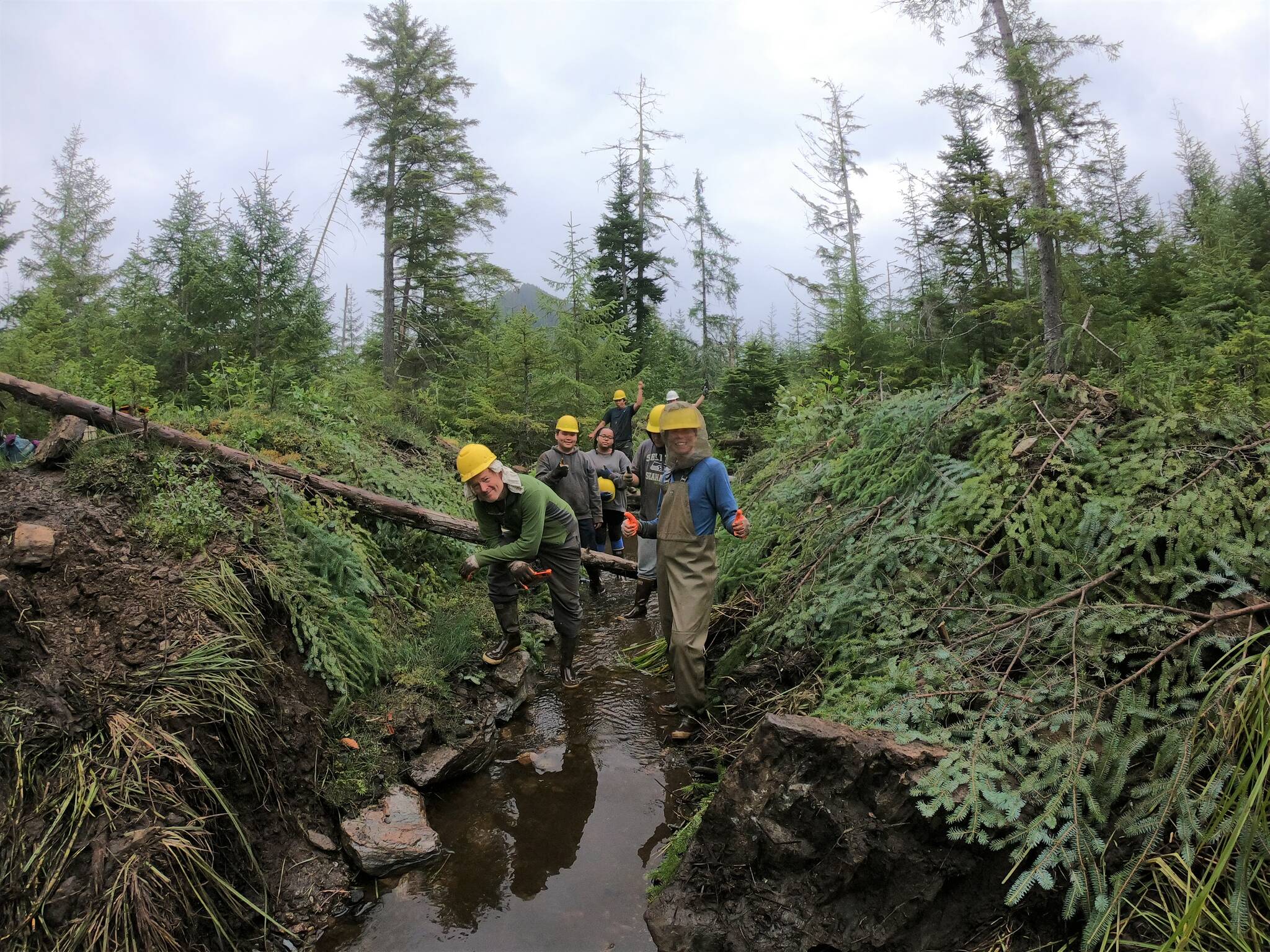
A Southeast Alaska Watershed Coalition crew poses next to their recently completed restoration project on Castor Creek, on Admiralty Island. (Courtesy Photo / Southeast Alaska Watershed Coalition)
Keeping the ecosystem intact in the first place, he said, has direct benefits to Southeast Alaskans — both personal, since residents are more likely to be able to catch fish, and economic, since the majority of fish produced in the region originate in the lakes, rivers and streams of the Tongass National Forest.
“The Southeast Alaska Sustainability Strategy is just really in line with the way our organization works, and what our goals are, and what we hope to see happen in the region,” Cadmus said. “Empowering communities to steward their lands and restore fish habitat in a collective way? We’re all for it.”
‘Sharing the story of Angoon, from Angoon’s perspective’
Jonathan Wunrow, interim President and CEO of Kootznoowoo — Angoon’s Native corporation — said the corporation plans to use the sustainability strategy money it received to “jump-start small-scale tourism” that is based in Angoon.
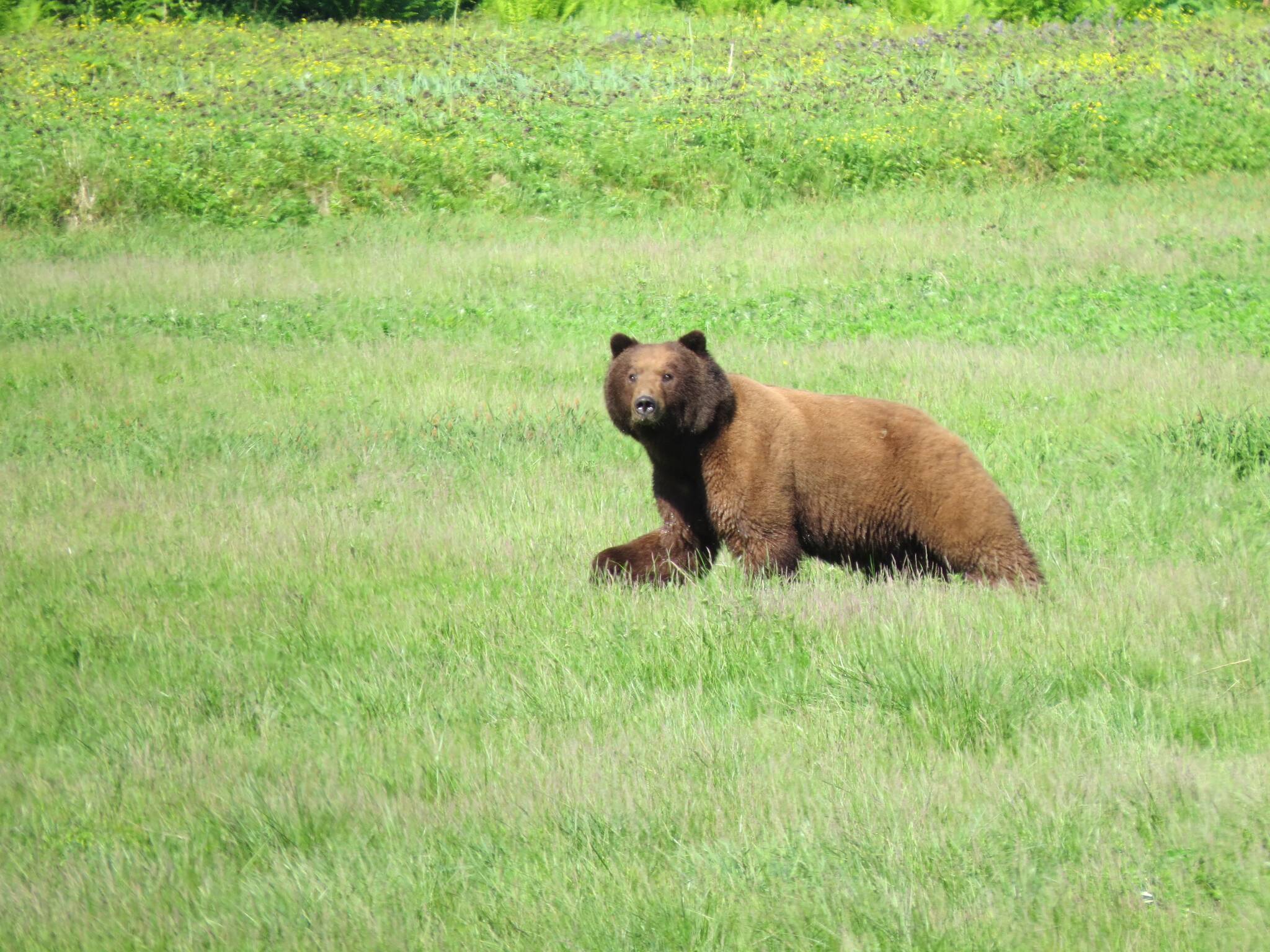
An Admiralty Island brown bear walks through Pack Creek. Pack Creek is the only current bear-viewing area on Admiralty (called, in Lingít, Kootznoowoo), known for its dense concentration of brown bears — one per square mile. Most visitors fly out of Juneau to visit Pack Creek. Kootznoowoo Inc., the Native Corporation of the village of Angoon, hopes to establish a new bear viewing area closer to the community. The name “Kootznoowoo” means “Fortress of the bears.” (Courtesy Photo / Mary Catharine Martin)
Some of the projects Kootznoowoo received funding for are the development of a new bear-viewing area nearer to town, which could be more affordable to visitors and would employ local guides; the development of a Cross-Admiralty Island canoe route guided trip; and extending the Danger Point Trail in Angoon from Angoon cemetery to the Danger Point Peninsula and the Danger Point Lighthouse Reserve.
“Angoon really has no formalized tourism right now,” Wunrow said. “The question is, how do we move forward in a way that is respectful that won’t have a significant adverse impact on the community, will generate jobs, and will emphasize what makes Angoon unique? What are the opportunities where we can dip our toe into the visitor industry, and begin to develop infrastructure that can support tourism, but also provide maximum benefit to the local community and economy?”
Pack Creek is the only current bear-viewing area on Admiralty Island, known for its dense concentration of brown bears — one per square mile. Most visitors fly out of Juneau to visit Pack Creek.
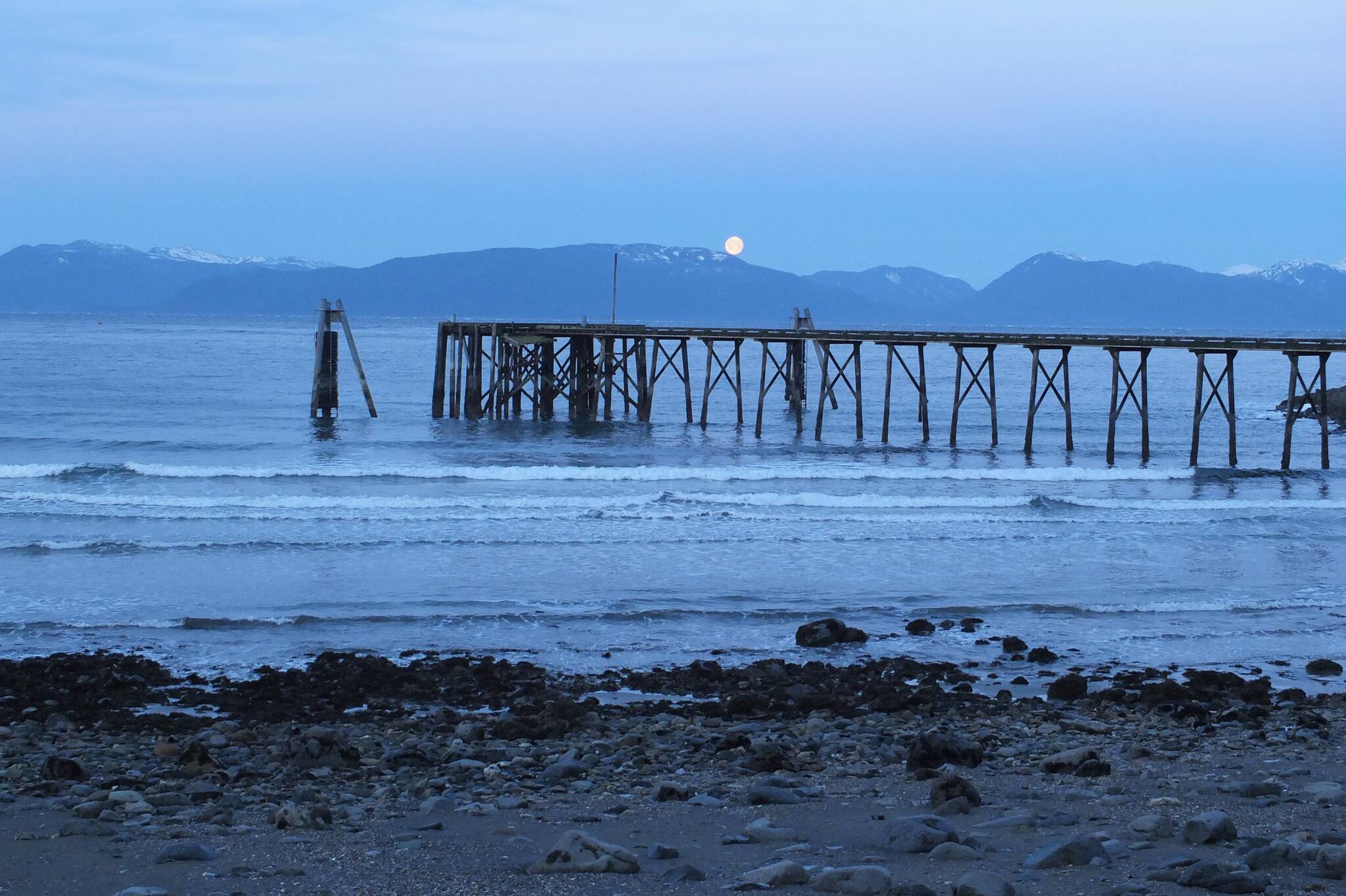
The moon sets over the mountains as seen from an Angoon beach in February of 2015. (Courtesy Photo / Mary Catharine Martin)
“Our goal is that the gateway to Admiralty National Monument becomes the community of Angoon,” Wunrow said. “Right now it’s Juneau. Visitors to Admiralty should come through Angoon, and listen to the voices of Angoon Elders before they visit Kootznoowoo land — not as a control thing, but so they can honor and learn about whose land they are entering. Admiralty National Monument would not exist without the visionary leadership of the Tlingit people of Angoon in the early 1970s. They’re the ones who went to DC and fought for it. Creating small-scale tourism opportunities based in Angoon will allow people in Angoon to tell the story of Angoon from their perspective. The true perspective. Angoon has an amazing story of strength and survival and wisdom that is waiting to be told.”
Long term
Long term, beyond the initial $25 million investment, the goal of the sustainability strategy is “restoring and shaping the management of lands that sustain all of us that live here,” Miranda said. “Advancing community-based food and energy security… looking at how do we work together across Southeast to retain and develop a skilled workforce for all the different industries?”
“This is a special place,” Miranda said. “We all get to live here. We’re neighbors. We’re so fortunate we live in this abundant, amazing place, and the people that have stewarded it for thousands of years — it is a collaborative effort to now take all that learning and work together to implement some good stuff for Southeast.”
The full list of 25 projects already funded under the initial sustainability strategy investment is available online at chrome-extension://oemmndcbldboiebfnladdacbdfmadadm/https://www.fs.usda.gov/Internet/FSE_DOCUMENTS/fseprd1008622.pdf. An additional $15 million in grants will be announced this summer.
• Mary Catharine Martin is the communications director of SalmonState, an organization that works to ensure Alaska remains a place wild salmon and the people who depend on them continue to thrive.
