
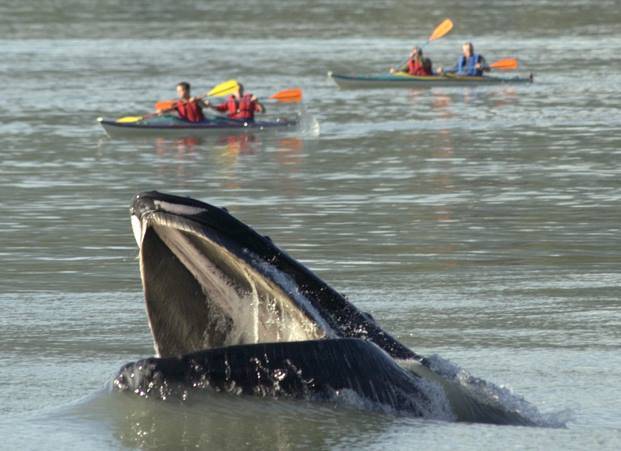
It’s the peak of tourist season and thousands of visitors arrive to our city each day to take in its natural wonders. For some wildlife enthusiasts, seeing whales in their natural environment is at the top of the list. We are fortunate to live in a place with a high level of marine mammal biodiversity that not only includes humpback and killer whales, but also Dall’s and harbor porpoise, Steller sea lions, and harbor seals.

Embarking on a whale-watching trip and seeing these animals in the wild can be the thrill of a lifetime. Roughly one-quarter of the 1.3 million cruise ship passengers that will visit Juneau this year are expected to go whale watching. What, if any, effect does this have on the whales? A recent article in the Capital City Weekly (“Residential group says there are too many tourists”) revealed that some Juneauites are concerned about the environmental impact of whale watching.
For the past seven years, my students and I have studied the pros and cons of whale watching in Juneau. My students have surveyed thousands of whale-watching passengers to understand the educational and conservation value of whale watching and have spent hundreds of hours observing interactions between humpback whales and whale-watching vessels.
Our results show that the majority of passengers gain most of their knowledge about whales from their whale-watching tour and show increased knowledge of and support for regulations and guidelines in place to protect whales. These findings indicate that whale watching is an important platform for teaching the public about whales, and that passengers support whale conservation measures.
From the whale’s perspective, we found that whale-watching vessels cause behavioral changes. In the presence (vs. absence) of whale-watching vessels, humpback whales changed direction more often, swam faster, and had higher breath rates. As the number of vessels increased, whales showed further increases in their direction changes and breath rate. These findings indicate that humpback whales may be taking measures to avoid vessels. This increased level of activity, combined with a higher breath rate, may also indicate that whales are expending more energy in the presence of whale-watching vessels.
Humpback whales spend their summers in Juneau feeding. Their goal is to eat as much food as possible to replenish energy reserves lost during their winter fast on Hawaiian breeding and calving grounds. Expending extra energy in vessel avoidance behaviors could negatively impact a whale’s overall energy budget and, potentially, its health in general.
Humpback whales also raise their calves in Juneau. This year, we have documented three mother-calf pairs, which is the most we’ve seen in several years. The 3,000 mile journey from Hawaii to Juneau is arduous. One calf already has signs that it may have been previously entangled during its first few months of life. Fortunately, this calf and its mom look to be healthy, but it is a reminder of how vulnerable these animals are.
Still, mothers have a tough job during the short few months they spend on the feeding grounds. They need to get enough food to replenish their own energy reserves while pumping energy into their calves through nursing.
We have identified nearly 100 individual whales in Juneau since 2013. Typically, though, there are fewer than 10 humpback whales present at any given time during the summer. Some of these whales represent a “core” population that remains here throughout the entire summer, returning year after year. These whales support a whale-watching industry comprised of an estimated 65 vessels and worth roughly $35 million per year.
It is clear that whale watching has value in terms of its economic, educational and other intrinsic benefits. I saw my first whale on a whale-watching trip as a middle schooler. I still remember the thrilling sight of a gray whale surfacing and the remarkable stench of its blow wafting towards me. That was one of several visceral experiences that helped to shape my intellectual path toward becoming a marine mammal scientist.
For whale watching to remain a viable industry, we need to ensure it’s sustainable for the whales. This means giving whales space to thrive in our waters and treading lightly on their ocean home. Humpback whales face a myriad of other threats including ship strikes, entanglement, noise pollution and climate change. Juneau is one of the best places in the world to see whales. We must protect this beautiful yet vulnerable natural resource, for the benefit of whales and humans alike.
• Dr. Heidi Pearson is an Associate Professor of Marine Biology at the University of Alaska Southeast and lives in Juneau. She is a member of the University of Alaska Southeast Sustainability Committee. The “Sustainable Alaska” is a monthly column, appearing on the first Friday of every month. It’s written by UAS Sustainability Committee members who wanted to promote sustainability. The views expressed here do not necessarily represent the views of the University of Alaska Southeast.
