

This Nov. 5, 2020, photo provided by the Sealaska Heritage Institute shows a Zoom memorial service for Tlingit elder David Katzeek, conducted by the Institute, showing highlights of Katzeek’s life as people honored him over the internet as the pandemic had made in-person ceremonies impossible. (Sealaska Heritage Institute)

This Nov. 5, 2020, photo provided by the Sealaska Heritage Institute shows a Zoom memorial service for Tlingit elder David Katzeek, conducted by the Institute, showing highlights of Katzeek’s life as people honored him over the internet as the pandemic had made in-person ceremonies impossible. (Sealaska Heritage Institute)

Technology allows thousands to say goodbye to Tlingit elder

‘They were all over the country, wherever our clan members are living’

By MARK THIESSEN

Associated Press

ANCHORAGE — When a Tlingit elder dies, leaders from the Alaska Native tribe’s two houses, the Raven and Eagle clans, typically come together along with family and well-wishers for a memorial ceremony featuring displays of traditional tribal regalia.

After elder, tribal leader and college professor David Katzeek died last month, the tribe scrambled to find a way to observe their sacred traditions while keeping everyone safe during the pandemic, with coronavirus cases surging in the state.

“We know that many of our people are grieving over this great loss, but we also recognized that we need to protect each other and make sure we stay healthy. We also wanted to honor Kingeisti in our traditional way,” Sealaska Heritage Institute president Rosita Worl said, using Katzeek’s Tlingit name.

Katzeek, 77, died unexpectedly Oct. 28, according to the Juneau-based institute, an Alaska Native nonprofit that promotes Tlingit, Haida and Tsimshian cultures. Worl said they understood the cause to be heart failure.

The first president of what has since become the institute, Katzeek is credited with helping revive Alaska Native culture in the state’s southeast, encouraging oral histories and efforts to preserve the Tlingit language.

To honor him safely, the institute turned to the same technologies that people across the world have employed to remain connected in the coronavirus age, using Zoom video conferencing to bring people together while broadcasting live on its YouTube channel.

The institute had already been transforming in-person programming such as theater lectures to virtual events due to the coronavirus.

They figured, “If we can do that for all of these other activities, why can’t we do that for our cultural activities?” Worl said.

During a memorial ceremony, leaders of the clans typically offer comforting words while also bringing out regalia such as Chilkat robes, clan hats and blankets, invoking the spirits of clan ancestors to assist the grieving process.

Held virtually, there had to be some adjustments such as not having people stand near others in support but instead taking turns speaking on the video call. The chatroom served for tribe members to give the traditional thanks to speakers and comfort others. The clan regalia was visible in the background of those who spoke instead of being displayed in front of a coffin or held in person as at a traditional memorial.

Perhaps the biggest change was capping how many could speak and limiting each person to five minutes. So while memorials can run as long as 10 hours, this one happened in just about four.

Holding the memorial online had at least one advantage, in that it allowed some 2,000 people to take part from New Mexico to California — “they were all over the country, wherever our clan members are living,” Worl said.

She said the memorial was an innovative and successful merging of traditional rites with modern technology and the public health and safety requirements demanded by the pandemic. The institute is now using the experience to write guides for others to do the same.

“One of the strengths of our people is our ability to transform our cultural needs to current circumstances … while at the same time maintaining our culture,” Worl said.

Provided by the Sealaska Heritage Institute, this photo from a Nov. 5, 2020, Zoom memorial service for Tlingit elder David Katzeek, in Juneau, Alaska, shows a 2018 recording of children performing a song written by Katzeek as people honored Katzeek over the internet as the pandemic had made in-person ceremonies impossible. (Sealaska Heritage Institute)
Provided by the Sealaska Heritage Institute, this photo from a Nov. 5, 2020, Zoom memorial service for Tlingit elder David Katzeek, in Juneau, Alaska, shows a 2018 recording of children performing a song written by Katzeek as people honored Katzeek over the internet as the pandemic had made in-person ceremonies impossible. (Sealaska Heritage Institute)

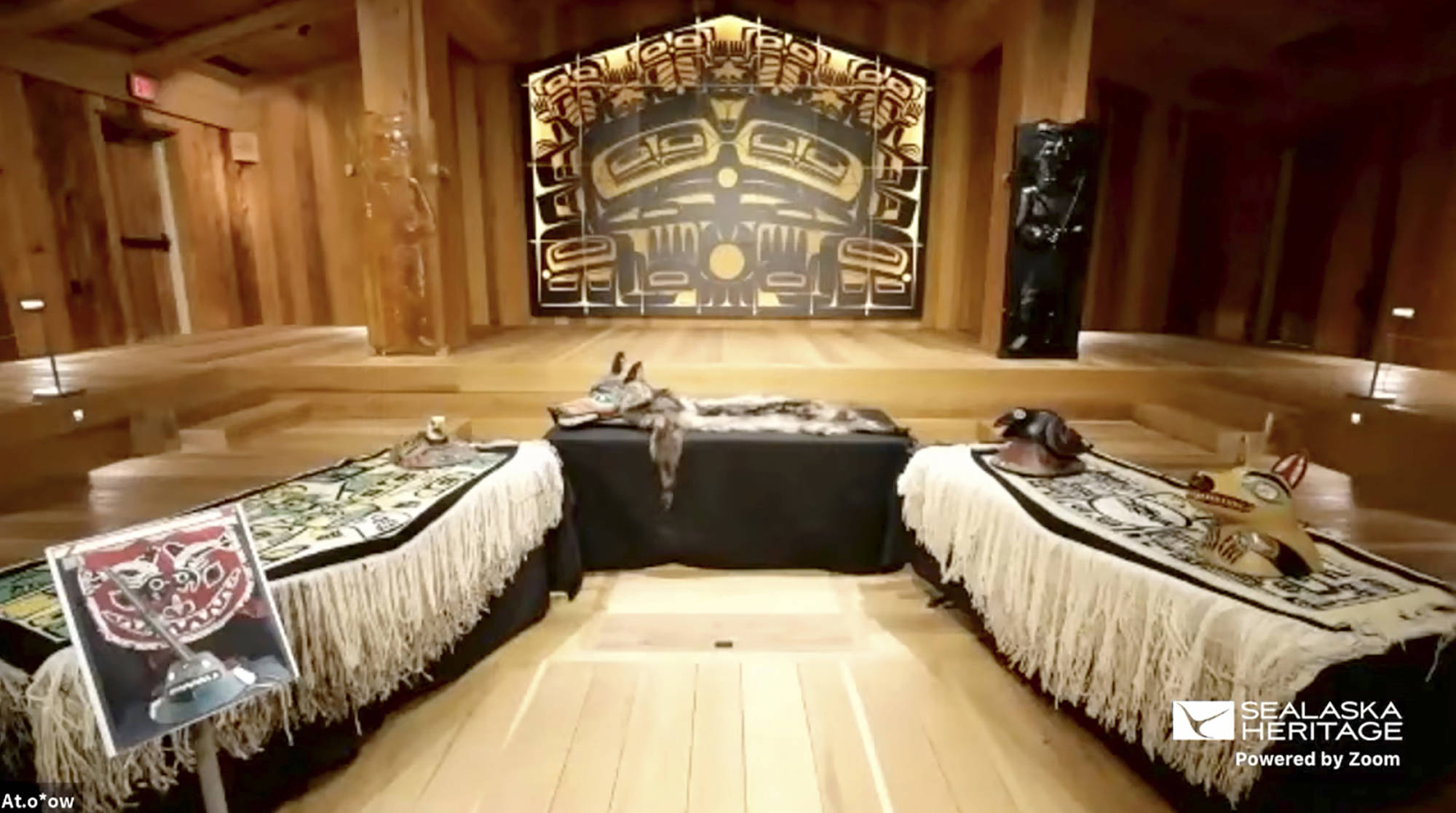
Provided by the Sealaska Heritage Institute, this photo shows a Nov. 5, 2020, Zoom memorial service for Tlingit elder David Katzeek, conducted by the Sealaska Heritage Institute, showing the hall in Juneau, Alaska, where his memorial service would have been performed if the pandemic hadn’t made that impossible. Cultural leaders scrambled when Katzeek died at age 77 in late October 2020, to find a way to still hold the traditional memorial during a pandemic. (Sealaska Heritage Institute)

Provided by the Sealaska Heritage Institute, this photo shows a Nov. 5, 2020, Zoom memorial service for Tlingit elder David Katzeek, conducted by the Sealaska Heritage Institute, showing the hall in Juneau, Alaska, where his memorial service would have been performed if the pandemic hadn’t made that impossible. Cultural leaders scrambled when Katzeek died at age 77 in late October 2020, to find a way to still hold the traditional memorial during a pandemic. (Sealaska Heritage Institute)

More in News

The northern lights are seen from the North Douglas launch ramp late Monday, Jan. 19. A magnetic storm caused unusually bright northern lights Monday evening and into Tuesday morning. (Chloe Anderson/Juneau Empire)
Rare geomagnetic storm causes powerful aurora display in Juneau

The northern lights were on full display Monday evening.

teaser
Juneau activists ask Murkowski to take action against ICE

A small group of protesters attended a rally and discussion on Wednesday.

A female brown bear and her cub are pictured near Pack Creek on Admiralty Island on July 19, 2024. (Chloe Anderson for the Juneau Empire)
Pack Creek permits for bear viewing area available now

Visitors are welcome from April 1 to Sept. 30.

Cars pass down Egan Drive near the Fred Meyer intersection Thursday morning. (Clarise Larson / Juneau Empire file photo)
Safety changes planned for Fred Meyer intersection

DOTPF meeting set for Feb. 18 changes to Egan Drive and Yandukin intersection.

Herbert River and Herbert Glacier are pictured on Nov. 16, 2025. (Mari Kanagy / Juneau Empire)
Forest Service drops Herbert Glacier cabin plans, proposes trail reroute and scenic overlook instead

The Tongass National Forest has proposed shelving long-discussed plans to build a… Continue reading

A tsunami is not expected after a 4.4-magnitude earthquake northwest of Anchorage Wednesday, Feb. 4, 2026. (U.S. Geological Survey)
No tsunami expected after 4.4-magnitude earthquake in Alaska

U.S. Geological Survey says 179 people reported feeling the earthquake.

ORCA Adaptive Snowsports Program staff member Izzy Barnwell shows a man how to use the bi-ski. (SAIL courtesy photo)
Adaptive snow sports demo slides to Eaglecrest

Southeast Alaska Independent Living will be hosting Learn to Adapt Day on Feb. 21.

Cars drive aboard the Alaska Marine Highway System ferry Hubbard on June 25, 2023, in Haines. (Photo by James Brooks)
Alaska’s ferry system could run out of funding this summer due to ‘federal chaos problem’

A shift in state funding could help, but a big gap likely remains unless a key federal grant is issued.

Photo by James Brooks/Alaska Beacon
U.S. Sen. Dan Sullivan stands with acting Coast Guard Commandant Adm. Kevin Lunday during the after the commissioning ceremony for the Coast Guard icebreaker Storis on Sunday, Aug. 10, 2025, in Juneau, Alaska.
Coast Guard’s new Juneau base may not be complete until 2029, commandant says

Top Coast Guard officer says he is considering whether to base four new icebreakers in Alaska.

Most Read