
By Dr. Michael Navarro
University of Alaska Southeast
I dwell on this question constantly. In the Sustainable Alaska monthly column, scientists are regularly referenced for their contributions toward sustainability in Alaska. From plastic pollution, to climate change, to stopping COVID-19, scientists are contributing solutions to Alaska’s toughest problems. Scientists are needed in society to meet the accelerating challenges of the modern world and a key component to sustainability in Alaska is ensuring that we have the future scientists to meet these needs.
Where will these future scientists will come from? The truth is that scientists come in all shapes and sizes and from all walks of life. To the untrained eye, scientists are very difficult to pick apart from the crowd. Unlike Hollywood movies or TV sitcoms, we don’t wear white lab coats all the time nor are we always socially awkward (but we have our moments.) The truth is that scientists come from all communities all across Alaska.
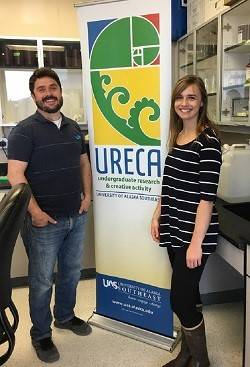
Courtesy Photo 2018 UAS URECA Program scholar Dawn Wehde stands next to faculty adviser Michael Navarro. Wehde graduated in 2018 and now works in a fisheries related job in her hometown of Nome.
At the University of Alaska Southeast, one of the great joys of my job as an assistant professor in the Natural Sciences Department is in facilitating student career development. I have found that scientists more often than not don’t know that they are scientists at the beginning of their career. One hot spot for scientist development is at undergraduate universities, such as at UAS. During this time, undergraduates get hands-on experience developing their own creative ideas and have access to resources and mentorship to complete an authentic science project.
This year, much like all my years here since arriving in Juneau in 2016, the student ideas have been excellent. For example, this year I have had the privilege of working with six outstanding scholars in one of my classes that have each developed their own research projects. All the projects reflect their interest in adding new knowledge to improve the lives of residents of City and Borough of Juneau and Alaska. Research topics include (in no particular order):
■ clarifying the oceanic conditions for the public to know when shellfish are safest to harvest and eat and when harmful algal blooms are least likely to occur.
■ improving techniques to reveal the secret lives of dolphins including mother-calf swimming patterns
■ planting endemic shrubs to test them as a possible mitigate method to slow erosion along the Mendenhall River banks near residential areas
■ building specialized aquaria to house jellyfish in order to test whether they can be used for fertilizer and/or pet food
■ fabricating a model of the early Earth’s atmosphere to test questions about early life on Earth and to explore the possibilities of life in our solar system and beyond
■ constructing of oceanographic models for the inside passage to forecast when and where low oxygen levels might impact fisheries
As you can see, our students have exciting ideas!
Some of these students will submit for funding of their research ideas to the UAS Undergraduate Research Experience and Creative Activities Program. Many of our students are successful and use funds (up to $2,500) to complete their research project. Often this is the first opportunity for these students to conduct science as a scientist. Each student in the URECA program is mentored by a faculty advisor to ensure student success. The URECA program and faculty mentorship help undergraduates transition from students to start to explore a career path as a scientist. URECA scholars often go on to work at jobs that help the communities that the students care about.
Part of the story for Sustainable Alaska should include our communities investing time and resources in for the next generation to have opportunities to explore science as a career. As the workforce in Alaska grays, we need new energy and perspectives to keep our state vibrant. Supporting the development of the next generation in science, prepares them to receive the torch on that day when we will need to pass it to them. Scientists that we develop from our communities care about supporting our communities because they are from here. There are hot spots in our state where the next generation of Alaskans are thriving and we need to make sure to continue to support their success. If done well, the next generation of scientists will be a key component to the success of Sustainable Alaska.
• Michael Navarro is an assistant professor in the Natural Sciences Department. “Sustainable Alaska” is a monthly column, appearing on the first Friday of every month. It’s written by UAS Sustainability Committee members to promote sustainability. The views expressed here do not necessarily represent the views of the University of Alaska Southeast.
