
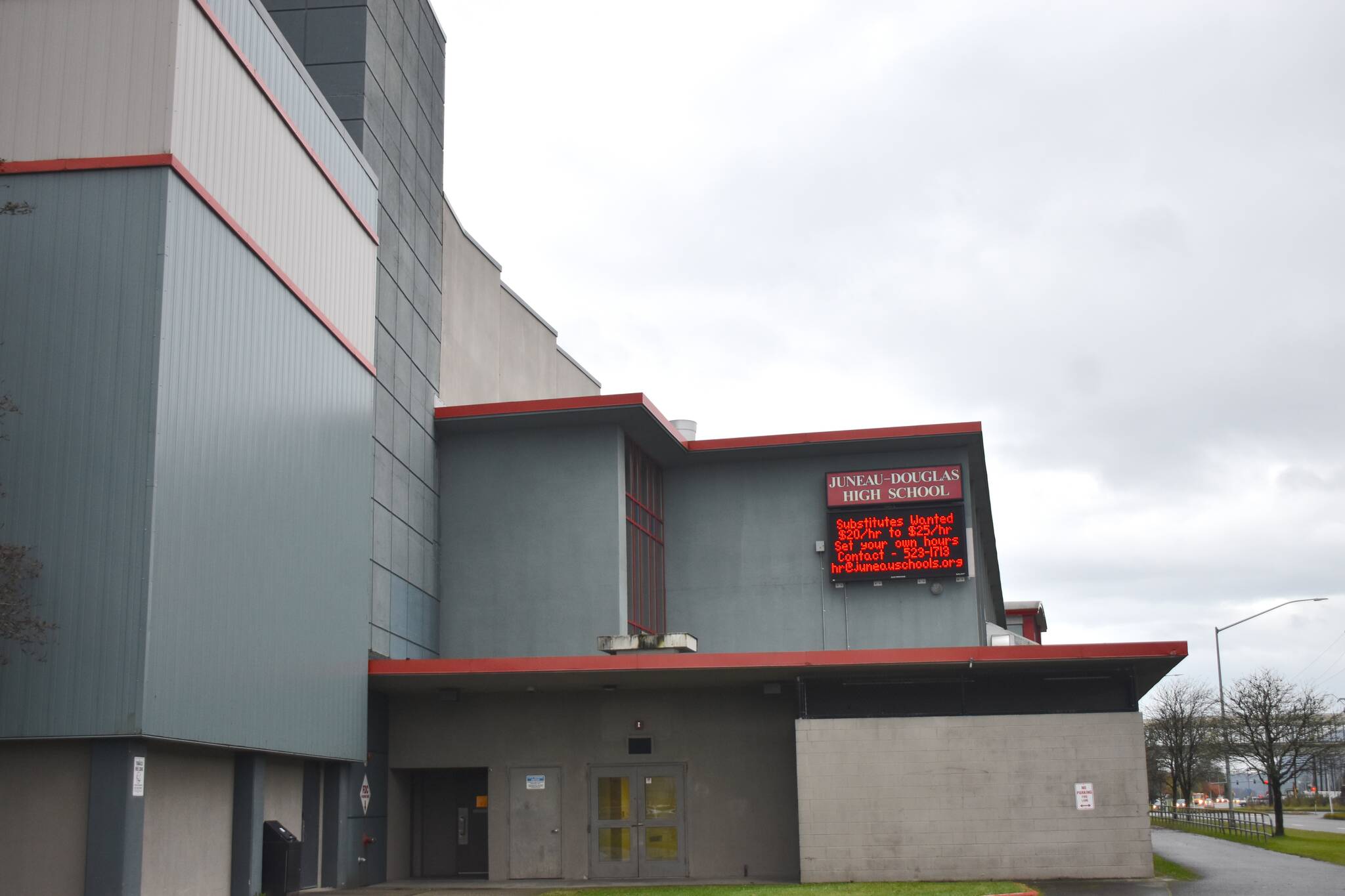
Graduation rates are up, as are vacant staffing positions throughout the Juneau School District. The district’s budget continues to hinge on state and City and Borough of Juneau politics.
These were among the topics that Superintendent Frank Hauser presented at last week’s Juneau Chamber of Commerce luncheon, speaking before district staff and members of the public.
Graduation rates are higher post-consolidation
Graduation rates have risen in the first year since the consolidation of the former Thunder Mountain High School into Juneau-Douglas High School: Yadaa.at Kalé.
Facing a multimillion-dollar budget deficit, the Juneau School Board voted in February 2024 to approve the school closure and consolidation plan.
For the 2025-2026 school year, graduation rates at JDHS were 96.02%, compared with 92.8% at JDHS and 90.44% at TMHS the year before, according to data Hauser presented on Oct. 16.
District faces an uncertain budget
About 90% of the district’s current $76 million budget goes toward teacher salaries and benefits, according to Hauser’s presentation.
CBJ adds to that total, contributing the maximum amount allowed by state law — $35 million for fiscal year 2026 — as it has done every year since 2018.
With the two tax-cutting propositions on the ballot for municipal elections passing, Hauser said it’s unclear whether the district can expect maximum contributions from CBJ for fiscal year 2027.
Governor Mike Dunleavy and the Legislature clashed throughout the last state session over school funding. Lawmakers first failed to override Dunleavy’s veto of a bill that would have permanently raised the base student allocation, the formula used to determine per-student funding. In August, the Legislature narrowly succeeded in overriding Dunleavy’s budget, which would have cut school spending, leaving districts with a slight funding increase for the 2025-26 school year.
Hauser said that the district should not expect a base student allocation increase for 2026-27.
Staff vacancies are also up
In February 2025 the JSD childcare site Relationships and Leadership Learning for Youth, or RALLY, identified a shortage of applicants as an existential challenge, operating at a 49% vacancy rate. Two months later, they shut down the program because they did not have the staffing needed to meet licensing requirements.
Private childcare has stepped in to fill the gap. Now, according to Hauser, over 70 children are part of the Auke Lake Preschool and Afterschool LLC childcare, which operates out of JSD facilities.
JSD Site Council member Erin Harrington spoke to express her concern at the vacant positions on the district’s hiring site. Harrington noted open positions across elementary and middle school teachers, and special education certified teachers and specialists. She cited 30 vacancies for paraeducators, who play a crucial role aiding students with individualized education plans.
As of Oct. 24, there were 82 vacancies listed on the district’s hiring site.
“What I see is a crisis of applicants and frankly, an HR crisis across the district,” Harrington said. “So maybe not surprising that we weren’t getting applicants for RALLY when we actually are having what seems like a systemic failure to fill roles.”
Though there may be nearly 82 vacant positions, that doesn’t necessarily mean that there’s not an educator filling that role, Hauser said. There could be a substitute or paraeducator fulfilling the position.
Hauser said the district is currently seeking out international hires. They have put out offer contracts to three international teachers in special education, but the hiring process is lengthy.
It’s a strategy being used by school districts across the state. Some Alaska schools are hiring teachers from the Philippines to address the nationwide shortage of certified teachers.
School board member Emil Mackey weighed in from the audience, speaking frankly on recruitment.
“It comes down to, are we willing to compete economically and have a [base student allocation] and pay the taxes necessary to compete with the Lower 48 and convince people to come up to Alaska, where it’s very, very cold, where we have a piss poor retirement system, and teach our kids?” Mackey said “And the answer right now is no, because they ain’t coming.”
Harrington said that while the district addressed the mechanics of the nation and state-wide staffing issues, she believes that more can be done to hire non-certificated positions locally, and that the community needs to be aware of these vacancies.
“They’re gonna come from within Juneau to be in our schools, and those are the places where we can really try to address the problem locally,” Harrington said. “And so for a group like this, who is thinking about, you know, local solutions, I think it’s really important to know.”
Hauser to leave Juneau School District
Hauser announced on Oct. 10 that he would be resigning from his role as superintendent at the end of the 2026 school year, just one month after the board of education unanimously voted to extend his contract until 2028.
Mackey was the lone no-vote on Hauser when the new superintendent joined the school board in spring 2023. In an interview after the luncheon, Mackey said he has since changed his tune on the superintendent, citing Hauser’s response to the district’s economic hardship.
The school district discovered a $7.6 million shortfall for fiscal year 2024, plus a $1.9 million deficit from the previous year. Facing that huge gap, the district made the decision to close and consolidate schools.
Mackey described Hauser, as well as school board president Deedie Sorenson, as showing “courage” in their approach to getting the school through its recent deficits.
“He found himself in the middle of a minefield, having to figure how to get not just him, but the whole district out of it,” Mackey said. “He could have just quit — he was sold a false bill of goods, as far as I’m concerned — but he didn’t. He … got us out of the biggest budget quandary we’ve ever been in.”
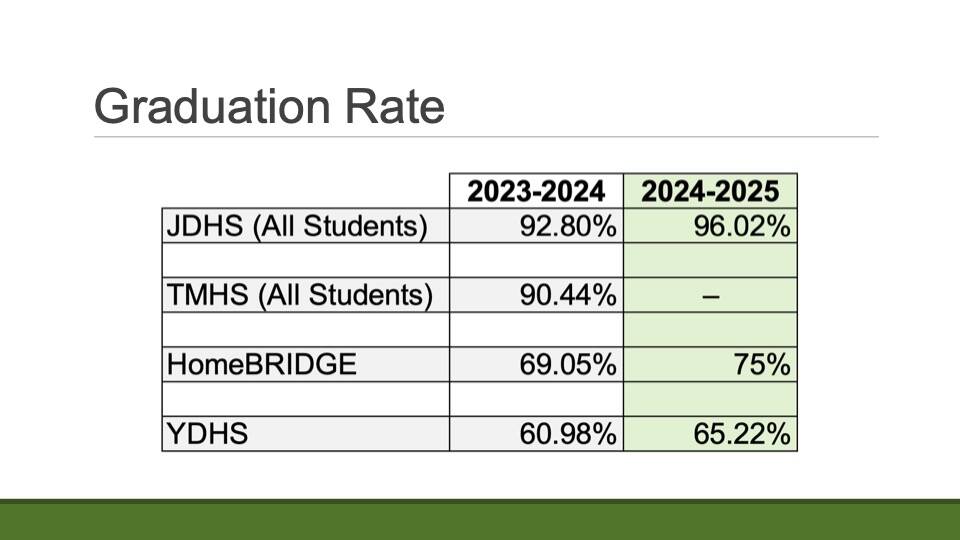
Data shows that graduation rates at Juneau-Douglas High School: Yadaa.at Kalé have rose last year, following the consolidation of Juneau high schools. (Juneau School District chart)
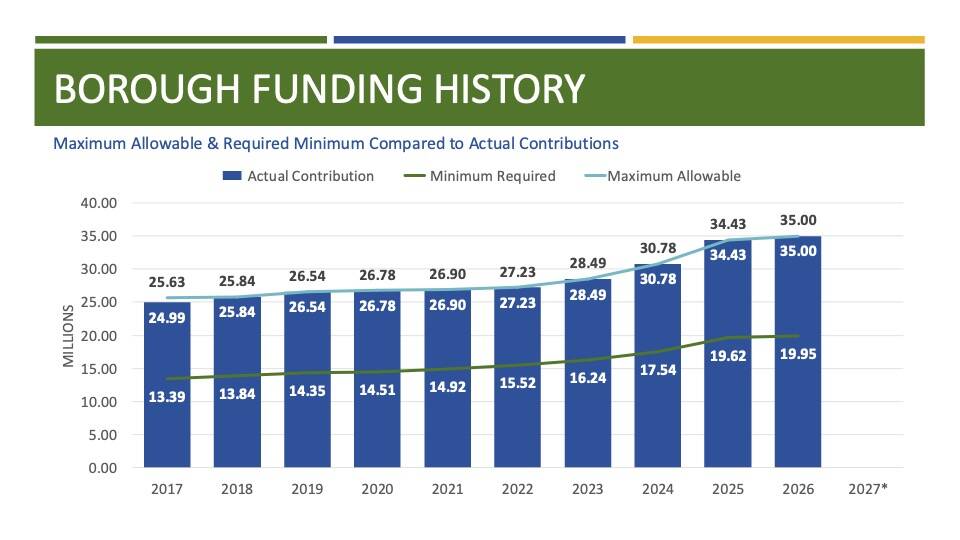
Graph shows the history of the City and Borough of Juneau’s funding for the school district. (Juneau School District graph)
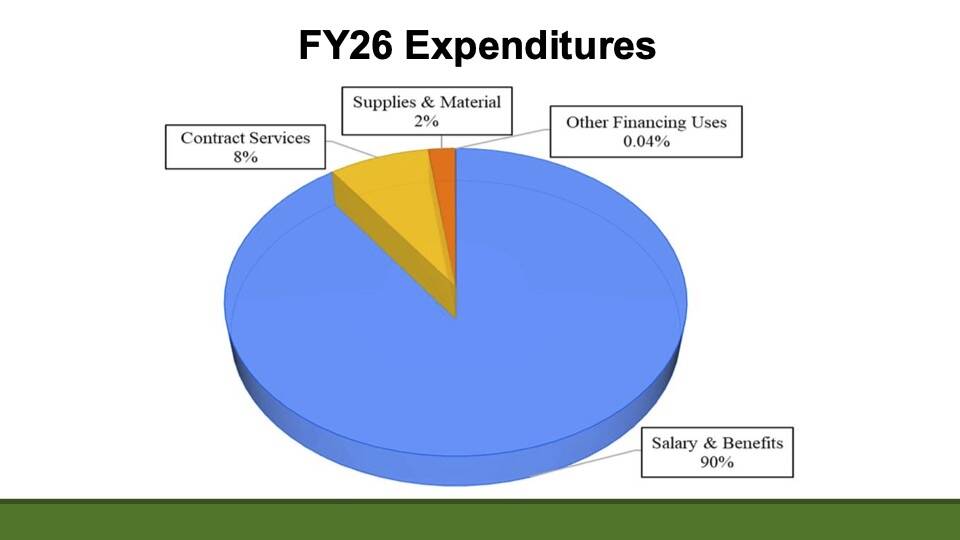
Chart shows that 90% of school district funding goes toward salaries and benefits. (Juneau School District chart)
