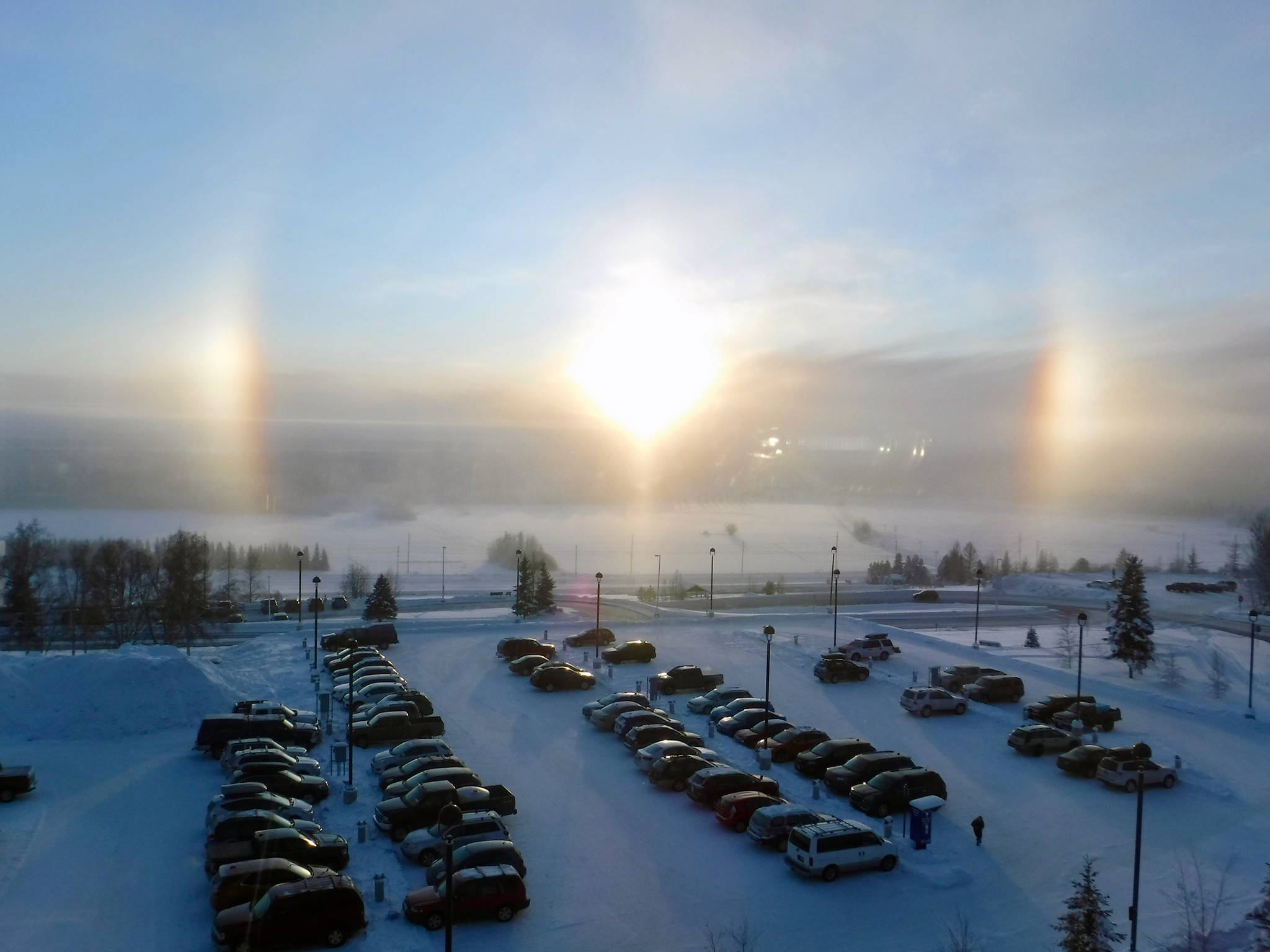
Ned Rozell | For the Juneau Empire                                 Sundogs seen from the University of Alaska Fairbanks campus on Jan. 23.

Ned Rozell | For the Juneau Empire Sundogs seen from the University of Alaska Fairbanks campus on Jan. 23.

Sundogs, light pillars enliven the dog days

There are some rewards that come with cold, clear skies.

Fairbanks’s recent mornings in the minus 30s Fahrenheit may be extending local residents’ winter fatigue, but there are some rewards that come with cold, clear skies.

Sundogs are two colorful bursts of light that appear on either side of the sun. Besides spicing up the skyscape, sundogs indicate the presence of falling ice crystals, which also form halos around the sun and moon. The ice crystals falling through the Alaska air, known as diamond dust, also create pillars of light that extend upward from outdoor lights and sometimes downward from the sun.

Sundogs form when ice crystals act as a prism, according to writers of the text Meteorology Today. Ice crystals sometimes take on flat, hexagonal shapes, looking like microscopic stop signs.

The six-sided, platelike ice crystals sometimes fall with their flat surfaces parallel to the earth. Sundogs become visible if the crystals fall when the sun is low on the horizon and both the viewer and ice crystals are on the same horizontal plane as the sun.
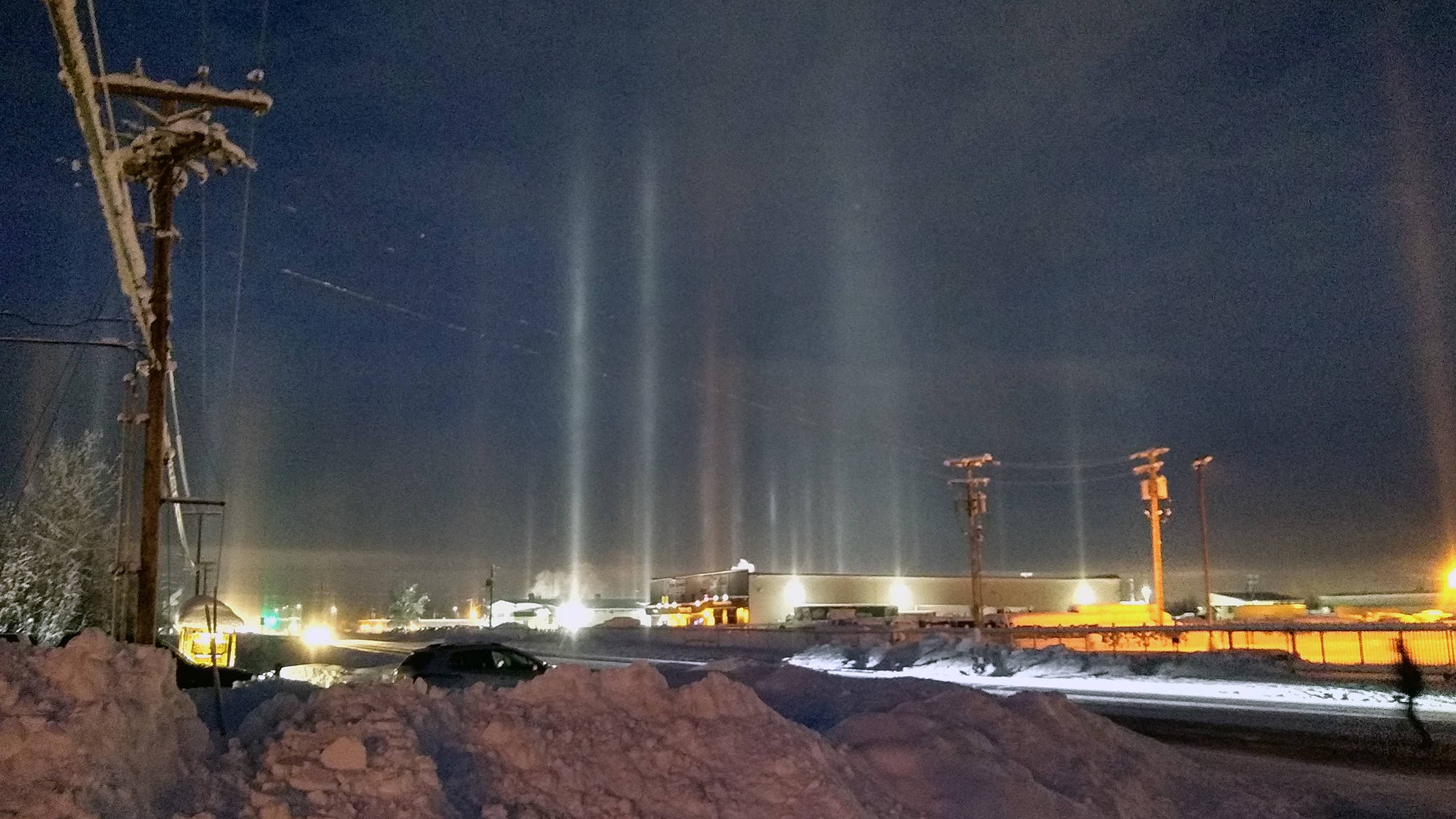
Light pillars appear when falling ice crystals reflect light off their undersides. John Shook took this photo on Feb. 7 in Fairbanks. (Courtesy photo)

Light pillars appear when falling ice crystals reflect light off their undersides. John Shook took this photo on Feb. 7 in Fairbanks. (Courtesy photo)

Just as white light bends when it passes through a glass prism, the ice crystals bend sunlight so it separates into different colors. Sundogs usually feature red closest to the sun and blue on the outside.

People have also called sundogs mock suns. The Greeks called them “parhelia,” meaning “with the sun.”

Halos surrounding the sun or the moon are indicative of slightly different forms of ice crystals, those within high cirrus clouds about 30,000 feet high. Instead of tiny stop signs, ice crystals sometimes take the form of Ticonderoga pencils: still six-sided, but long rather than flat.

Sunlight passing through these crystals is once again bent, forming a halo surrounding the sun or moon at an angle of about 22 degrees. Former Geophysical Institute Professor of Physics Glenn Shaw said the old tale that a ring around the moon signals approaching bad weather was true: high-altitude, thin cirrus clouds can precede a storm front by one or two days.

A third light show caused by ice crystals is a pillar of light extending upward from outdoor lights or downward from the sun. While sundogs and halos are caused by ice crystals bending light, pillars are caused by light reflecting off ice crystals. As either pencil- or stop-sign shaped crystals fall, they sometimes waft down like falling leaves, allowing light to reflect off their flat undersides. This collective reflection sometimes appears as a spotlight beam above or below any bright light source — the sun, the moon, streetlights or car headlights.

• Since the late 1970s, the University of Alaska Fairbanks’ Geophysical Institute has provided this column free in cooperation with the UAF research community. Ned Rozell is a science writer for the Geophysical Institute.

More in News

A residence stands on Tuesday, Dec. 23 after a fatal house fire burned on Saturday, Dec. 20. (Mari Kanagy / Juneau Empire)
2 house fires burn in 3 days at Switzer Village

Causes of the fires are still under investigation.

A house on Telephone Hill stands on Dec. 22, 2025. (Mari Kanagy / Juneau Empire)
Court sets eviction date for Telephone Hill residents as demolition plans move forward

A lawsuit against the city seeks to reverse evictions and halt demolition is still pending.

A Douglas street is blanketed in snow on Dec. 6, 2025. (Mari Kanagy / Juneau Empire)
Precipitation is forecast later this week. Will it be rain or snow?

Two storm systems are expected to move through Juneau toward the end of the week.

Juneauites warm their hands and toast marshmallows around the fire at the “Light the Night" event on winter solstice, on Dec. 21, 2025. (Mari Kanagy / Juneau Empire)
A mile of lights marked Juneau’s darkest day

Two ski teams hosted a luminous winter solstice celebration at Mendenhall Loop.

A Capital City Fire/Rescue truck drives in the Mendenhall Valley in 2023. (Clarise Larson / Juneau Empire file photo)
Juneau man found dead following residential fire

The cause of the fire is still under investigation.

CBJ sign reads “Woodstove burn ban in effect.” (City and Borough of Juneau photo)
Update: CBJ cancels air quality emergency in Mendenhall Valley Sunday morning

The poor air quality was caused by an air inversion, trapping pollutants at lower elevations.

A dusting of snow covers the Ptarmigan chairlift at Eaglecrest Ski Area in December 2024. (Eaglecrest Ski Area photo)
Update: Waterline break forces closure at Eaglecrest Friday, Saturday

The break is the latest hurdle in a challenging opening for Juneau’s city-run ski area this season.

Patrick Sullivan stands by an acid seep on July 15,2023. Sullivan is part of a team of scientists who tested water quality in Kobuk Valley National Park’s Salmon River and its tributaries, where permafrost thaw has caused acid rock drainage. The process is releasing metals that have turned the waters a rusty color. A chapter in the 2025 Arctic Report Card described “rusting rivers” phenomenon. (Photo by Roman Dial/Alaska Pacific University)
Ecosystem shifts, glacial flooding and ‘rusting rivers’ among Alaska impacts in Arctic report

NOAA’s 2025 report comes despite Trump administration cuts to climate science research and projects

The U.S. Capitol in Washington, D.C., on Oct. 1, 2025. (Photo by Jennifer Shutt/States Newsroom)
Moderate US House Republicans join Dems to force vote on extension of health care subsidies

WASHINGTON — Republican leaders in the U.S. House will face a floor… Continue reading

Most Read