
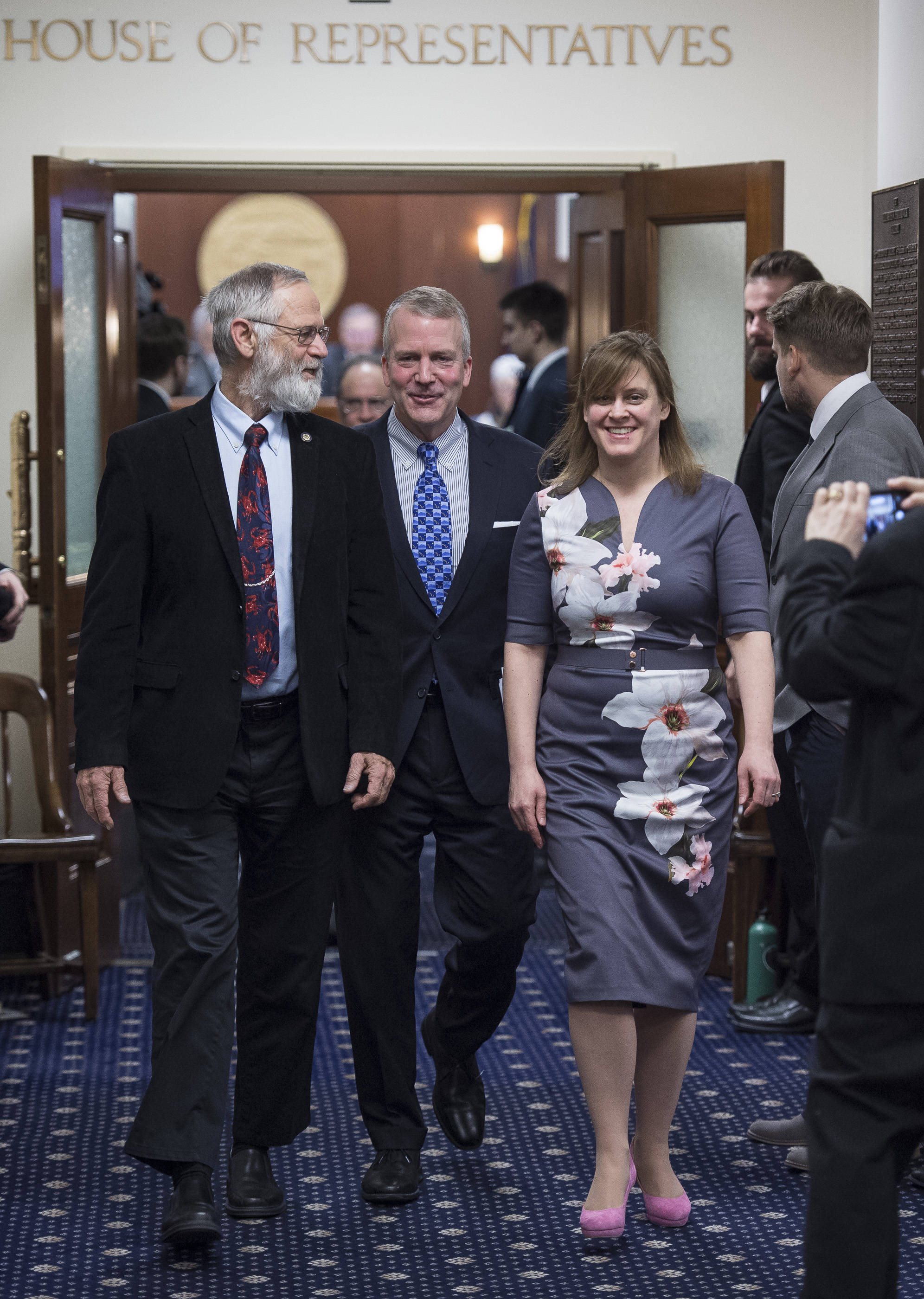
This is Sen. Dan Sullivan, optimistic.
In a 36-minute Monday address to the Alaska Legislature, Alaska’s junior U.S. Senator drew repeated rounds of applause from lawmakers as he outlined six reasons for optimism in a state grappling with economic recession, high unemployment and a multibillion-dollar annual deficit.
“Hey, every now and then we’ve got to take a step back, and realize that yeah, we’ve got big challenges, but holy cow, we’ve still got some great, great opportunities,” Sullivan said in an editorial board meeting with the Empire on Monday afternoon. “You know, I think people appreciate that, as long as you’re not lecturing at them.”
Sullivan’s address received notably more applause from lawmakers than the address given by senior U.S. Sen. Lisa Murkowski, R-Alaska, last week.
Sullivan framed his speech around the idea that Alaska today resembles the Alaska of 1969, after the enormous North Slope oil lease sale, but before construction of the trans-Alaska oil pipeline.
“I believe so much like today and like then, seems right around the corner,” he said. “There is optimism, there is opportunity, if we are wise enough to seize it.”
Sullivan promoted the idea that with Republicans in control of the U.S. House, U.S. Senate and Presidency, Alaskans have been able to take key positions that allow economic development.
Sullivan, who served as attorney general under Gov. Sarah Palin and commissioner of natural resources under Gov. Sean Parnell, remarked that it was “surreal” for him to watch a state hearing earlier this year in which Alaska’s current attorney general talked about “good news” regarding the federal government.
With federal cooperation as his first reason for optimism, Sullivan turned to resource opportunities as the second. He spoke about the vote to open the Arctic National Wildlife Refuge for drilling and about other moves to put more oil in the trans-Alaska oil pipeline.
He proceeded to speak about his efforts to fight ocean debris and his recent visit with Canadian federal officials to address Alaska concerns about Canadian mines near the border.
He said those actions are helping create “healthy communities,” his third reason for optimism, and he said low-cost health care is also important to that effort. On the health care front, he trumpeted his successful support of a move to repeal the tax penalty on Americans who do not buy health insurance.
Mandatory health insurance was a key provision of Obamacare designed to encourage healthy people to buy insurance and thus spread health care costs among more Americans.
Sullivan proceeded to talk about community safety, his fourth reason for optimism, and he addressed efforts toward the opioid abuse epidemic, the wave of crime in Southcentral Alaska, and his efforts to fight domestic violence and sexual assault.
He also addressed the Parkland, Florida school shooting but did not commit to any particular response. Instead, he wants to have a broad discussion about not just that particular shooting but the broader cultural context.
“This isn’t going to be solved overnight, this isn’t going to be solved with votes in the next weeks or so,” he told reporters in a press conference following the speech.
To answer subsequent questions, Sullivan suggested Congress should look at the influence of violent video games and movies on children.
Sullivan is a member of the U.S. Senate’s Armed Services Committee, and in his fifth reason for optimism, he said Alaska should be the “front line of freedom,” and recent federal military spending boosts will bring big construction projects to the state.
The arrival of F-35 fighters at Eielson Air Force Base in the next several years means more than 100 state-of-the-art aircraft will be based here. According to historical records, that’s more than were present in the state during the Cuban Missile Crisis.
Sullivan also suggested new construction at Fort Greely, near Delta Junction, will cement Alaska’s place as the centerpiece of the nation’s missile defense infrastructure.
In his final reason for optimism, Sullivan echoed Alaska’s official slogan and said the state can be “a land of the future” with high technology investment.
He said that as a member of the committee in charge of the National Oceanic and Atmospheric Administration, he has been seeking ways to move NOAA facilities and employees to Alaska.
Currently, many of NOAA’s Alaska offices — including the National Marine Fisheries Service region for the state — are found in Washington and Oregon. The City and Borough of Juneau has long sought to transfer some or all of those offices to the capital city.
“As for science, we have so much potential to be a vibrant hub of research, but the federal government needs to be a better partner,” Sullivan said.
Sullivan concluded his remarks by urging the Legislature to act on its opportunity.
“We have this moment. We’ve got to grab it,” he said.
To reporters, afterward, he acknowledged thinking in that comment about the impending fall election, which could flip control of one or both bodies of Congress from the Republican Party.
“Elections have consequences,” he said.
• Contact reporter James Brooks at james.k.brooks@juneaumpire.com.
