
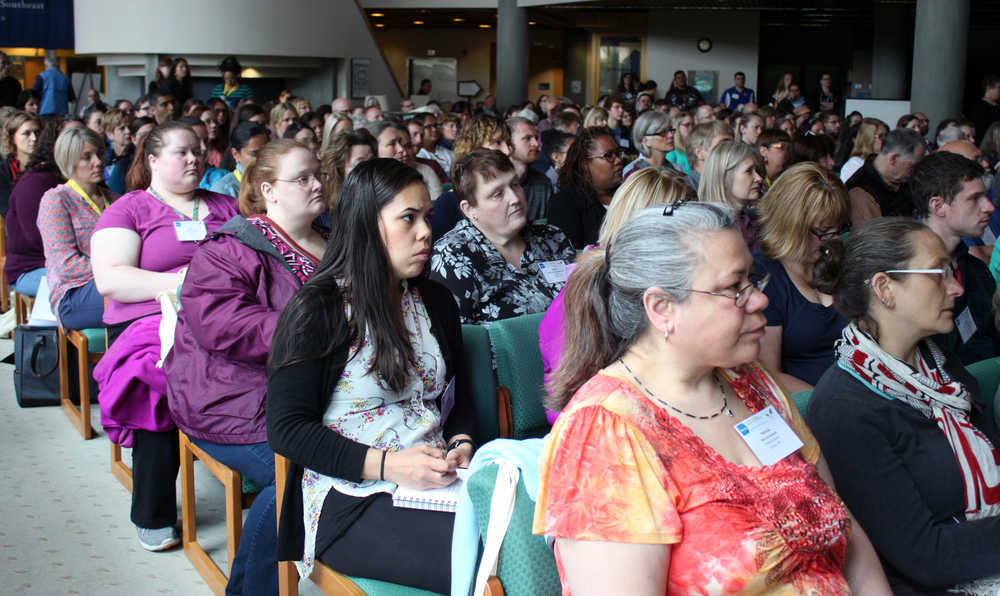
During opening remarks for the Juneau Suicide Prevention Coalition’s conference, “Adverse Childhood Experiences and Suicide,” Alaska Lt. Gov. Byron Mallott talked about the challenging and traumatic experiences he and his family experienced.
“My mother — a full-blooded Tlingit lady — her entire experience of life was that of adversity. Her mother was born, and living at the time that missionaries came to our community and changed our world forever,” he said to an audience of more than 200 people at the Egan Library Thursday morning.
Mallott said his mother saw drastic changes that left lasting impacts to their home village of Yakutat — the first cannery, the first school, the first health care.
Mallott remembers hearing his mother “talking Tlingit and laughing, eating seagull eggs, dipping them in seal oil,” but he was also told, “to learn English because that was the language of our future, that not only must we learn English, somehow speaking Tlingit was not good for us.”
He said all the changes destroyed his mother and she was an alcoholic. Starting in first grade, Mallott attended Catholic boarding school, which he called “an incredible learning experience,” but it was also where he witnessed abuse of another child.
Mallott said the issue of suicide prevention is very intense and personal to his life. He said he had a family member commit suicide.
“I live with rage inside me every single day,” Mallott said. “Every single day I work to channel it into something positive, to reach out and build another relationship, to learn something of another, to make a connection that maybe is worth something.”
Dr. Rob Anda called aspects of Mallott’s personal story examples of historical trauma, which can have devastating effects on future generations. Anda, the first key note speaker of the conference, spoke on, “The Progressive Nature of Adverse Childhood Experiences: Building Self-Healing Communities.”
Anda is a co-founder of the Adverse Childhood Experiences Study conducted by the Centers for Disease Control and Prevention and Kaiser Permanente in the mid-1990s. Results of the study showed the relationship between traumatic childhood experiences and health and social problems from adolescence to late adulthood.
Adverse Childhood Experiences, or ACEs, include physical, emotional and sexual abuse; neglect; domestic violence; living with an alcoholic or addict; and homelessness.
“There are more people that have been affected by adverse childhood experiences than those who have not,” Anda said. “We found that ACEs rarely occur in isolation. They come in groups. They come in clusters.”
The study found exposure to adverse childhood experiences can increase the risk of both social and health problems, like adolescent and unintended pregnancy, alcoholism, depression, drug use, heart disease, liver disease, domestic violence, smoking, sexually transmitted diseases, homelessness and suicide attempts. The more ACEs you experience, the higher the risk.
Pointing to a slide showing a graph, Anda said, “This is the risk of attempted suicide as the ACE scores goes from zero to seven or more. It’s about 1 percent for an ACE score of zero and it increases rapidly. The far right, 35 to 40 percent of people with an ACE score of seven or more, have attempted suicide.”
He said people with an ACE score of seven or more are 31 times more likely to attempt suicide.
Anda used to think that “suicide just sort of happens, and sometimes it does. What the ACE study shows me is that it’s one of the most predictable health and social problems of all the ones we studied.”
Society tends to try to treat the outcomes of ACEs, like disease, disability and social problems, which can be expensive and frequently ineffective, Anda said. He wants to start treating the problem from the onset and stop ACEs before they occur.
“People who have adverse childhood experiences have a tendency to grow up and present similar experiences to the next generation,” Anda said.
But he also said ACEs are not destiny.
“No matter what your ACE score is or what my ACE score is, there are no one-to-one relationships between adversity and any health or social outcomes. So having any particular ACE score does not mean anyone is destined to any one of these social problems, “ Anda said. “We talk about risk, but not destiny — very important point.”
He said becoming trauma-informed is a way to change the cycle of trauma and decrease intergenerational ACEs. Being trauma-informed helps us to change the judgment that we put on people who may be practicing risky behaviors like smoking, drinking or using drugs.
“From, ‘What’s wrong with that person?’ to saying, ‘What happened to them?’ If I know the story, I can understand, in many cases, why that behavior is there,” he said.
“The ACE score provides a chance to see the story of your life and to create a different path for the future,” Anda continued. “It transforms that story from one that is shameful and confusing … to create a different path for the future with hope, meaning and purpose.”
He said people who’ve experienced traumatic and adverse things as children are well equipped to help others.
Sharon Wright-Brown agreed. She’s a case manager for Juneau Youth Services’ family outpatient services and a conference participant.
She started working with JYS last September but has been in social services for 15 years.
“I had taken the ACE test myself and came up with a score of nine. To me, that was quite an eye-opener,” Wright-Brown said.
“I have been in this business for a long time, and I know that my dedication was to the betterment and wellness of families and their children. I had a feeling I wanted to contribute because of what I’d gone through, but to see that test score myself, I’ve realized just how much I’ve gone through and how I can empathize with others,” she said.
Empathy, she said, goes a long way in her work.
“We work with troubled youth,” Wright-Brown said, “and at times, I’ve spoken with children and said, ‘Hey, I know what you’re going through. I’ve been there.’”
• Contact reporter Lisa Phu at 523-2246 or lisa.phu@juneauempire.com.
