
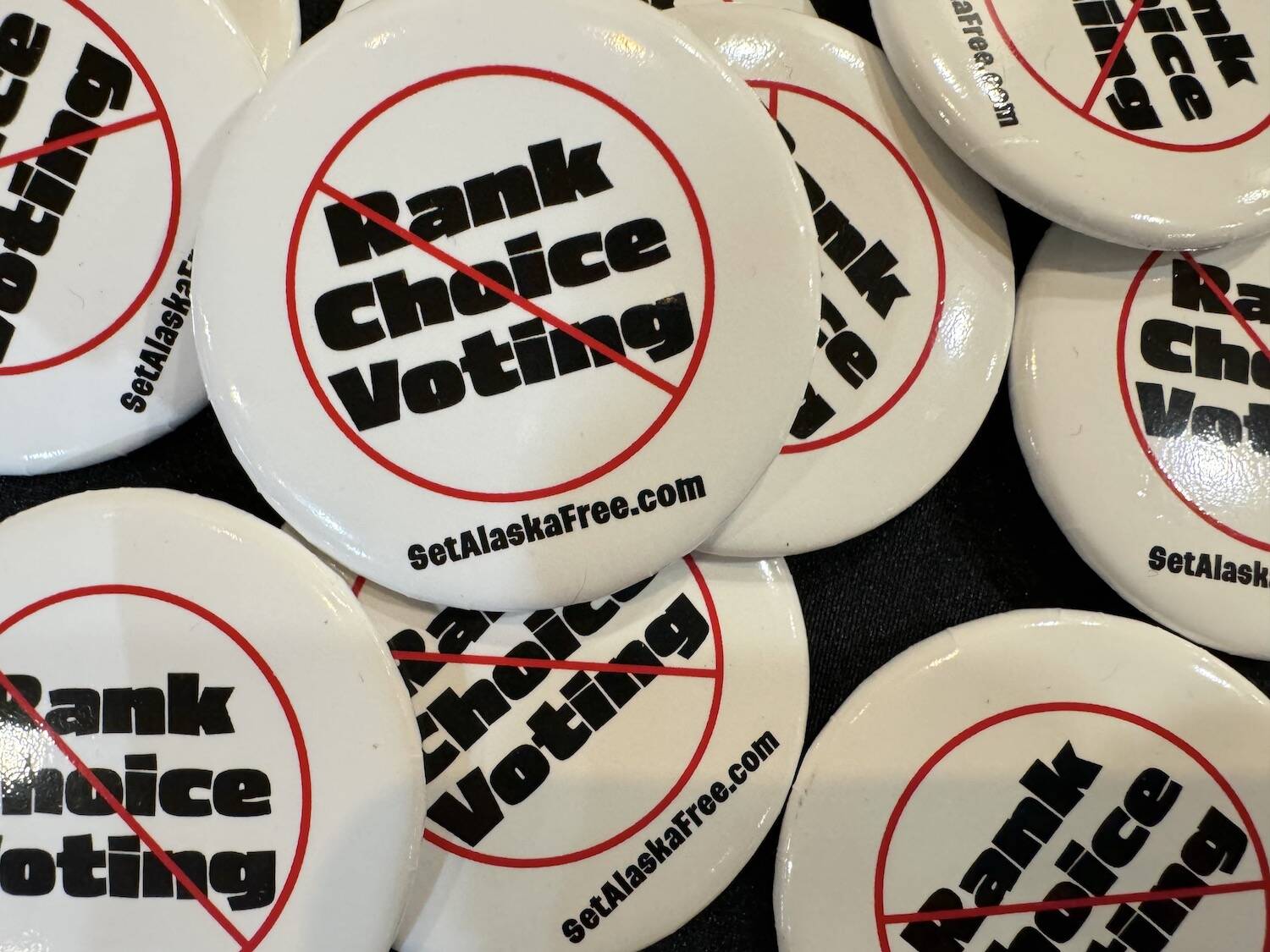
An Anchorage Superior Court judge has ruled that opponents of Alaska’s ranked choice election system violated state campaign finance laws in their effort to gather signatures for a repeal ballot measure.
In a 54-page order, Judge Laura Hartz upheld almost all fines issued in January by the state’s campaign finance regulator and concluded that Alaska’s “true source” disclosure laws apply to ballot measures.
Those laws state that if a nonprofit contributes to a political campaign, it must reveal the names of its donors, the true source of the money.
Hartz said one fine, levied for the misreporting of $2,358 in cash contributions, may not have been warranted and remanded the issue back to state regulators.
That was a small aspect of the overall case, which involved more than $94,000 in fines levied by the Alaska Public Offices Commission against groups and individuals who backed a ballot measure that seeks to eliminate both ranked choice voting and the state’s open primary, which places all candidates — regardless of party — into a single election for each office.
The repeal measure is slated for the November general election. A separate lawsuit has challenged the signature-gathering process used to put it on the ballot.
Preliminary orders in that case, including one issued Friday, have been in favor of allowing the repeal measure to go forward. A trial on the issue is scheduled to begin Monday.
Hartz’s 54-page order did not touch on that case, only the matter of the fines.
The Alaska Public Offices Commission, which regulates campaign spending in the state, concluded last year that Art Mathias, an opponent of ranked choice voting, contributed $90,000 to the Ranked Choice Education Association, an organization incorporated as a church in Washington state.
RCEA then gave money to Alaskans for Honest Elections, which campaigned in favor of the repeal measure.
Members of the Public Offices Commission concluded that was a violation of state campaign laws that forbid donations in the name of another person and require nonprofits to list their donors if they pass money to a political campaign.
Some ranked choice opponents appealed the fines, as did Alaskans for Better Elections, a pro-ranked choice group that sought larger fines. The Alaska Department of Law, representing the commission, sought to uphold the commission’s decision.
Hartz ruled almost entirely against both appellants, finding that only one fine — involving the handling of cash donations gathered at campaign events — may not have been warranted.
She sent that issue back to the Public Offices Commission for further consideration.
In 2020, Alaskans passed Ballot Measure 2, which included ranked choice voting, the open primary and a law stating that nonprofits that donate to a political campaign must disclose who gave them the money, revealing its “true source.”
That law didn’t directly address ballot measures, but Hartz said that ballot measures are included in the law because of an older law that forbids donations in the name of another person or group.
Her order said in part, “the court concludes that true source reporting requirements do apply to contributions in support of a ballot initiative when the contribution is passed from the true source through an intermediary to an initiative sponsor.”
Using that conclusion, Hartz upheld most of the commission’s actions.
“Because RCEA derives its funds from ‘contributions, donations, dues, or gifts,’ RCEA is an intermediary and not, by definition, the true source of a contribution,” she wrote.
Hartz rejected arguments suggesting that the First Amendment gives donors a right to privacy, thus negating the “true source” law.
“There is no constitutional right to make anonymous contributions for the purpose of influencing the outcome of an election,” she wrote. “There is likewise no right to contribute through an intermediary or in the name of another, and the court declines to create such a right.”
Supporters of the ranked choice repeal suggested they might face threats, harassment or reprisals for their donations and support, but in her ruling, Hartz said that they failed to show “any evidence of a ‘reasonable probability’” that would happen.
Friday’s order is unlikely to be the final word on the matter. Appellants could request a review from the Alaska Supreme Court.
In addition, since the initial filing against Alaskans for Honest Elections, supporters of ranked choice voting have filed additional complaints alleging further problems.
• James Brooks is a longtime Alaska reporter, having previously worked at the Anchorage Daily News, Juneau Empire, Kodiak Mirror and Fairbanks Daily News-Miner. This article originally appeared online at alaskabeacon.com. Alaska Beacon, an affiliate of States Newsroom, is an independent, nonpartisan news organization focused on connecting Alaskans to their state government.
