
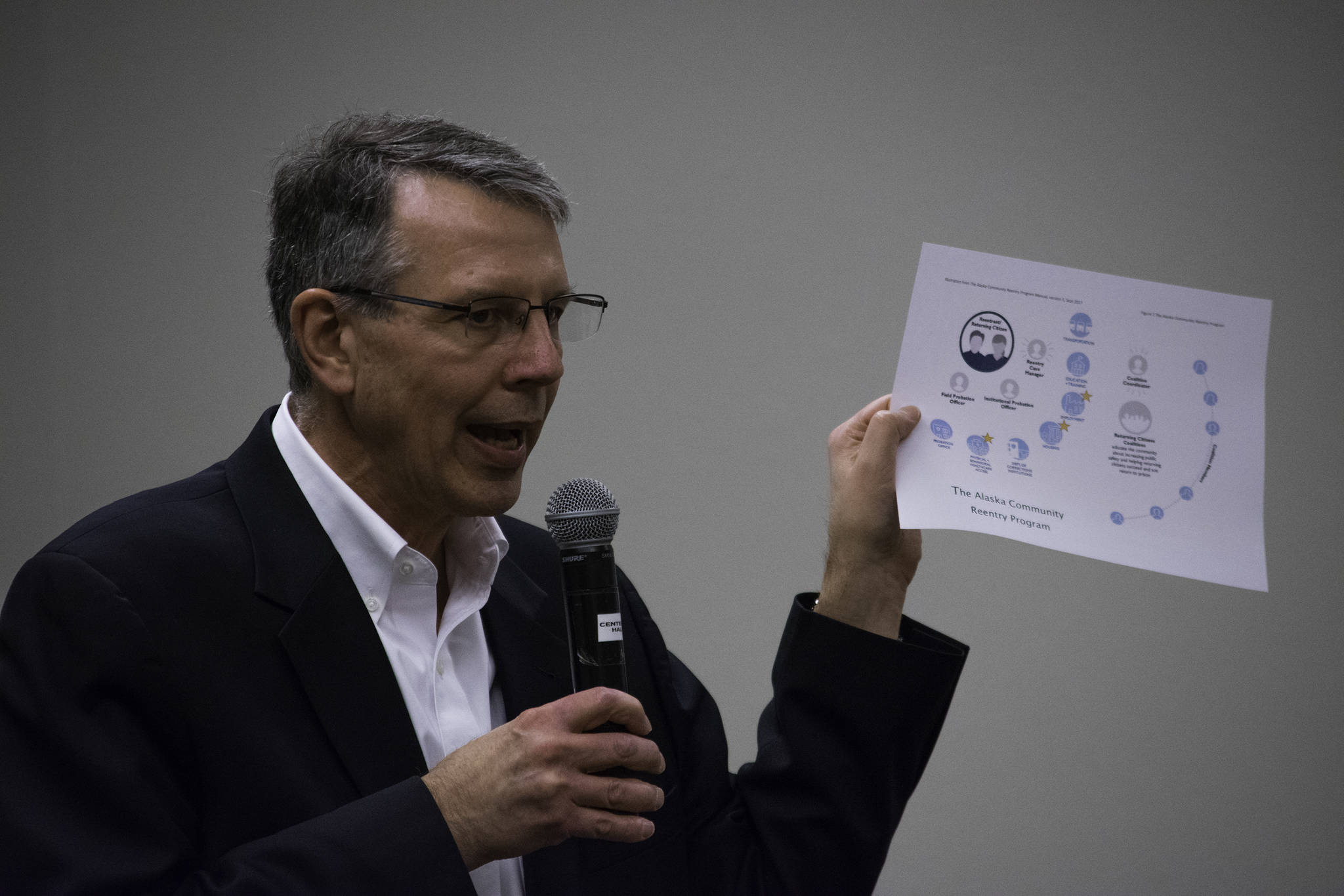
Vince Libertino doesn’t like to admit that he feels stress. His pride, he said, won’t let him.
As he spoke at a Juneau Reentry Coalition meeting on Wednesday night, Libertino was willing to reveal that finding housing after he was released from prison in 2016 was a major cause of stress.
“Not having a clean place to sleep at night, to wash my clothes, to have a house, to go to Fred Meyer and buy a steak and cook something, that’s stressful,” Libertino said. “It caused me to relapse at one point through this whole thing. I’ve fought and I’m back and I’m good.”
Libertino said he’s been in recovery since 2009 and there have been speed bumps on the way. He and two other speakers Wednesday night talked about the bumpy road to finding housing after incarceration.
The main question at hand at Wednesday night’s meeting, that around 20 community members attended, was whether Juneau needs additional reentry housing. Those in attendance agreed that there needed to be more options than the ones available now, such as the Department of Corrections’ halfway house or the nonprofit Haven House that provides a space for women after being released.
Irene Gallion, who was recently named the City and Borough of Juneau Housing and Homelessness Services Coordinator, provided statistics about the lack of available housing in Juneau. A normal rate of vacant housing, Gallion said, is about 6-7 percent. According to Department of Labor statistics, she said, Juneau’s vacancy rate was between 3.2 and 3.5 percent in the month of March from 2011-2016. Census data, she said, estimates the rate at 4.5 percent.
“These are some challenging vacancy rates for anybody looking for housing,” Gallion said, “much less somebody with challenges.”
As Libertino and other speakers told their stories of struggling to find housing either due to their prior conviction or a family member’s prior history, those challenges became clear. Financially, it’s hard to afford housing on top of restitution, legal fees, child support and other expenses that build up due to a felony conviction, they said.
Darryl Anders, who is trying to find a home as his sentence comes to an end, said he still hasn’t been able to find housing. He said he’s “getting turned down left and right,” due to his conviction, despite having saved enough money while in the halfway house to afford housing.
“They tell you when you go to a judge and you’re sentenced, that you’re going to pay your debt to society,” Anders said. “Well, you never do, because that debt follows you for the rest of your life.”
Finding housing, both Anders and Libertino said, serves as the foundation for everything else that happens when someone is reintegrating into society. As Libertino said, having a place to keep your clothes, bathe yourself and get a good night’s sleep can set somebody up to be at appointments on time and to live a more stable life.
The attendees agreed that there need to be more options for people freshly released from prison. They brainstormed ways to make this possible, listing ideas from helping community members be more informed about the effects of trauma to the hope of partnering with cruise agencies to use the apartments above businesses on South Franklin Street during the offseason. They’re all just ideas at this point, but Juneau Reentry Coalition Community Coordinator Don Habeger collected the sheets at the end of the meeting to keep track of the thoughts.
These meetings will continue, Habeger said. Every other month, they will take place on the third Wednesday of the month and will examine topics including transportation, employment, health care access and others that relate to reentry.
Haven House Director Kara Nelson brought up the fact that the CBJ is looking into scattered-site housing, which is an approach that would coordinate local social services and landlords to get people off the streets and into housing around town wherever there are openings. In October 2017, the CBJ Committee of the Whole voted unanimously to look into scattered-site housing.
Nelson said Juneau has taken some steps in recent years to become more aware of the needs of those dealing with reentry, and wheels are in motion.
“Obviously, as you can see here, we are not where we need to be,” Nelson said, “but we have come a long ways and a foundation to move forward.”
• Contact reporter Alex McCarthy at 523-2271 or amccarthy@juneauempire.com. Follow him on Twitter at @akmccarthy.
