
At last, after a mini-winter that kept the Easter bunnies in their burrows, it seems that spring is real. Robins are hopping along the roadsides and singing in the trees. I had reports of hummingbirds and ruby-crowned kinglets, and finally, I heard a kinglet singing. That’s when spring starts for me.
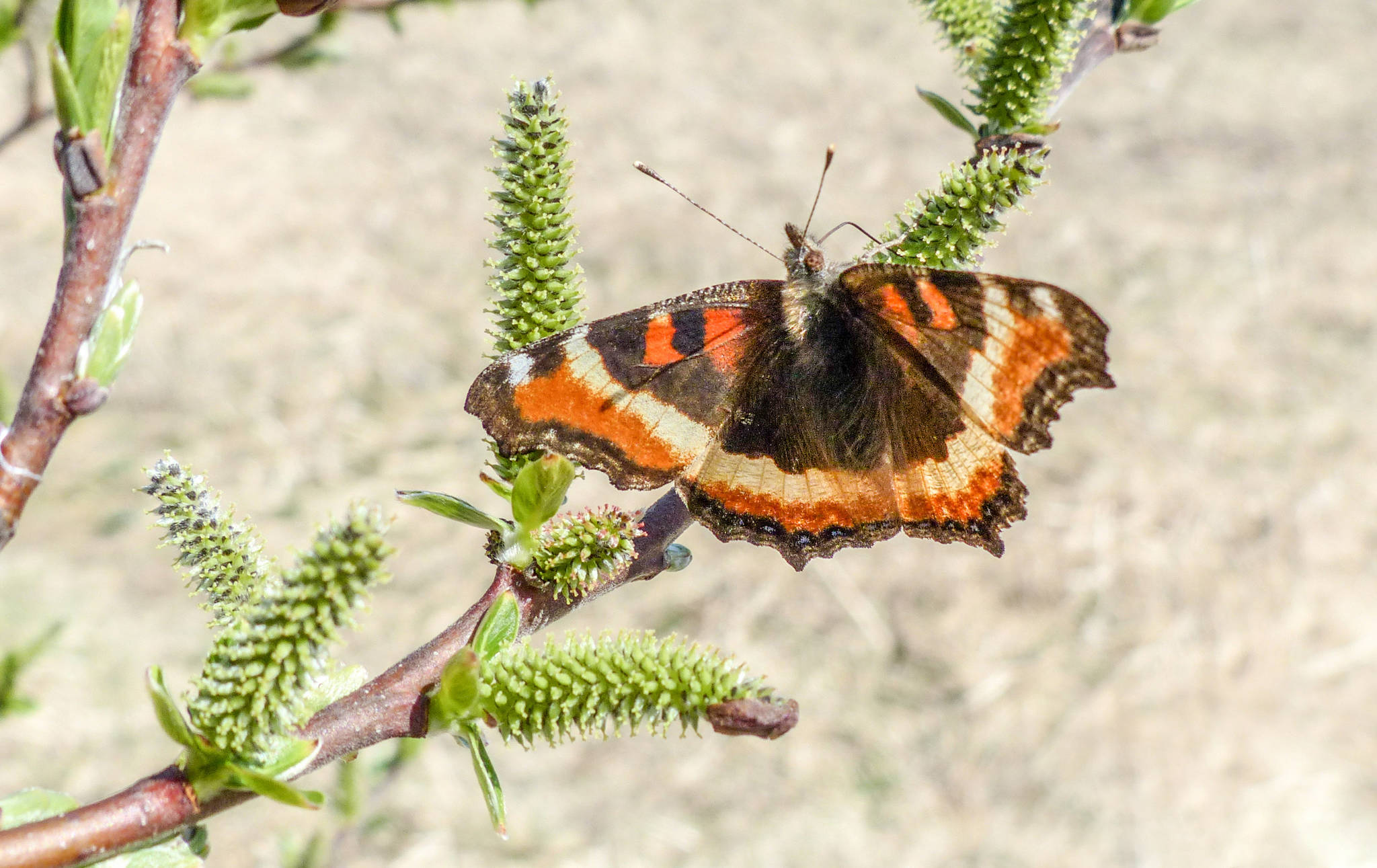
One good sign of spring was seeing Milbert’s tortoiseshell butterfly on the wing, at the edge of a meadow near the Boy Scout camp. I’d just spotted three snow geese grazing with a bunch of Canadas, when a fast-moving butterfly zipped by, making erratic turns. I had brief glimpses of a reddish color when the wings opened, and my slow mind gradually retrieved the name.
The day after seeing that one, I went to the Jensen Arboretum expecting to see more. I found just one, foraging on the huge, ball-shaped inflorescences of a plant called Petasites japonica, whichis related to our local coltsfoot. The butterfly seemed to be quite unsystematic in its foraging pattern. Sometimes it moved from one plant to the next one; other times it leaped up into the air and came down in another part of the flower bed altogether. Bumblebees and flies of various sizes were also visiting these inflorescences, but the butterfly didn’t meet them very often. Just once I saw it avoid an inflorescence with two flies on it. And just once I saw an encounter between the butterfly and a bee on an inflorescence. The bee held its place as the butterfly walked over many flowers toward it. When face to face, the butterfly backed off and went away. Later, it basked in the sun with spread wings.
Milbert’s tortoiseshells hibernate as adults, so they are ready to appear after a few warm days. When they emerge, they reportedly forage on plant sap, dung, rotting fruit and nectar, perhaps pollinating some flowers in the process — although there are only non-native garden flowers blooming just now. They also “puddle,” which refers to visiting damp spots on the ground where an animal has urinated; this is a source of nitrogen. The female butterflies lay hundreds of eggs on stinging nettles, which is the larval food. Young larvae feed in groups, often webbed together, but older ones are more spread out. When I visited the Arboretum, the nettles were not yet up, so early females would be out of luck, at least for a while.
[Widspread deception in the natural world]
The larvae give rise to a new generation of adults in summer. These adults fly until it’s time to hibernate, when they seek crevices in tree bark or buildings in which to wait out the winter.
Others signs are increasing too. Beach rye seems to be growing more than an inch a day. Little green clusters of cow parsnip leaves are pushing up through the litter on the upper beaches. Red alders are showing a faint flush of green all along the highway. The buds of new spruce tips are just starting to show. In the warm spots, salmonberry and elderberry bushes are leafing out. The annual show of “swamp lanterns” — AKA skunk cabbage — is splendid in places that warm up early. And purple mountain saxifrage is blooming along Perseverance Trail.
The gang of twenty to thirty mallards that congregated on my icy pond has dispersed — and the ice has finally melted — as the females settle down to egg-laying and incubation. Now, the only visitors are pairs that are still in the process of building a clutch of fertilized eggs or single males that have already done their part.
After the little sunny spell that brought out the butterflies, the weather turned cool and damp. Ice and snow on many of the trails is slow to disappear. The advance of spring slowed down a bit, leaving me impatient for more spring-time discoveries.
• Mary F. Willson is a retired professor of ecology. “On The Trails” is a weekly column that appears every Wednesday.
