
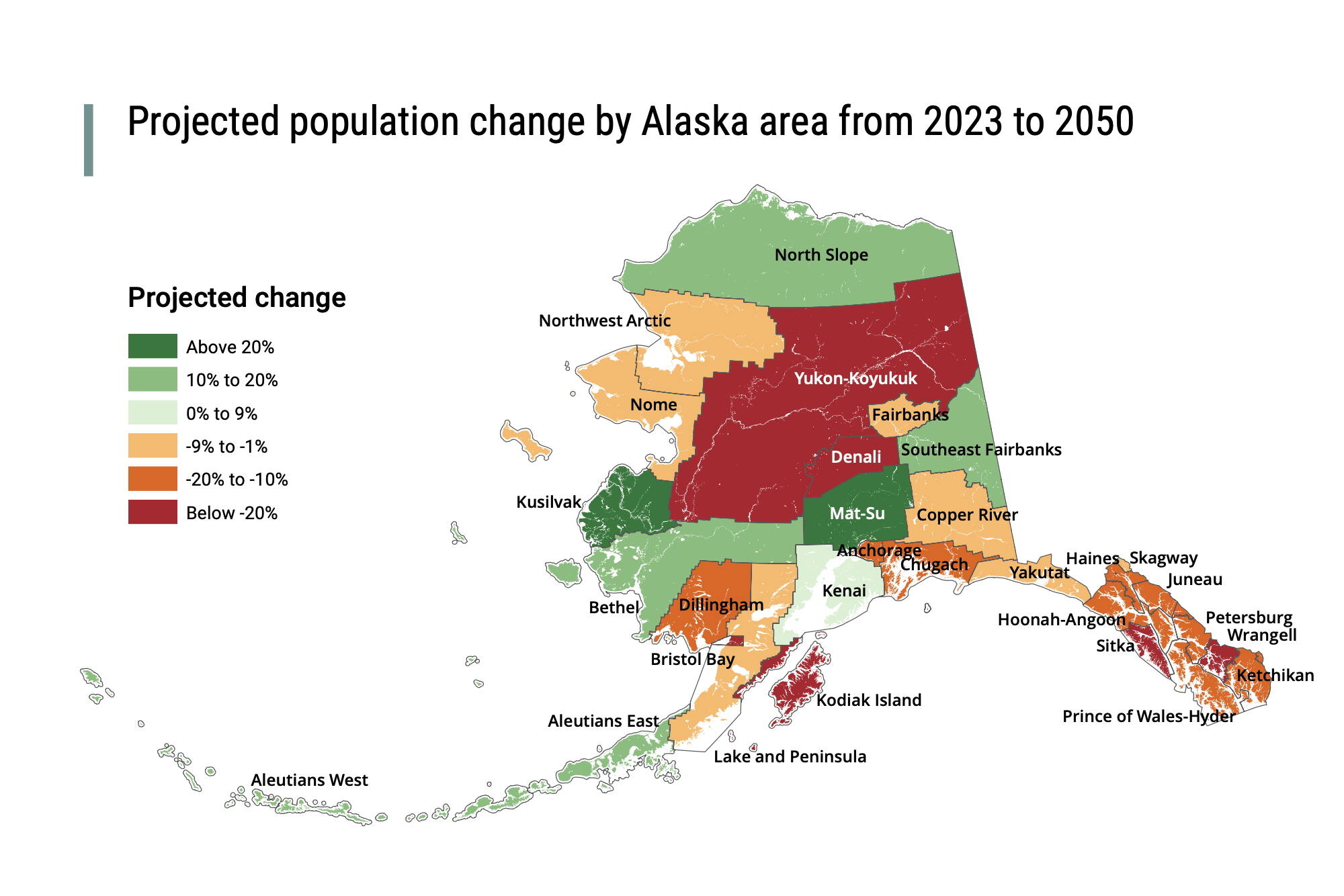
Southeast Alaska’s population is expected to drop 17% between 2023 and 2050, far more than any other region of the state and enough to account for most of a 2% statewide population drop during that period, according to a report published Monday by the Alaska Department of Labor and Workforce Development.
Furthermore, with “only” an 8.6% drop forecast during that time for Juneau, which accounts for nearly 45% of the region’s current population, most other Southeast communities are expected to see significantly larger drops than the 17% average.
The population of Southeast Alaska is expected to decline by 12,000 people by 2050, while a total statewide drop of 15,000 people (from 737,000 people in 2023 to 723,000 in 2050) is projected in the report published in the December issue of Alaska Economic Trends, the department’s in-house magazine.
“Southeast is older than most of the state and its birth rates are lower, leading to natural decrease,” the report notes. “Deaths outnumbering births throughout the projected period and net migration losses point to a steady population decline in Southeast.”
The only other major regionwide decline projected in the report is a 7% drop in the Interior. Increases of 11% in Southwest Alaska, 4% in the northern region of the state and 1% in the Anchorage/Mat-Su area are forecast — but there is considerable variance in changes to city and village populations within all of the state’s regions.
The findings for Southeast are consistent with other recent economic and demographic studies projecting a population drop, although Monday’s report extends the timeline well past the roughly decade-long period of other studies.
Juneau’s population of about 31,550 as of July 1, 2023, is expected to drop about 8.6% to below 27,200 by 2050, according to Monday’s report. Southeast’s population is expected to drop from 71,077 in 2023 to 59,109 in 2050, with some of the biggest declines being a roughly 33% drop in Wrangell (from 2,039 to 1,349), 24% in Sitka (8,231 to 6,266) and a 20% drop in Ketchikan (13,475 to 10,790).
The grim population news was published in the same issue of Alaska Economic Trends as a report noting a rise in statewide jobs and wages, a trend also reflected in recent studies of Southeast Alaska’s economy.
But while a “Southeast Alaska by the Numbers” report presented in late September stated overall numbers and optimism among industries are high — especially after the COVID-19 pandemic downtown — there were huge variances within industries. Tourism employees got 44% more in total wages in 2023 compared to the year before, for instance, while seafood industry workers got 26% less in 2023.
Issues of concern to residents and business leaders are housing shortages and affordability, and lack of various essential services including childcare, which in turn is causing workforce shortages, according to the economic report compiled by Rain Coast Data.
The drop in Juneau’s younger population has also been a years-long concern reflected in school enrollment, which dropped from a peak of 5,701 in 1999 to roughly 4,000 this year and is projected to drop by several hundred more students by the end of the decade.
Among developments over the past year local officials hope will slow or reverse the trend — at least temporarily — is the announcement the U.S. Coast Guard will homeport an icebreaker in Juneau within a few years. The Coast Guard projects about 190 personnel plus roughly 400 family members would eventually relocate to Juneau as a result.
The projected statewide decline in population is the first since the department began its projections, according to Monday’s report.
“Previous releases showed Alaska losing population in the latter part of the projected decades but still growing overall,” the report states. “The projected decrease stems from prolonged net migration losses and the number of births losing ground to the number of deaths. While the size of Alaska’s population is not projected to change much over the next 27 years, its makeup will shift to a considerably older state with a much smaller number of children.”
Southwest Alaska and the northern part of the state have relatively younger populations and higher fertility rates compared to the rest of the state, prompting the projected increases there. The study notes that while the Anchorage/Mat-Su area will remain essentially the same, a trend of an increase in the Mat-Su area and decrease in Anchorage is expected to continue.
• Contact Mark Sabbatini at mark.sabbatini@juneauempire.com or (907) 957-2306.
