
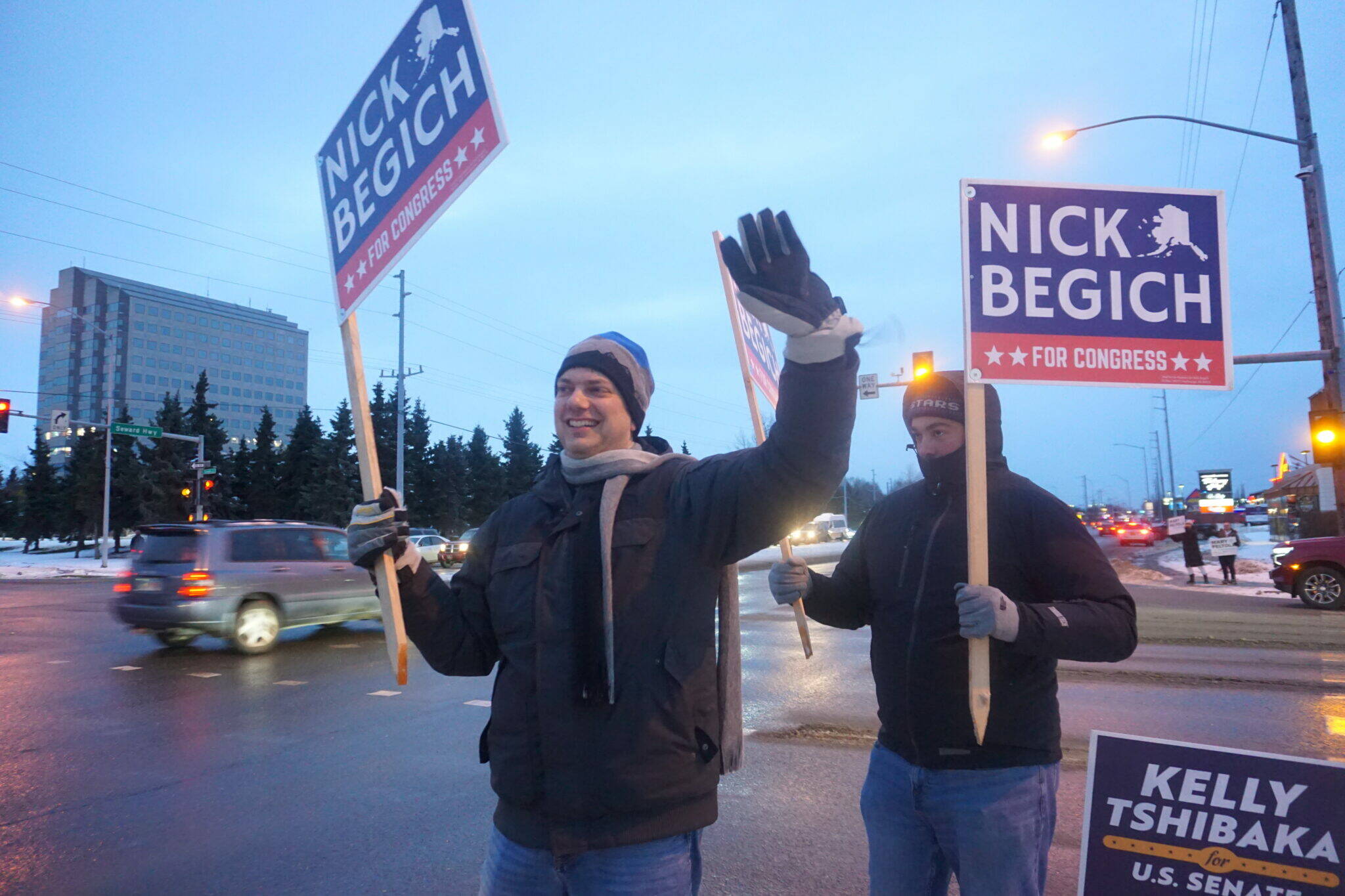
In some Alaska races, Republican candidates have pledged to withdraw from the general election in November if they do not receive the top votes among fellow party members in the primary.
The most high-profile pledge was made by Nick Begich III, who is running for Alaska’s single U.S. House seat. Begich publicly pledged in April to withdraw from the race if he is bested by another Republican in the primary election. Josh Walton, Begich’s campaign manager, confirmed last week that Begich still plans to abide by his pledge.
Lt. Gov. Nancy Dahlstrom is another prominent Republican running for the U.S. House seat, which was won by Democratic Rep. Mary Peltola in 2022. Earlier this month, Dahlstrom said she will not drop out of the race if she places behind Begich in the primary. Her press team confirmed last week that her position has not changed.
Similar pledges were signed by some Republican candidates in two state legislative races in Anchorage.
Both of these pledges were written by Trevor Jepsen, who is the chief of staff to Rep. Tom McKay, R-Anchorage, and also consults part-time for campaigns. For Jepsen, the pledges are a way to “circumvent ranked choice voting” by treating the open primary like one under the old system.
In 2020, Alaskans voted to establish ranked choice voting in the state. Since then, Alaska has become nationally recognized for the system, drawing both praise and criticism.
Alaska’s ranked choice voting system is used in the general election, but not in the primary. The primary is open to all candidates, regardless of party, with voters choosing one.
The top four vote-getters in the primary advance to the general election. Then, in the general election, voters can rank up to four candidates. After the votes are counted, if a candidate receives the majority of first-place rankings, they are the winner.
However, if there is not a majority, the lowest-ranked candidate is booted from the count and their votes are reassigned to the voters’ next preference. This process repeats until there is a winner.
Right now, Jepsen is making what he described as a “main push” for candidates to commit to the pledge in Senate District H and House District 9 in Anchorage. According to Jepsen, Republican candidates in those districts risk losing because both races have multiple Republican candidates running against a member of another party.
“We can’t win that Senate seat with two Republicans in the race. The numbers don’t work out. It’s not possible,” he said. “And that district nine seat, we would have three Republicans going to the general. Even though that’s technically a Republican seat, you know, they split the vote, exhausted ballots.”
“Exhausted ballots” is a term for ballots that are not included in the final ranked choice count because the voter ranked only candidates who were already eliminated.
In Senate District H, which stretches from Ted Stevens International Airport to Campbell Lake, McKay and Liz Vasquez are the two Republican candidates on the ballot, as well as incumbent Democratic Sen. Matt Claman, D-Anchorage.
McKay signed the pledge to withdraw. Vasquez has been given the pledge but not yet signed it, and did not respond to an interview request.
According to McKay, he signed the pledge because he felt “like we could win that seat if it’s one-on-one” in the general election.
For McKay, the pledge eliminates the “complexity” created by voters with exhausted ballots. “When their ballot is exhausted, then they don’t get a second bite at the apple,” said McKay.
Meanwhile, in House District 9, which covers the Anchorage Hillside, Girdwood and Whittier, three Republicans are running against one independent. Two of those Republicans, Lucy Bauer and Brandy Pennington, have both signed the pledge.
Pennington proposed the pledge to the other candidates. The pledge was written by Jepsen, who is currently working on her campaign.
Bauer and Pennington did not respond to requests for comment.
Lee Ellis, the president of Midnight Sun Brewing Co. and the district’s third Republican candidate, was the lone Republican holdout on signing the pledge. Ellis described the pledge as an “ill-conceived effort” that ignored the voting history of the district.
Ellis said his campaign research shows that a significant percentage of House District 9 voters ranked their choices when voting in 2022. His choice to not sign the pledge, he said, is “about historical behavior.”
And while Ellis is more favorable toward open primaries, and less favorable toward ranked choice voting, he said he spoke with a number of campaign experts who advised him not to sign the pledge.
Ellis suggested that the candidates sit down after the primary election and “decide what the best pathway forward was,” but because the pledge was non-negotiable, he chose not to sign.
Anchorage attorney Scott Kendall was a key author on the 2020 legislation that launched ranked choice voting. While Kendall declined to comment on a specific race or pledge, he said that pledges such as these harm the party that is signing them.
The pledges rely too strongly, he said, on the assumption that Alaskans will always vote along party lines. “We’re a small state, people know each other. People know other people’s reputations. So this idea that you can drop out and just sort of give all of your support to another candidate seems very flawed to me,” Kendall said.
Ranked choice voting is praised for reflecting the complexities of voter identification, especially in Alaska, which has the highest share of independent voters in the country. In 2022, the first time that Alaskan voters used nonpartisan open primaries, more than half of voters split the ticket, meaning that they didn’t vote strictly along party lines.
Another issue with pledges, Kendall said, was their reliance on results from primary elections. Voter participation in primary elections is consistently lower than general elections, meaning that a candidate who receives a low number of votes in a primary could still prove very popular in the general election, when a larger group of people are voting, said Kendall.
“By taking one of your horses out of the running as a Republican Party, you’re lessening the chance the Republican Party will win,” Kendall said.
A proposed ballot measure seeks to repeal ranked choice voting. If approved by voters in November, in future elections, voters would choose only one candidate in the general election, instead of ranking multiple candidates. The state’s open primary system would also be eliminated, and political parties would be able to limit who can vote and who can run in primaries.
• This article originally appeared online at alaskabeacon.com. Alaska Beacon, an affiliate of States Newsroom, is an independent, nonpartisan news organization focused on connecting Alaskans to their state government.
