
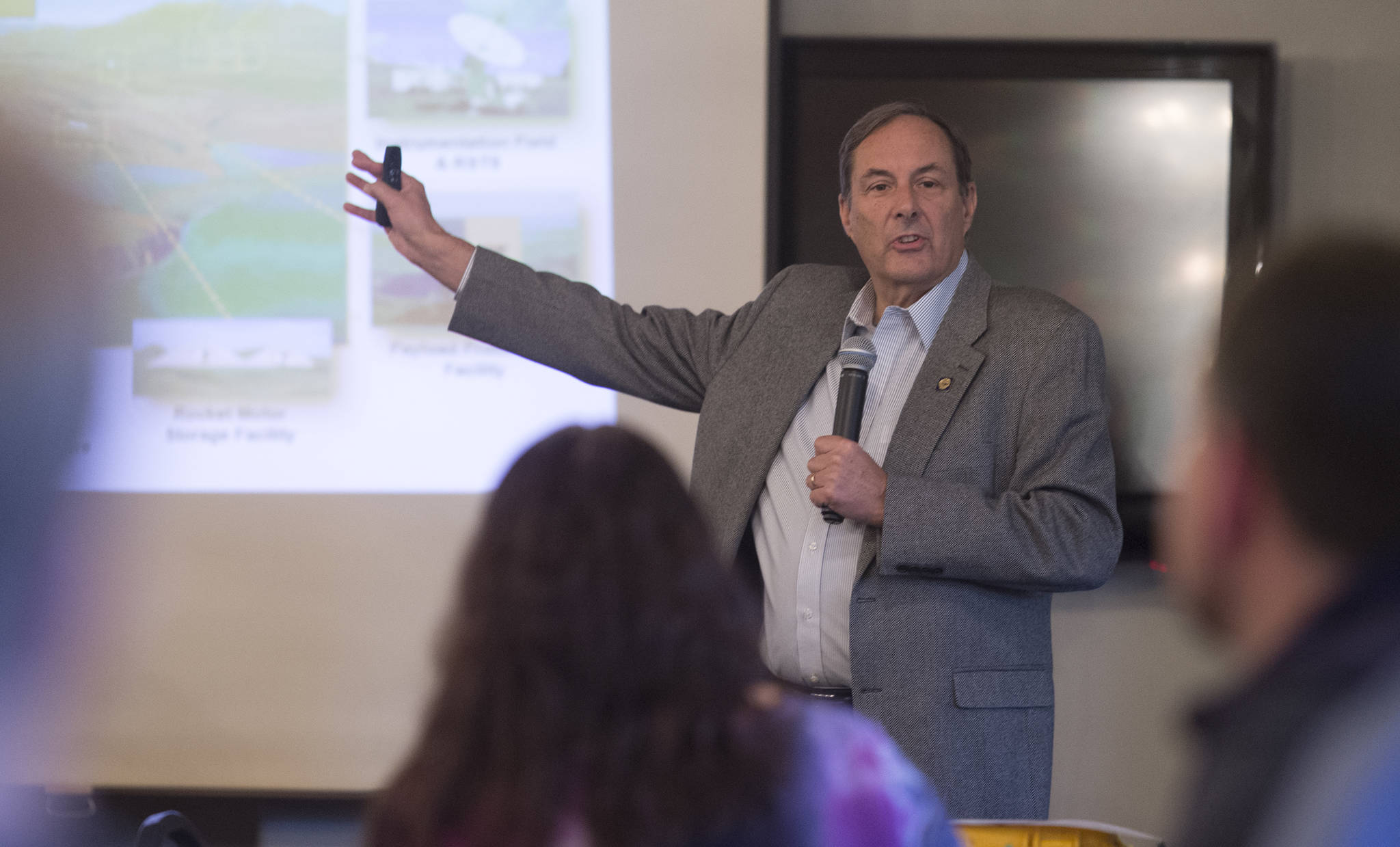
Craig Campbell remembers the night when they tested the missiles.
Campbell, the president and CEO of the Alaska Aerospace Corporation (AAC), presented pictures of a successful missile defense system test from July 10 to a group at the Chamber of Commerce luncheon on Thursday.
A photo of a Terminal High Altitude Area Defense System (THAAD) missile taking launch stood on the screen as Campbell’s eyes widened.
“It was done in July, so the sun was barely set,” Campbell recalled. “If you looked to the horizon, it was bright to the north and kind of dark to the south. This picture is facing south. That rocket is pretty bright when it launches.”
It was the first launch in more than two years at the Pacific Spaceport Complex-Alaska (PSCA) in Kodiak, which was damaged during a failed launch in August 2014. Campbell hopes that there are many, many more successful launches in the PSCA’s future.
Speaking to the Chamber on Thursday, Campbell said that the AAC has a contract with the Missile Defense Agency but that a large part of the company’s future is actually dependent on commercial launches.
The PSCA is one of just four facilities in the country that can launch rockets into orbit, Campbell said, but it’s only capable of launching smaller rockets. Instead of huge launches akin to those seen at Cape Canaveral, Florida, the PSCA is built more for smaller, much less-expensive rockets and satellites.
“We are at the leading edge at Alaska Aerospace of bringing small, and ultra-small rockets to Alaska that are gonna support a commercial industry of small and ultra-small satellites,” Campbell said.
One example Campbell used was a company called Planet Labs, which has 160 satellites located around the Earth that supply up-to-date satellite images to companies looking to develop land. Planet Labs needs to replace these satellites regularly, and needs companies that can launch them into orbit.
Campbell wants AAC to be one of those companies.
AAC has been working with many similar companies such as Rocket Lab, Vector Space Systems and Ad Astra Rocket Company for the past few months, and aided with a launch of a Rocket Lab rocket in May in New Zealand. Ad Astra is scheduled to launch a rocket from Alaska in either January or February, Campbell said.
The other three facilities that launch to orbit, Campbell said, are owned and operated by the federal government. The State of Alaska owns the AAC, and Campbell is proud of the facility.
“We have tremendously modern facilities and capabilities here in Kodiak that are the envy of the world,” Campbell said.
Though the state owns the AAC, the company is run without money from the state. Campbell tells the story often, about a meeting between him and Gov. Bill Walker in 2014. With budget constraints, Walker told Campbell that the state was going to pull its funding from the AAC.
It was then that Campbell pledged that the AAC was going to find a way to make money through commercial means. With a small profit in 2015, followed by a $2 million dollar loss in 2016 and a $2.6 million gain in 2016, the AAC keeping its head above water financially, Campbell reported.
Half of the AAC’s funding, Campbell said, comes from federal grants while half stems from customer revenues. The commercial services are paying off, and they’ve hardly even begun launching. Campbell said there are about 15,000 small satellites in production around the world right now, so there will be a huge number of rockets in need of launching in the next few years.
When one Chamber member asked, Campbell estimated that Kodiak could be launching a rocket as often as once a month. Down the line, AAC hopes to also expand to another facility near the equator (Campbell said they’re currently looking at locations in Saipan and Hawaii) so they can get even more of a share of the launch market.
The goal, Campbell said, is for the AAC to make enough money in five years where it can give some of its revenue to the state of Alaska. Though the state doesn’t provide funding, Campbell believes that state-owned organizations should do what they can to give back.
“I think it’s fair that as a state corporation we become very profitable, we become very active, we do stuff across the state, we create money,” Campbell said, “and then we start paying back the state of Alaska.”
• Contact reporter Alex McCarthy at 523-2271 or alex.mccarthy@juneauempire.com.
