
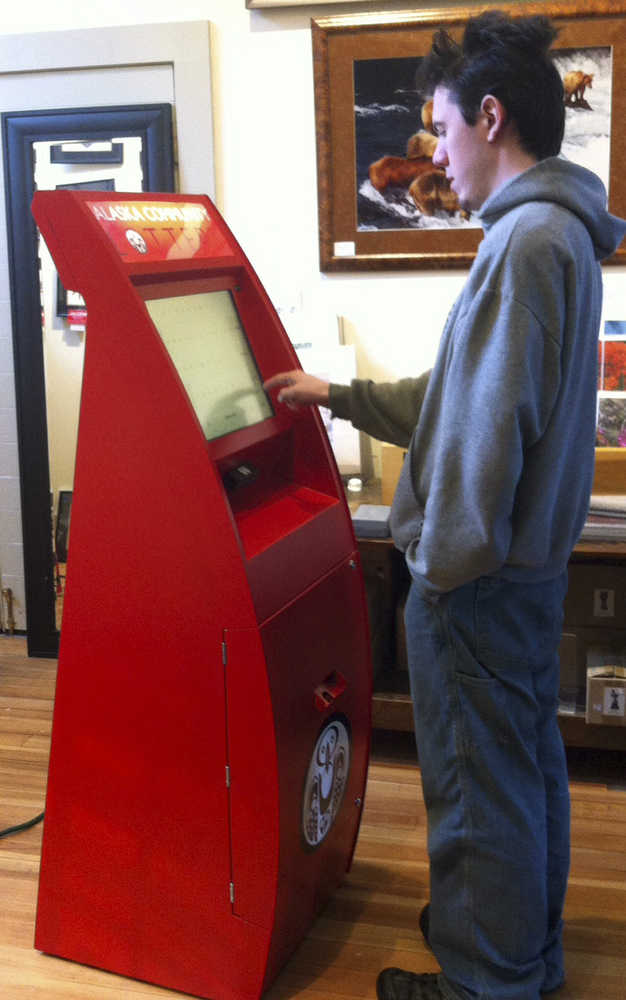
JUNEAU — An innovative fundraising method could take hold in Alaska after residents of a remote town developed a system for buying and selling raffle tickets via vending machines and ATM-like kiosks.
Brother and sister Greg Klupar and Olivia Klupar were granted an operator’s permit to run a raffle with the nonprofit Skagway Arts Council in 2014. However, a change in the Department of Revenue’s interpretation of raffle laws left them without a permit to operate in 2015.
The siblings hope that bills introduced in the Alaska Legislature gain support and pass, changing state regulations to allow machines like theirs.
Their fundraising idea was born from the duo’s desire to raise money for the arts council by enticing tourists to take a chance instead of leaving the burden to the town’s 1,000 residents. Their first, and thus far only, venture was a raffle for the arts council with a cash prize of $500. Tickets sold for $2 each. Olivia Klupar wrote in an email to The Associated Press that the raffle sold 400 tickets in a three-day period, netting $800 for the arts council.
“This raffle was really just to test our concept,” she wrote.
Each year, cruise ships bring hundreds of thousands of visitors to Skagway, which is located 90 miles northeast of Juneau at the northern end of the Lynn Canal, just west of Alaska’s border with British Columbia.
In 2015, 30 ships made 402 scheduled visits to the town, bringing more than 792,000 people, according to data from the Skagway city cruise ship calendar.
“We saw all these cruise passengers flood Skagway pretty much every day,” Olivia Klupar, co-founder of raffle vending machine company Alaska Community Partners. “We tried to figure out how to reach that population.”
While the Klupars’ first raffle was a success, the operator’s permit denial put the startup company’s future efforts in a bind. Cost was a concern for the siblings. Klupar said the company custom designed its own kiosks to reduce costs. Buying new, pre-designed machines would have cost more than $6,000 per machine.
“We didn’t have the startup. So we ended up making our own which is probably about $2,000 a machine,” she said.
She said she and her brother have given up full-time work and spent their life savings to get the business running.
“We had exhausted all of our resources and just couldn’t get anyone in the government to respond to us,” she said.
But, after a conversation with State Rep. Sam Kito III, D-Juneau, in the Skagway town library, Klupar said progress toward changing state regulation looked promising.
Kito introduced HB 235 after hearing of the Klupars’ plight. It would clarify state law to specifically allow electronic kiosks or vending machines to be used in the sale of raffle tickets and lottery tickets. State Sen. Dennis Egan, D-Juneau, introduced the companion bill in the Senate on Friday.
Kito said he didn’t think the bill would lead to games like pull tabs, which have a minimum age requirement, being played from electronic machines as state statutes for raffles and lotteries differ from those of pull tabs.
State law allows pull tabs to be played from a vending machine but with the restriction that the machine can’t be touched by the customer. An operator must be standing by to dispense the cards.
Selling pull tabs from unattended vending machines would be more difficult to regulate than the raffles the Klupars designed.
“There is an age restriction on pull tabs,” Kito said. “There is no age restriction on buying or selling lottery tickets.”
Ken Alper, director of the department of revenue’s tax division said the department hoped to create the ability for the department to approve the machines with a regulatory change.
“Since these sort of kiosks are open to the public and not necessarily supervised, we want to ensure that any activities that may be allowed on them are only those for which there is no specific age restriction,” Alper wrote in an email to the AP.
Klupar said she and her brother plan to target not-for-profit organizations with the custom-designed bright red machines she compared to an airport check-in kiosk.
Users can use a touch screen on a machine that’s either freestanding or mounted to the wall in a retail store, purchase a raffle ticket and get it printed from the machine. The Klupars make their money by charging an operating fee for running the raffles and through advertising in the machines.
“The budget deficit in Alaska is reducing funding for nonprofits,” Klupar said. “We see this as a way to help nonprofits with an additional revenue stream.”
Kito said his office has been working with the Department of Revenue to come up with new regulations pertaining to electronic raffles.
“If they are able to move forward in the regulation process then the legislation may not be needed,” Kito said.
Department of Revenue Deputy Commissioner Jerry Burnett said his department had discussed allowing the new gaming delivery method but any regulatory change would take time to complete as it would have to go to public comment, be proposed as regulation and then formally adopted.
