
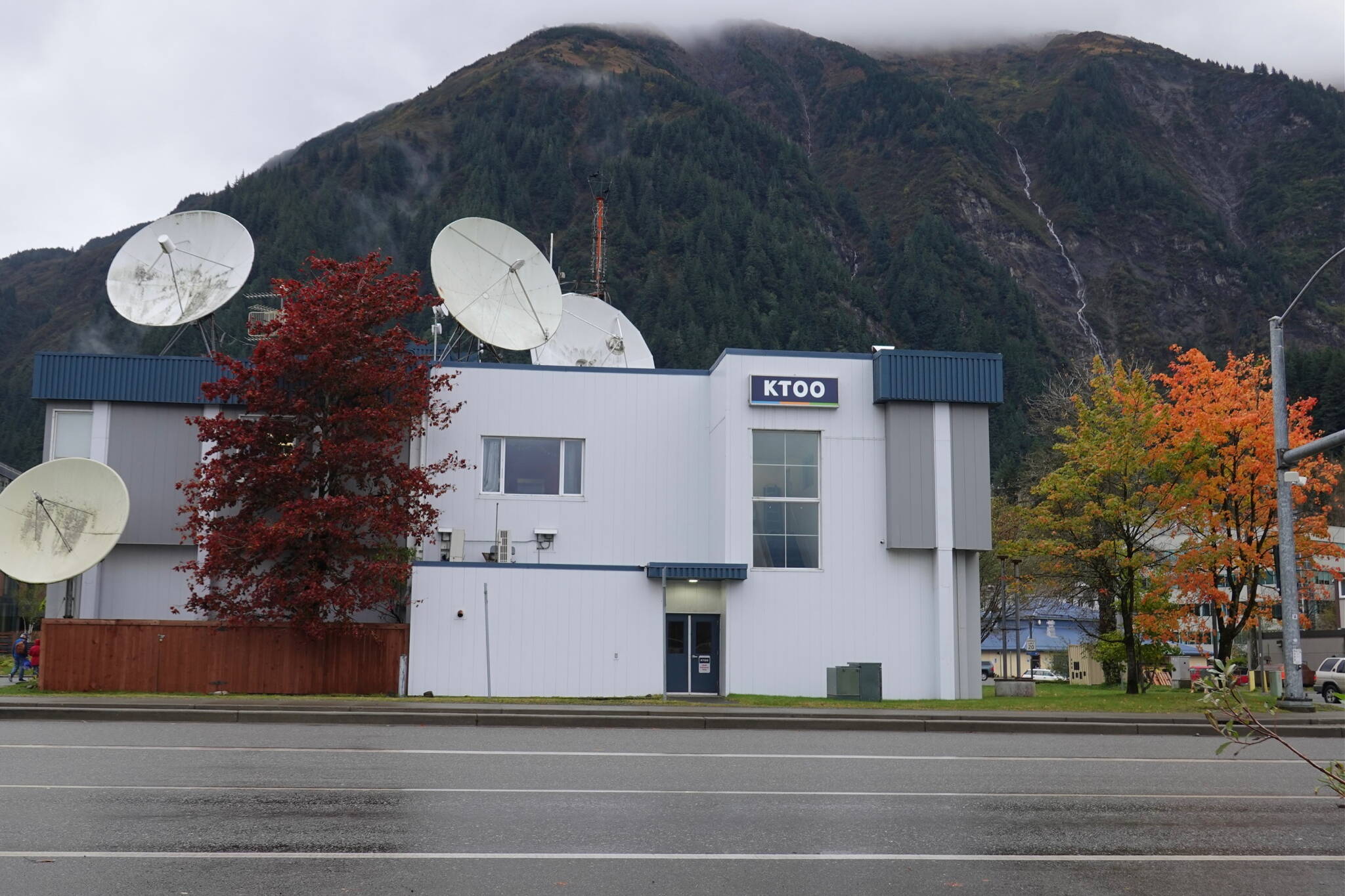
As Juneau’s public broadcasting station KTOO celebrates its 50th anniversary its legacy is built on a public communications system started by the U.S. Army Signal Corps in 1900.
As with many innovations in Alaska the impetus was the Klondike and then Nome gold rushes that drew thousands of stampeders into the wilderness to make their fortunes. At the time of those events in the late 1890s, Alaska was managed loosely by the U.S. military that had a limited presence.
After the United States assumed ownership of Alaska from Russia in 1867 the military was in charge, but with lackluster involvement. When the hordes of gold seekers rushed to Skagway from Seattle en route to Canada’s Dawson City for Klondike nuggets — and a year later to Nome — the U.S. military stepped in to provide law and order. The military also built vital navigation aids along the Inside Passage and upgraded communications — which at that point was mail carried in winter by dogsled, and in summer by horses and river steamers.
[See also: Legere leaves a legacy — KTOO’s evolution over the decades under former longtime general manager]
In 1900 remote military outposts were hacked out of the wilderness to create a land-based telegraph line by soldiers with pack animals in summer or sleds in the frozen darkness. Eventually 72,000 poles with wires strung on them networked through the interior of Alaska, linking Valdez at tidewater north to a fort at Eagle on the Yukon River then west to St. Michael near Nome at the Bering Sea.
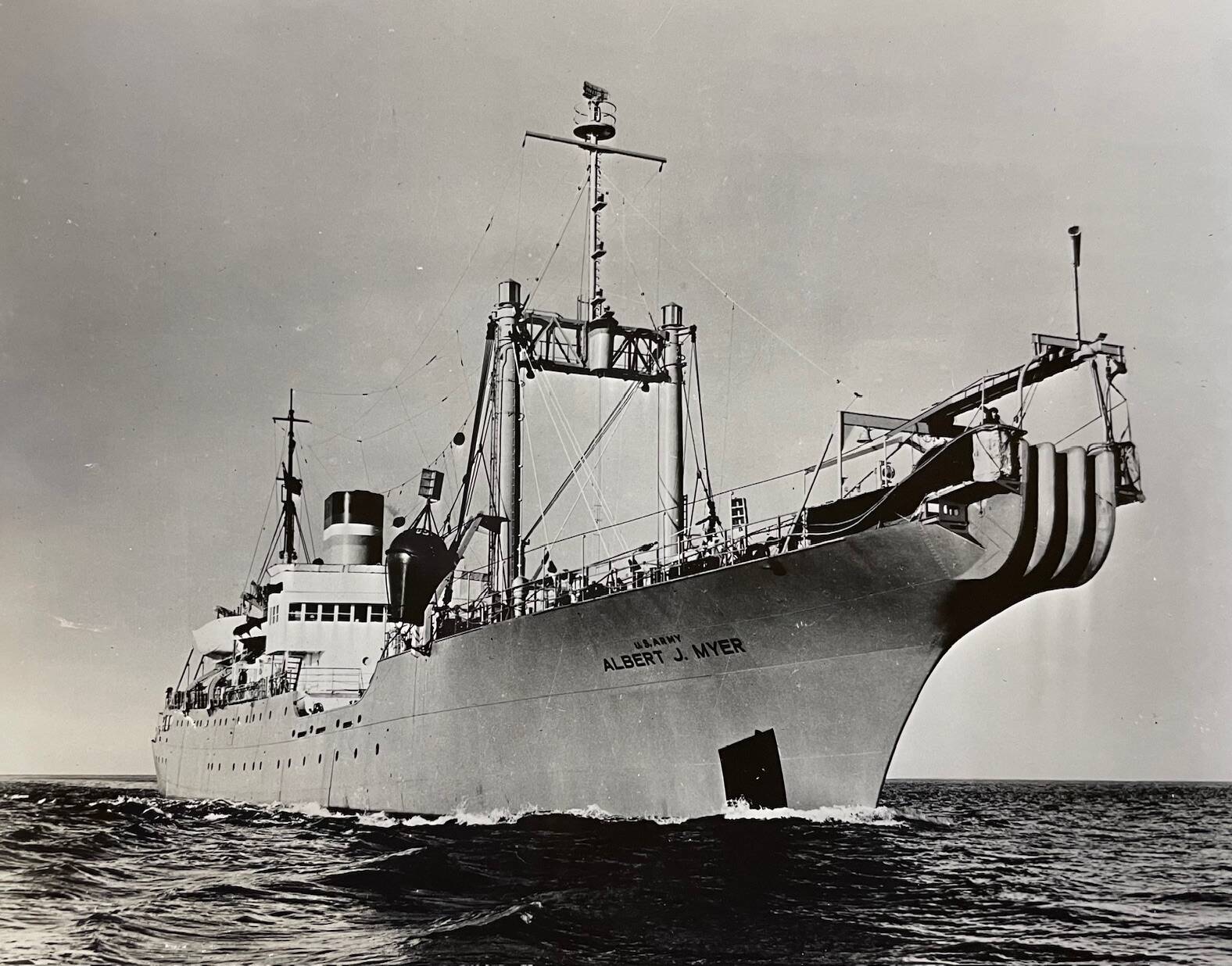
The U.S. Army cableship Albert J. Myer in 1956 with its specialized bow track for spooling out telecommunications cables. The ship was named after an assistant Army surgeon who in 1860 developed a system of flag signaling to communicate messages. It became the military’s Signal Corps, as stated in the Congressional Record testimony of Alaska Delegate Bob Bartlett in 1948. (PCA-64-1895)
Simultaneously, icy and mountainous Southeast Alaska was linked with an undersea cable laid in 1903-04 from Seattle to Sitka and Juneau, then on to Skagway where a land connection could be made via Canada to the Lower 48 states. Shortly thereafter, however, Congress decided it preferred an all-Alaska route to avoid passing military messages through a foreign country. More funding was given to develop a spider web network without using neighbors to the east.
Throughout its 124-year history Alaska communications have steadily evolved more efficient methods. By 1907, the army started to replace wires with radio antennas that sent wireless electronic signals through the air. That had a 500-mile limit so relay stations were added to forward messages beyond. Thus was born the Washington-Alaska Military Cable and Telegraph System, known as “WAMCATS.”

An unusual artifact of KTOO’s former antenna atop the Hurff A. Saunders Federal Building before all operations were coalesced into the building at the intersection of Whittier Street and Egan Drive. (Laurie Craig / Juneau Empire)
During World War II Alaska’s role in national defense rose to sudden prominence. Unbeknownst to many Americans even today, Japanese forces occupied several Aleutian Islands after the attack on Pearl Harbor. The U.S. realized Alaska’s vulnerability to foreign invasion and its vital supply line opportunity. In 1942 during an incredible eight-month period the U.S. military built the “ALCAN” Highway which connected Canada’s road system to interior Alaska. Alongside road access, telegraph lines — often needing tripods to stiffen the poles against freezing ice loads on the wires — stretched 1,570 miles from Dawson Creek, British Columbia — to Delta Junction and Fairbanks. The railroad linked Anchorage and Fairbanks. Transportation and communication networks allowed supplies, information and personnel to mobilize into remote sites.
After the war concluded and the Japanese military departed, the new era of the Cold War created additional nervous concerns about Alaska’s proximity to Russia, a mere 50 miles’ separation across the Bering Strait. Defense needs expanded. Communications advanced to include a new system in 1955 that bounced signals off the Earth’s atmospheric level called the troposphere. Huge antennas — described as looking like outdoor drive-in movie screens — were erected across Alaska under nicknames of White Alice and the DEW Line. First letters of the words “Alaska Integrated Communications Extension” created the name “Alice” and “White” was added to signify snow. “Distant Early Warning” system became the DEW line along the Arctic coast.
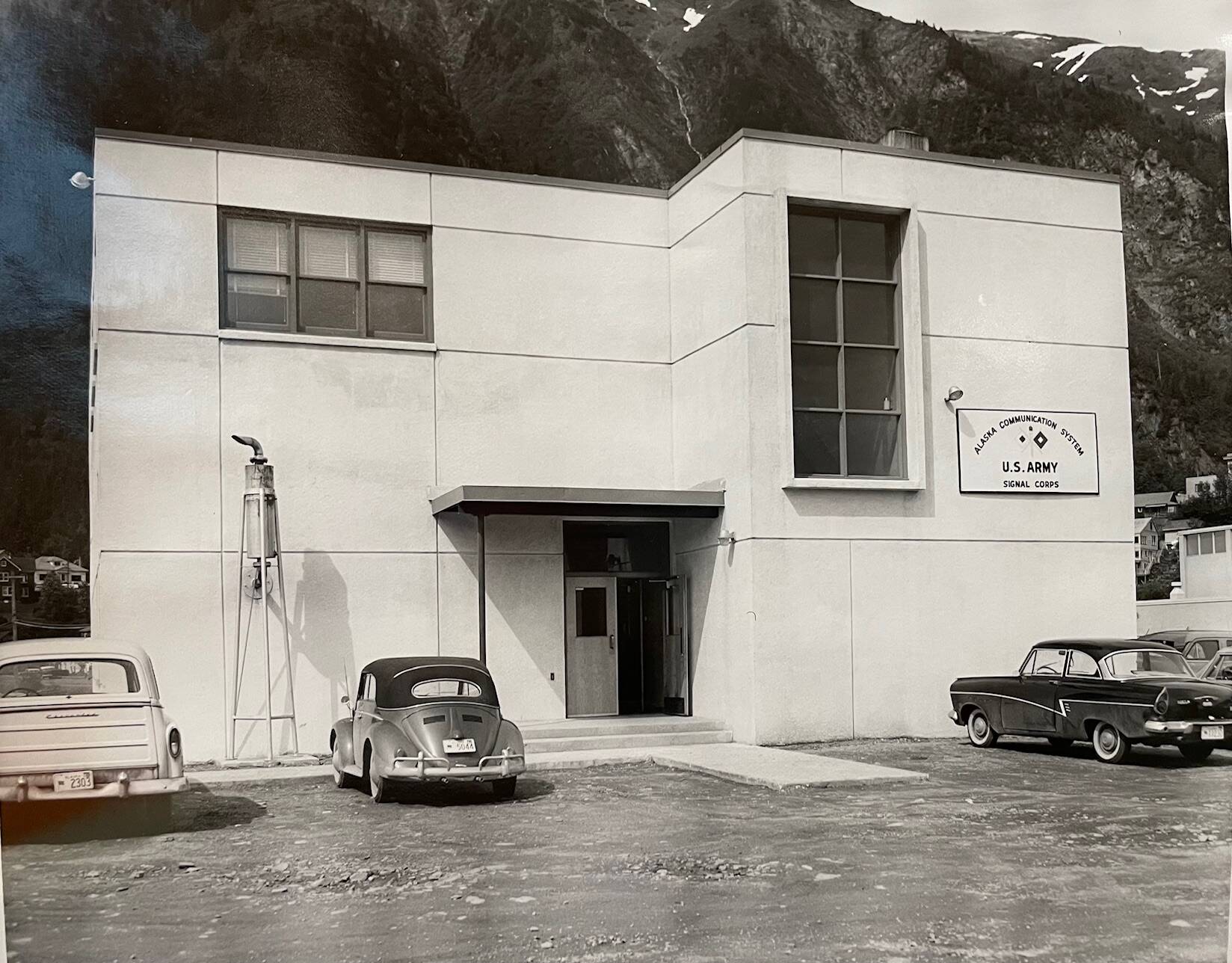
An undated (but likely early 1960s) photo of the Army’s Signal Corps building that housed communications equipment used for ship-to-shore radio transmissions on the ground floor and for operator-assisted long distance telephone service on the second floor. (Alaska State Library Collection PCA-64-1348)
As systems became more sophisticated the army divested the signal corps to the Air Force. Then into the 1960s the federal government wanted to get out of the public communications business. The Alaska Communication System was put up for sale. After a protracted few years of conflicting opinions, the military entity was no longer needed and was sold for $28 million in August of 1969 to a Radio Corporation of America entity called RCA Global Inc.
One giant leap for broadcasting in Juneau
A month earlier, in July of 1969, Alaskans witnessed their first live television broadcast by special programming when astronaut Neil Armstrong walked on the moon. Usually, at that time, television shows arrived in a can of taped film for broadcast often three weeks after airing Outside.
Satellite communications were the eventual next step. Some Juneauites recall telephone calls initially made via satellite had annoying echoes. It was a bumpy start. Today 49th state residents know ACS — Alaska Communications System — as a privately owned company that provides business and residential telephone, cell, internet and WiFi service via cable or satellite. For most of the 20th century, ACS was the official government communications network with the same name.
Meanwhile, Juneau’s cable communications system was operated from Lena Point and downtown Juneau and eventually in the building KTOO operates from today. It was constructed in 1959 and was known as the RCA or ALASCOM building.
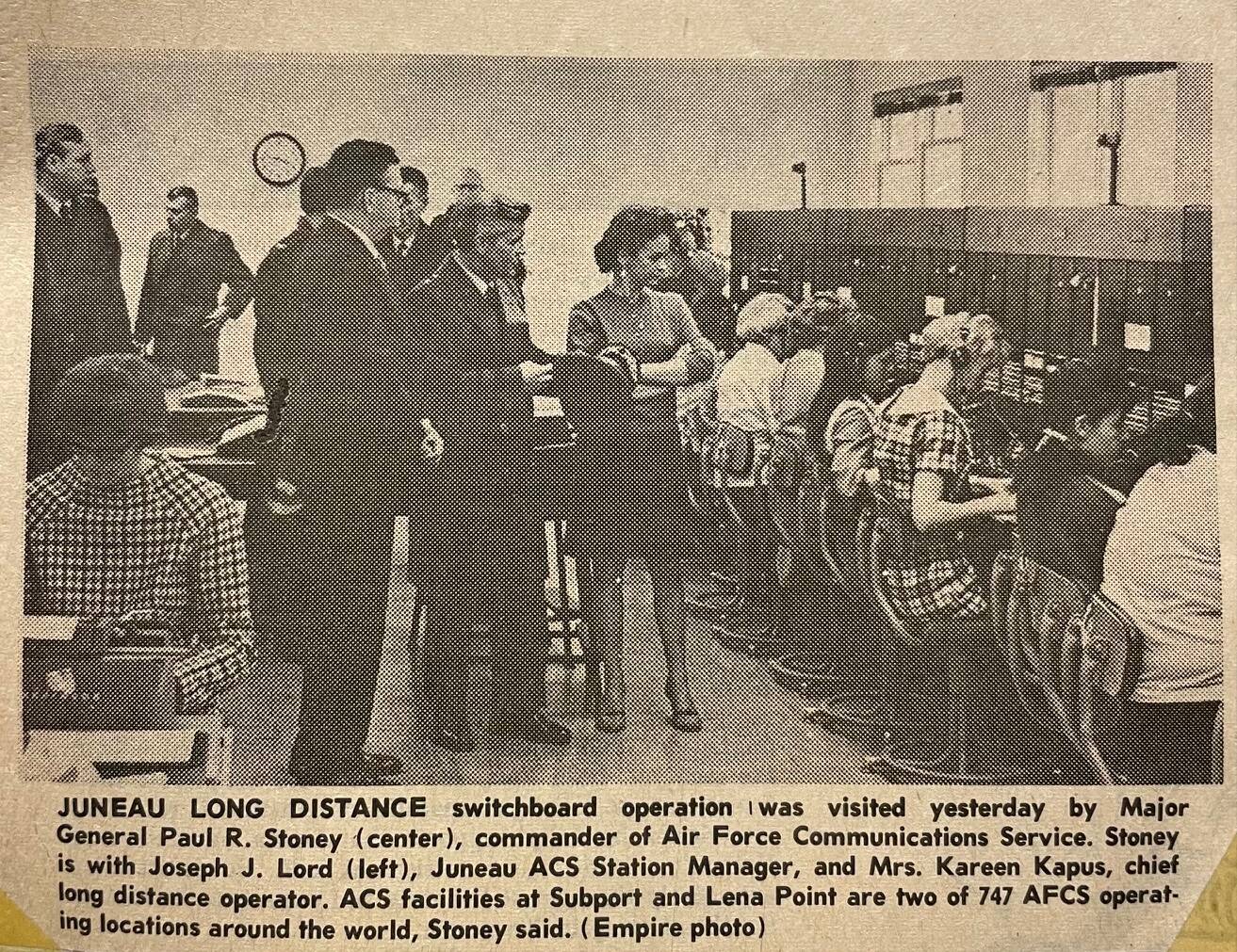
A yellowed February 1970 Southeast Alaska Empire news clipping showing Juneau women as long-distance telephone operators at their switchboards in the Alascom building. Direct dialing for long-distance calls had not been initiated yet. (PCA-64-Binder 1970)
Direct dialing to Outside locations had not yet been developed so long-distance operators, mostly women, worked switchboards on the second floor while radio men worked on the ground floor with marine radio systems created in 1947 for fishermen and other mariners.
Third-generation Alaskan and longtime Juneauite Kim Metcalfe was one of the long-distance operators in the ACS building.
“When I worked there (1966-1968),” said Metcalfe in an email this week, “they only hired women long-distance operators. Men were hired later. The downstairs area had a ship-to-shore radio facility” where only men worked.
“The job was under the U.S. Air Force and I remember having to be fingerprinted as part of the application process,” she added.
KTOO debuts in donated building, celebrates 50th year in state-of-the-art studios
KTOO, Juneau’s public broadcasting radio and television station went on the air on Jan. 27, 1974. It moved into the present building in 1995 from its previous location on Fourth Street where Rainbow Foods is currently located. Alascom donated the building to KTOO, according to retired KTOO general manager Bill Legere, but major updating was needed for the building to support advanced communications systems. Design work was provided locally.
Architect Wayne Jensen, writing in an email on Wednesday, said his firm — in 1959 called Foss, Olsen and Sands — designed the original building which was called the Toll and Operations Building. It was owned by Signal Building, Inc.
“In 1972 the east portion was added as the ‘Juneau Toll Building Addition’ for R.C.A. Communications,” Jensen wrote of his architectural firm’s work. His company, under a variety of names, “has been involved with several remodels of the building,” he said. That includes new soundproof radio and TV studios and an elevator.
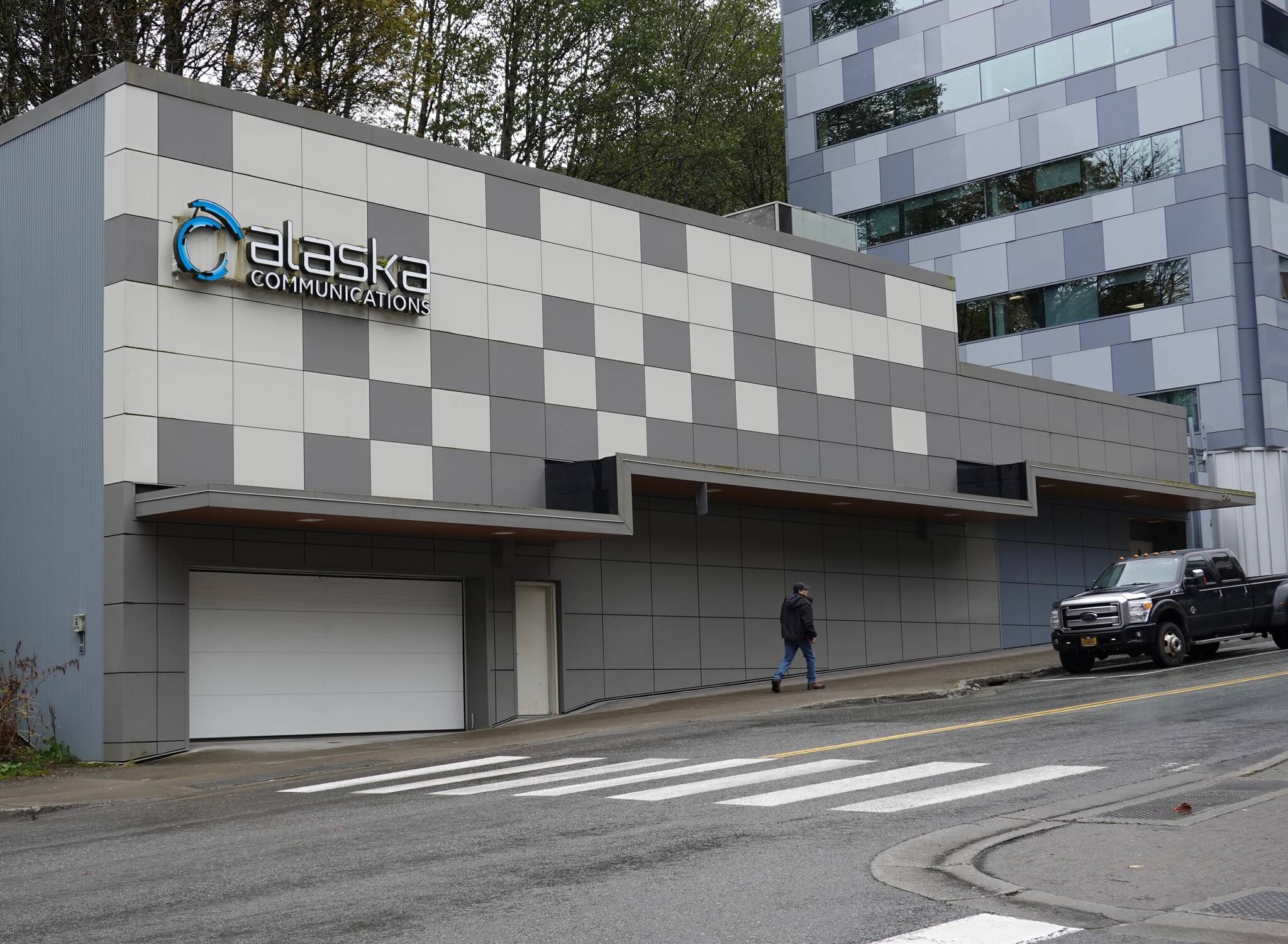
A man walks past the building housing private telecom company ACS on Main Street in downtown Juneau on Monday, Oct. 7, 2024. (Laurie Craig / Juneau Empire)
Newest system updates include digital connections for 40 small video cameras installed in the Alaska State Capitol to provide Alaskans with live and recorded legislative hearings and events.
Telecommunications have come a long way since the first marine cable was laid from Seattle to Juneau in the early 1900s. What was once a luxury is now essential. Author Heather Hudson, in her 2015 book “Connecting Alaskans, Telecommunications in Alaska from Telegraph to Broadband,” stated the value well:
“Today, distance learning over the internet extends educational opportunities to isolated communities, village entrepreneurs market crafts and ecotourism over the Internet, and rural businesses from commercial fishing to mining to retail stores manage their logistics, banking and payroll online,” Hudson wrote.
That’s why a recent visitor to the remote Southeast Alaska village of Kake can purchase a hot coffee from a barista there and use a credit card with the small business’s point-of-sale device connected by Starlink to global banking systems.
• Contact Laurie Craig at laurie.craig@juneauempire.com.
