
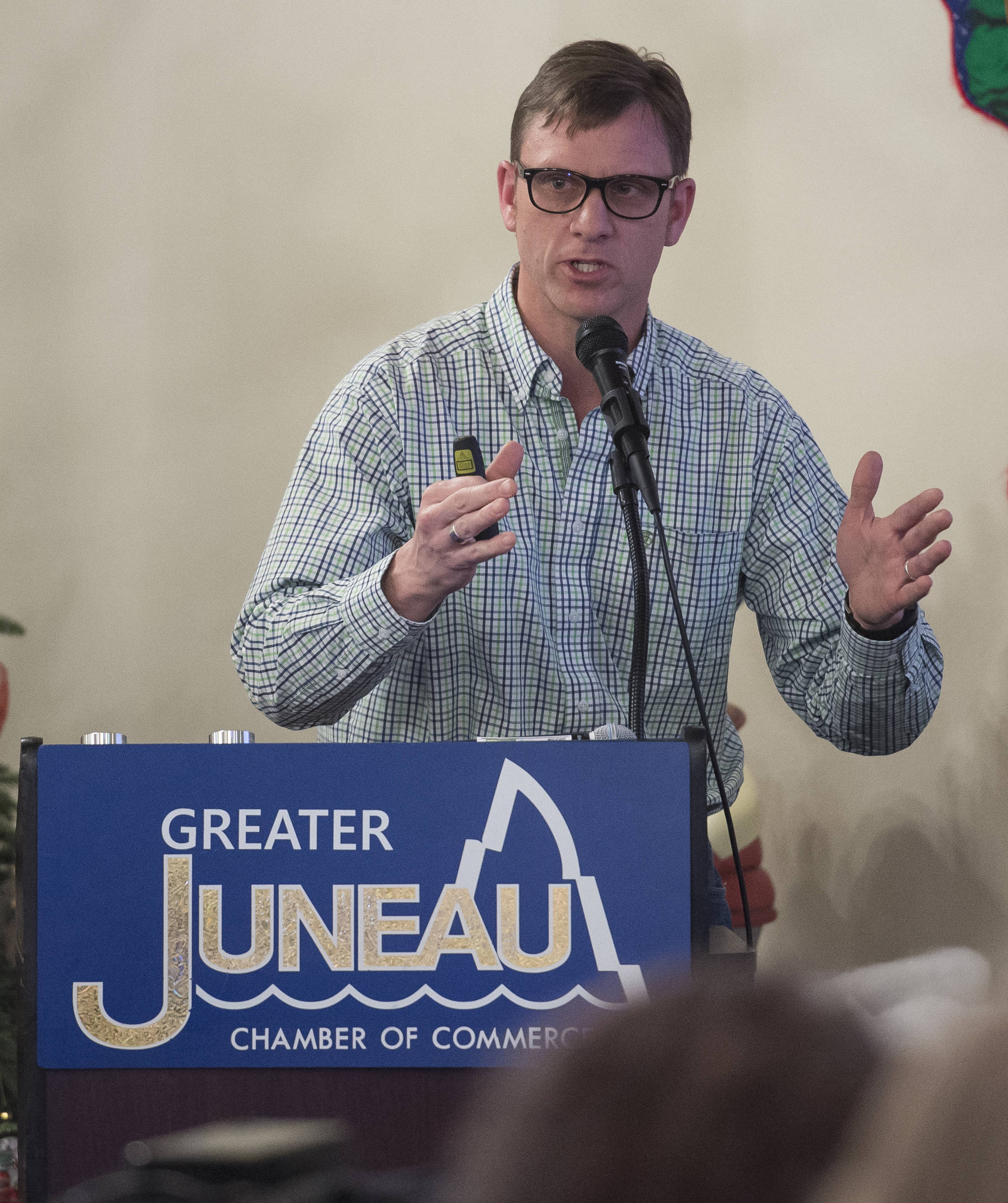
Kensington gold mine General Manager Mark Kiessling has a few statistics he’s optimistic about. The underground mine has milled three times more ore in 2016 than 2010, their first year of mining. Safety incident rates are down and cost efficiency has improved, Kiessling said at a Thursday Juneau Chamber of Commerce luncheon.
Seven years in the mine is hitting its stride, Kiessling said under holiday decorations and in front of a packed house at the Juneau Moose Lodge. Recovered ounces have increased year over year from just over 40,000 in 2010 to around 124,000 in 2016, he said.
The mine has also improved its cost efficiency. It cost Kensington around $900 to produce an ounce of gold when it opened. Now, it costs around $800, a number much closer to industry standard.
“In 2013, Kensington was in the top 75 percent of high-cost gold producers. That’s bad, you don’t want to be up in this part of the graph,” Kiessling explained, pointing to a powerpoint presentation. “Today, we’re between 25 and 50 percent, so we’re getting ourselves down into the low-cost producers, and that’s where we need to keep driving ourselves to be.
The mine currently has enough resources to keep them in operation through 2023, but they hope to stay longer. They’re currently conducting exploratory drilling to prove the existence of additional ore in their two existing Kensington and Raven ore bodies as well as a third, as-yet-untouched ore body Kiessling referred to as “Jualin.” The mine currently working on a plan to add space to their tailings facilities to accommodate further production. They hope to have those requests filed next year.
Recruiting and retaining qualified miners, mechanics and technicians remains challenging. Kensington currently employs 367 people, 240 of whom are Alaskans. Kiessling said they project an uptick in employment next year to “just under 400” if mining economics remain the same. They’re currently getting most of their new recruits from out of state.
Kiessling said efforts to train miners locally through the University of Alaska Southeast Center for Mine Training program have been successful, but retaining miners has been an issue. Kensington switched to hair follicle drug and alcohol screening last year. Hair follicle testing can detect drug and alcohol use much longer than urine testing. The move was expensive — hair follicle testing is costly — and the move led to some miners leaving Kensington.
“We took a hard stand on drug and alcohol last year and we’ve improved our workforce,” Kiessling said. “We lost some good miners because we went to hair follicle testing, but you know what, they’re not going to be good miners for us if they can’t be clean. That’s one of our struggles here locally.”
Simply retaining people to work in the demanding industry is another issue. Finding qualified mechanics is particularly difficult, Kiessling said. But that said, Kiessling reported that they have a “good core” of highly-experienced miners which will allow Kensington to take on less-experienced workers in years to come.
“I wouldn’t say we’re getting all our miners from down south, but quite a few of them are,” Kiessling said. “What we’re struggling with, even in that program, is finding people that actually want to stay working at Kensington and stay working in the mining industry. After they come out and they get that class, they may take a look at things and say ‘Hey, maybe this is not for me.’”
The miners who do stay on to the mine’s now company-wide two weeks on, two weeks off schedule are getting hurt less. Kensington averaged 2.5 injuries per 100 employees in 2010. It now averages 1 injury per 100 employees. Kiessling said he would like to get this number to zero.
Correction: This article originally stated that Kensington Mine had 2.5 safety incidents per month in 2010 and 1 per month in 2016. Those statistics are actually calculated yearly for injuries per 100 employees: Kensington Mine had 2.5 injuries per 100 employees in the entire year of 2010 and 1 injury per 100 employees in 2016. Additionally, an ore body was originally spelled “Joellen,” while the correct spelling is “Jualin.”
• Contact reporter Kevin Gullufsen at kevin.gullufsen@juneauempire.com or 523-2228.
