Update: Legislature passes budget with minutes to spare
Published 10:30 pm Tuesday, May 17, 2022


This story has been updated to include new information.
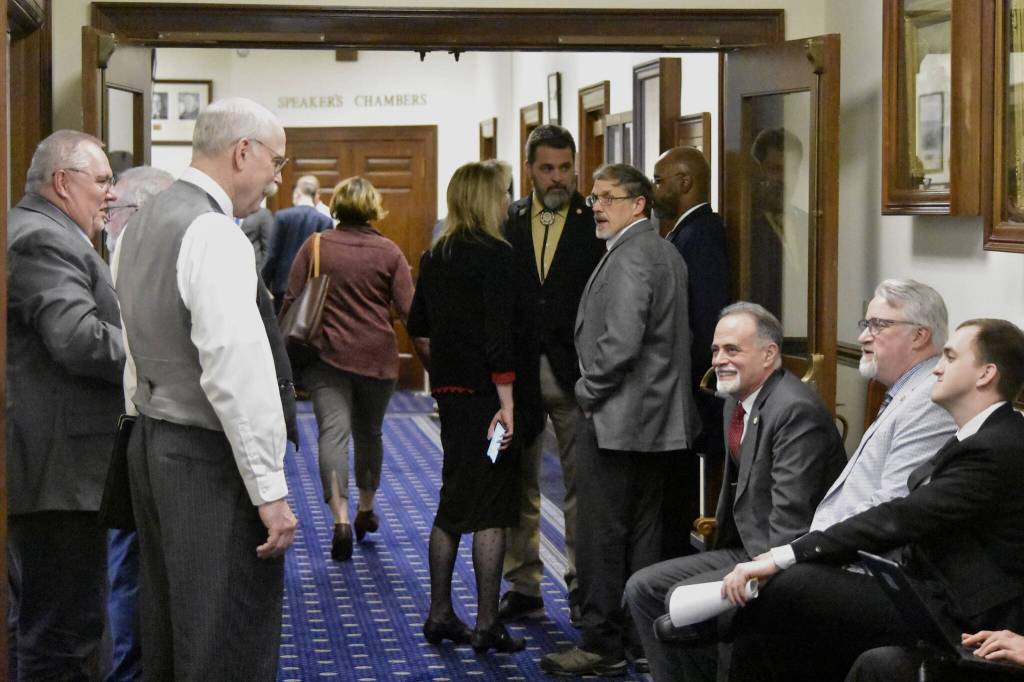
The Alaska State Legislature passed the state’s budget bill Wednesday evening, less than a half-hour before the midnight deadline.
The Alaska Senate approved of a final version of the budget Wednesday afternoon, but it took the House of Representatives until past 11:30 p.m. before all elements of the budget were passed.
After House members failed to concur on a budget passed by the Senate last week, the state’s final budget bill has been under negotiations by a bicameral budget committee of six lawmakers, three from each body. The conference committee finished its work Tuesday afternoon, and the budget was taken up by the Senate Wednesday.
In the House
House members overwhelmingly passed the budget as well, in a vote following very little debate over the conference committee report. The only members to speak against the bill were Eastman and Kurka.
“This is the biggest budget in state history,” Kurka said.
House members approved the bill 33-7, with Republican Reps. David Eastman, Wasilla; DeLena Johnson, Palmer; Chris Kurka, Wasilla; Kevin McCabe, Big Lake; George Rauscher, Sutton; Cathy Tilton, Wasilla and Sara Vance, Homer, voting against the bill.
But House members failed to approve the transfer from the CBR, meaning Alaskans will receive roughly $3,150 from the state, $2,500 in a PFD and $650 in an energy relief payment. A vote to approve money from the CBR requires three-fourths of each body, and House members voted 29-11 — one vote short of the threshold — in favor of the payments.
Voting against the CBR draw were Reps. Matt Claman, D-Anchorage; Harriet Drummond, D-Anchorage; Bryce Edgmon, I-Dillingham; Grier Hopkins, D-Fairbanks; Andy Josephson, D-Anchorage; Jonathan Kreiss-Tomkins, D-Sitka; Dan Ortiz, I-Ketchikan; Calvin Schrage, I-Anchorage; Andi Story, D-Juneau; Adam Wool, D-Fairbanks and Tiffany Zulkowsky, D-Bethel.
Immediately following the CBR vote just before 11 p.m, House Speaker Louise Stutes, R-Kodiak, recessed the House to the call of the chair, but called members back shortly after for a vote on the effective date clause, which was passed 30-10.
In the Senate
Senators passed the budget 19-1, with only Sen. Lora Reinbold, R-Eagle River, voting against it.
Senators from both parties said the bill reflected a spirit of compromise, and while it is a large budget, it contained funding for desperately needed infrastructure projects throughout the state.
The final versions of the combined operating and capital budget bill and the mental health budget bill contained roughly $17.8 billion in total spending, Senate Finance Committee co-chair and member of the conference committee Bert Stedman, R-Sitka, said on the floor.
Of that nearly $17.8 billion, Stedman said $9.5 billion came from the state’s unrestricted general fund; $972 million from the designated general fund and $5.4 billion in federal spending. The state’s operating budget, according to Stedman, was roughly $13.4 billion — with $7 billion UGF spending — while the capital budget was $3.7 billion with $1.1 billion in UGF funds.
[Committee compromises on PFD in budget plan]
The Senate’s initial budget bill contained a provision for a Permanent Fund dividend based on the state’s statutory formula, set in law but not followed by lawmakers since 2016, following a drop in the price of oil. In addition to that payment, which would have been roughly $4,200, Senators also approved an energy relief payment of $1,300, for a total of $5,500 to each Alaskan.
But lawmakers in both bodies were critical of that plan, which they said relied too heavily on the price of oil remaining high. The conference committee lowered the PFD payment to $2,500, a so-called 50-50 payment, based on taking half of the state’s annual percent of market value draw from the Alaska Permanent Fund. But the committee also approved a $1,300 energy relief payment, which Stedman said will likely be paid along with the PFD for a single payment of roughly $3,850 to each eligible Alaskan.
However, the committee split the fund sources of the energy payment, drawing half from the Constitutional Budget Reserve, which requires a three-quarter vote in each body. Senators voted to fund the full payment from the CBR in a vote of 15-5 with Sens. Click Bishop, R-Fairbanks; Lyman Hoffman, D-Bethel; Reinbold; Stedman and Natasha von Imhof, R-Anchorage, voting against drawing from the CBR.
Following the vote, Stedman said the 50-50 PFD was not sustainable, and his vote reflected a desire to keep money in the state’s savings account for when the price of oil inevitably drops. Lawmakers have been deeply divided over the amount of the PFD, but little progress has been made on agreeing to a new formula.
Many lawmakers who’ve advocated for a statutory PFD in the past have compromised on the 50-50 plan, saying the formula should be put in the Alaska State Constitution to ensure payments remain steady. But Stedman and other members of the Senate Finance Committee have noted a 50-50 payment is not sustainable without roughly $800 million in new revenues or cuts to the state’s budget.
It was because the state hadn’t cut enough from its budget that Reinbold said she couldn’t support the budget.
“Meaningful budget cuts are missing, in particular (the Department of) Health and Social Services,” Reinbold said. “The bottom line is (the budget) is not following the statute, it’s basically a billion dollars out of the pockets of Alaskans.”
But other lawmakers who advocate for a full PFD said the bill had a sizable dividend and funding for issues critical to Alaskans.
“I want the statutory dividend,” said Sen. Mike Shower, R-Wasilla, “Sometimes you don’t always get what you want, but I can’t vote no on something that is so close to a statutory dividend.”
Once passed by both bodies, the budget will go to the governor who has the power to veto line items within the budget.
Dunleavy issued a statement Wednesday evening, thanking members of the Senate for approving a large dividend and urging House members to approve the budget.
“It is my hope, and that of thousands of Alaskans who are currently discussing their own household budgets, that the House votes to concur with the Senate and pass one of the largest PFDs in state history,” Dunleavy said.
According to the Alaska Department of Revenue, the largest dividend in state history was in 2008 at $2,069.
• Contact reporter Peter Segall at psegall@juneauempire.com. Follow him on Twitter at @SegallJnuEmpire.