
Some Alaskans are envisioning a future that’s at least as much about seaweed sodas and electric buses as oil drilling — but unlike many “greenies” they’re envisioning the economic gains as well as the environmental ones.
A wealth of possibilities were discussed including micronuclear power, critical minerals mining, investing in carbon markets and adaptable food production during the three-day Alaska Sustainable Energy Conference in Anchorage that ended Thursday. The three-day conference, now in its second year, was hosted by Gov. Mike Dunleavy, who signed a pair of bills seeking to achieve different sustainable industry goals at the beginning and the end of the gathering that featured about 800 participants.
Dunleavy, mindful of criticisms by some people alleging environmental restrictions harm economic opportunities, emphasized repeated during the conference legislation he signed and the proposals he backs are not ESG (Environmental, Social and Governance) measures. But many participants at the conference emphasized they’re hoping both humans and nature will be appreciative of the potential and results of the sustainable industry research and activities now occurring.
Among the presenters was Katie Koester, Juneau’s public works director, who during a panel discussion about “decarbonizing ground transportation” said during the past decade there has been 28% reduction in greenhouse gas emissions due largely to local-level policies enacted.
“How did we meet that goal?” she said. “I’m not really sure, but transportation and energy efficiency improvements have definitely been a part of that.”
One action she particularly focused on as a learning experience for other conference attendees was the city obtaining and putting into service its first electric bus in 2021. Plenty of skeptics question the actual environmental benefit of electric vehicles since some type of facility has to generate power for them — perhaps by burning fuel or coal — but Koester said Juneau’s e-vehicles are truly zero-emissions because of local hydropower generators.
“I’d say we’re in the beginning of our path, but we have a lot of milestones to complete in our future,” she said.
The first bus has gone through myriad problems, Koester acknowledged. Fenders didn’t work properly in slushy conditions, range was shorter than advertised (much shorter during cold weather) and it was difficult for city mechanics because it was purchased from a different company than the traditional buses.
Each of those is now being solved with a mixture of creativity and logic — making fenders from horse hair, rearranging shifts to allow a “top-off” battery charge during the day and e-buses with the desired features now being offered by the traditional engine company, she said.
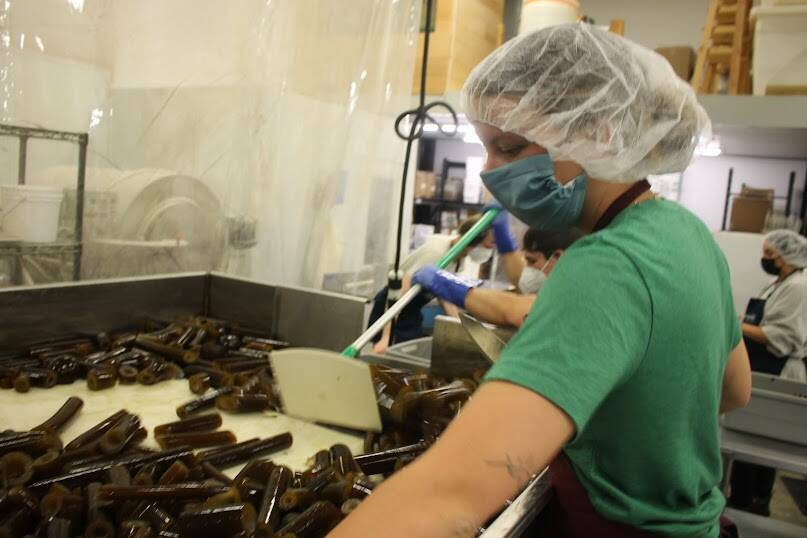
Creativity and scholarship in many forms were also the emphasis of panels addressing issues such as sustainable agriculture and mariculture. Five experts in the latter field ranging from science researchers to industrial analysts spent an hour discussing the vast range of possibilities of kelp and seaweed, suggesting it can do everything from absorbing carbon (which can then be sold to soda companies for carbonization) to being transformed into products such as cosmetics and a replacement for plastics.
“This is one of the reasons carbon removal will one of the biggest industries by 2050,” said Sophie Chu, principal oceanographer for Captura, a California-based company specializing in carbon removal projects.
Many conference participants cited Alaska as a potential leader among U.S. states in many sustainable industry projects, due both to its vast natural area and currently receptive political environment. While Dunleavy and other political leaders are continuing to aggressively pursue new oil and gas drilling projects, they are also increasingly turning to other potential sources of long-term revenue as oil continues its decades-long overall production decline.
Simon Freeman, an advanced research projects director at the U.S. Department of Energy, told a panel discussion audience Alaska is likely to approach a seaweed farm project by “just putting something together in a backyard and throwing it in the ocean” a few times until a working model is achieved, as compared to a more formal and complex process elsewhere.
“Trial and error by making and breaking things seems to be one of those awesome ways to ensure you’re successful and that’s something that hasn’t been tried before,” he said.
• Contact Mark Sabbatini at mark.sabbatini@juneauempire.com.
