
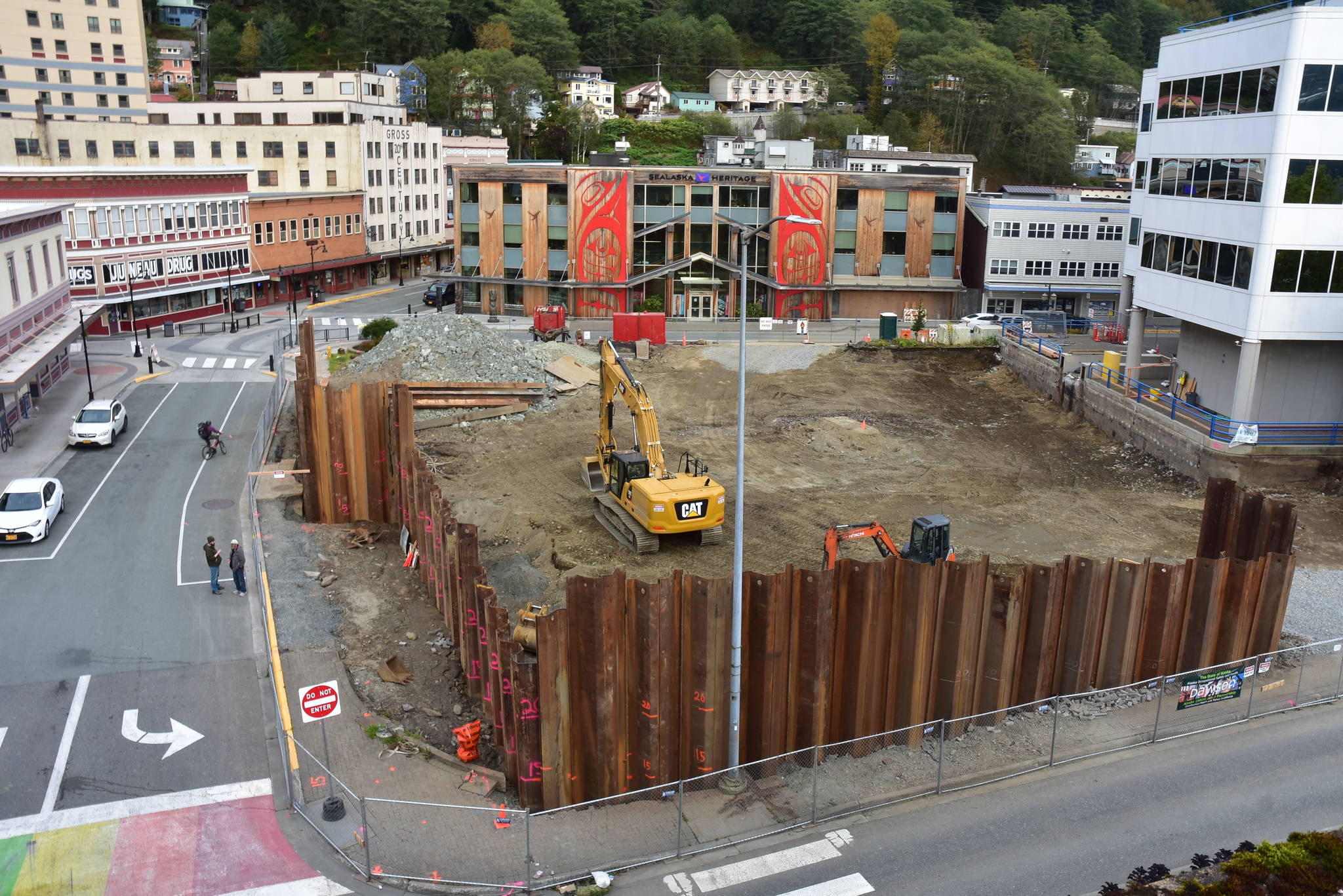
Unexpected contaminated soil means the in-progress Northwest Coast arts campus downtown needs city support soon to keep progressing, said the chief operating officer for the nonprofit creating the campus.
Lee Kadinger, COO for Sealaska Heritage Institute, said Wednesday during a City and Borough of Juneau Assembly Finance Committee meeting a $1.5 million grant being considered by the city is needed in the near future to cover additional expenses caused by the contaminated earth.
“Right now, with the significant added cost of the contamination, those dollars have to be spent today,” Kadinger said. “This is not something that can be put off until months from now. This is something that is impacting our community and is impacting Sealaska Heritage and this project today. I wish we were able to put it off. I wish we were able to put it off.”
An ordinance appropriating the funds will be introduced during an Oct. 26 meeting and a public hearing will be held on Nov. 23, following a motion by Deputy Mayor Maria Gladziszewski that passed unanimously.
In a phone interview Thursday, Kadinger said test results of soil samples at the site are just starting to return, but it appears some sort of fuel and — in one small, confined area — lead have contaminated the earth at the construction site.
“We’re getting our heads wrapped around, our hands wrapped around what volume we’re looking at,” Kadinger said.
He said the center of the site and the area of the site near the existing Sealaska parking garage seem to be clean, and contamination has only been detected 6 feet beneath street level.
However, workers will need to dig 12 feet down to reach the point at which the campus’ foundation can be poured, Kadinger said.
That could mean needing to dispose of several thousand tons of soil. How much that will cost and what sort of time that may add to the project will depend on how much and what sort of contamination additional testing reveals.
In the case of soil with lead contamination, Kadinger said containers will need to be ordered from the Lower 48, and the material would need to be sent away from Juneau.
Kadinger said during the meeting so far $11 million has been raised for the project that’s expected to cost about $13 million. In February, Sealaska Heritage asked the Assembly for a $1.5 million grant, but in May the nonprofit that preserves and perpetuates Southeast Alaska Native culture and art asked the city to delay consideration amid financial uncertainty created by the pandemic.
However, Kadinger said unexpected expenses mean full funding is needed soon to ensure the downtown arts campus does no run out of funding mid-project.
[Work begins at the Sealaska Heritage Arts Campus]
“If these funds are not provided in the near term, it will significantly impact the long term of the project,” Kadinger said. “Pretty much what would end up happening would be pausing everything in a big muddy, dirty contaminated hole for months.”
Assembly members generally spoke favorably of the project, which is projected to bring both construction jobs and long-term financial returns to Juneau. However, many voiced concerns about spending $1.5 million while facing an uncertain financial future.
Assembly member Carole Triem said when creating an acrostic poem based on her name in grade school, the R stood for “risk-averse,” and Assembly member Alicia Hughes-Skandijs said she falls near the “nervous Nelly” end of the risk-tolerance spectrum.
However, both Triem and Hughes-Skandijs said the project is a good one and something they support.
Assembly member Wade Bryson said he seeks out risk on the basis that the greater the risk, the greater the reward.
Bryson said Assembly members know a pandemic-weakened economy is likely, but investing in the project puts the city in a good position to realize a great return on investment.
“This is how we make investments in our community that will keep our economy moving forward and help take us out of the recession,” Bryson said.
[Construction continues at Sealaska Heritage Arts Campus]
Assembly member Rob Edwardson said if the city was offered a chance to invest $1.5 million to quickly attract $10 million of outside money, it would likely “jump at the chance.”
“This project has already brought in outside dollars, and it’s going to continue to bring in outside dollars for a modest investment in an organization that tends to succeed very big and very often,” Edwardson said.
• Contact Ben Hohenstatt at (907)308-4895 or bhohenstatt@juneauempire.com. Follow him on Twitter at @BenHohenstatt.
