
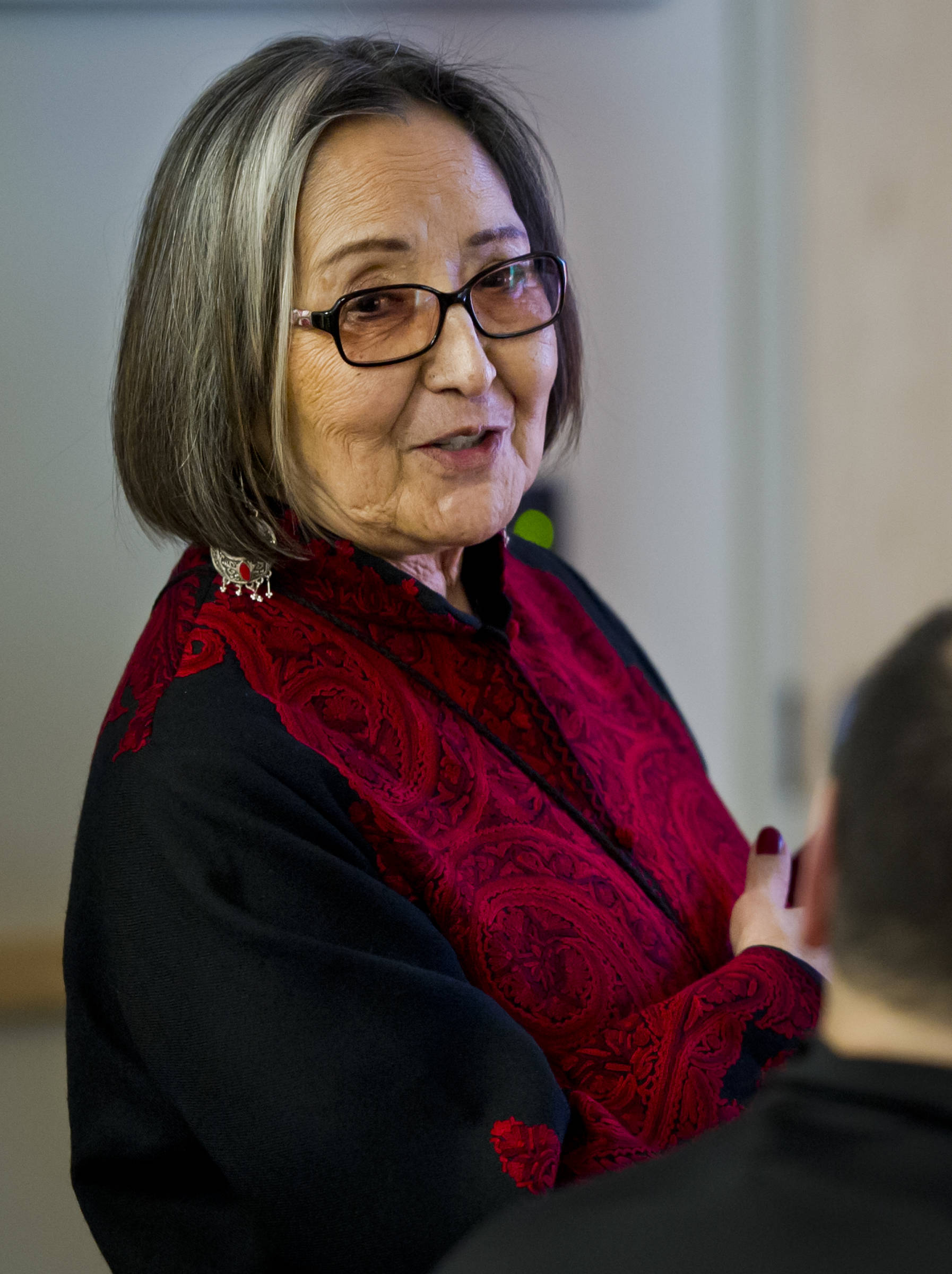
Dr. Rosita Worl, President of the Sealaska Heritage Institute, attends an event at the Walter Soboleff Center in November 2015. (Michael Penn | Juneau Empire File)

Dr. Rosita Worl, President of the Sealaska Heritage Institute, attends an event at the Walter Soboleff Center in November 2015. (Michael Penn | Juneau Empire File)

Sealaska announces Alaska Native language summit

Summit gathers fluent elders of Tlingit, Haida and Tsimshian for three-day event

Sealaska Heritage Institute on Thursday announced it will be hosting an Alaska Native language summit, geared toward fluent elders speakers of the Tlingit, Haida and Tsimshian languages.

There’s about 100 fluent remaining speakers of Lingít (Tlingit), Xaad Kíl (Haida) and Sm’algyax (Tsimshian), said a press release from SHI. The summit will be called “Voices of Our Ancestors.”

“When I was growing up, we heard (Alaska Native languages) all of the time,” Worl said. “I want our young children to have the benefit of hearing our people speak, laugh, joke in a Native language because most of them have been exposed to instructional Tlingit, Haida or Tsimshian and have not had the benefit of hearing a body of speakers. It’s for all that.”

The idea behind the summit is to have fluent Alaska Native elders converse with one another while allowing language students to observe the summit. SHI will videotape it for archival purposes.

Worl said the Alaska Native community always feels the loss when an elder dies and the loss of their knowledge, but this summit is not about mourning.

“It’s meant to be a moment of celebration that we still have speakers here. There are so many other tribes that don’t have any speakers and who are learning from documentation but we still have the benefit of having our speakers around, plus we have language learners who are doing just a great job and working on revitalization of our languages. So I don’t want it to be anything like a mourning. I want it more that we will be able to celebrate to hear the voices of our ancestors.”

Worl, who earlier penned a Letter to the Editor criticizing the separating of children from their families at the U.S./Mexico border, said the summit is especially relevant now. Public policy has an effect on culture and language, and people should be mindful of that, she said in an interview.

Videotaping the summit is a particularly important to record the social linguistics of these Native languages, she added. While there has been a great deal of study on the languages in terms of vocabulary and grammar, there hasn’t been much on how Native speakers communicate with their body, from hand movements, facial expressions and postures.

“A lot of us still do the hand movements, that you see done in our traditional languages, even the posture and the elevation of the voices when they’re doing oratory,” Worl said. “I can still hear one of the most significant oratory presentations from a ceremony held in Hoonah in the late ’60s. I could still hear it and I don’t know if a lot of people have had that chance. I think it will be an opportunity for younger generations to experience that.”

Invitations have been sent out to all known fluent speakers. The amount of those able to participate will be a determining factor for the Juneau location of the summit as well as the date, which is tentatively estimated to be sometime in late October or early November.


• Clara Miller is the editor of the Capital City Weekly. She can be reached at cmiller@capweek.com.


More in News

The northern lights are seen from the North Douglas launch ramp late Monday, Jan. 19. A magnetic storm caused unusually bright northern lights Monday evening and into Tuesday morning. (Chloe Anderson/Juneau Empire)
Rare geomagnetic storm causes powerful aurora display in Juneau

The northern lights were on full display Monday evening.

A tsunami is not expected after a 4.4-magnitude earthquake northwest of Anchorage Wednesday, Feb. 4, 2026. (U.S. Geological Survey)
No tsunami expected after 4.4-magnitude earthquake in Alaska

U.S. Geological Survey says 179 people reported feeling the earthquake.

ORCA Adaptive Snowsports Program staff member Izzy Barnwell shows a man how to use the bi-ski. (SAIL courtesy photo)
Adaptive snow sports demo slides to Eaglecrest

Southeast Alaska Independent Living will be hosting Learn to Adapt Day on Feb. 21.

Cars drive aboard the Alaska Marine Highway System ferry Hubbard on June 25, 2023, in Haines. (Photo by James Brooks)
Alaska’s ferry system could run out of funding this summer due to ‘federal chaos problem’

A shift in state funding could help, but a big gap likely remains unless a key federal grant is issued.

Photo by James Brooks/Alaska Beacon
U.S. Sen. Dan Sullivan stands with acting Coast Guard Commandant Adm. Kevin Lunday during the after the commissioning ceremony for the Coast Guard icebreaker Storis on Sunday, Aug. 10, 2025, in Juneau, Alaska.
Coast Guard’s new Juneau base may not be complete until 2029, commandant says

Top Coast Guard officer says he is considering whether to base four new icebreakers in Alaska.

Students from the Tlingit Culture Language and Literacy program at Harborview Elementary School dance in front of elders during a program meeting in 2023. (Clarise Larson / Juneau Empire file photo)
Sealaska adds more free Tlingit language courses

The new course is one of many Tlingit language courses offered for free throughout the community.

teaser
New Juneau exhibition explores art as a function of cultural continuity

“Gestures of Our Rebel Bodies” will remain on display at Aan Hít through May.

teaser
Juneau protestors urge lawmakers to defund Homeland Security after Minneapolis killings

Hundreds gathered hours before congressional delegation voted on whether to extend ICE funding.

Kyle Khaayák'w Worl competes in the two-foot high kick at the 2020 Traditional Games. (Courtesy Photo / Sealaska Heritage Institute)
Registration opens for 2026 Traditional Games in Juneau

The ninth annual event will feature a college and career fair and international guest athletes.

Most Read