
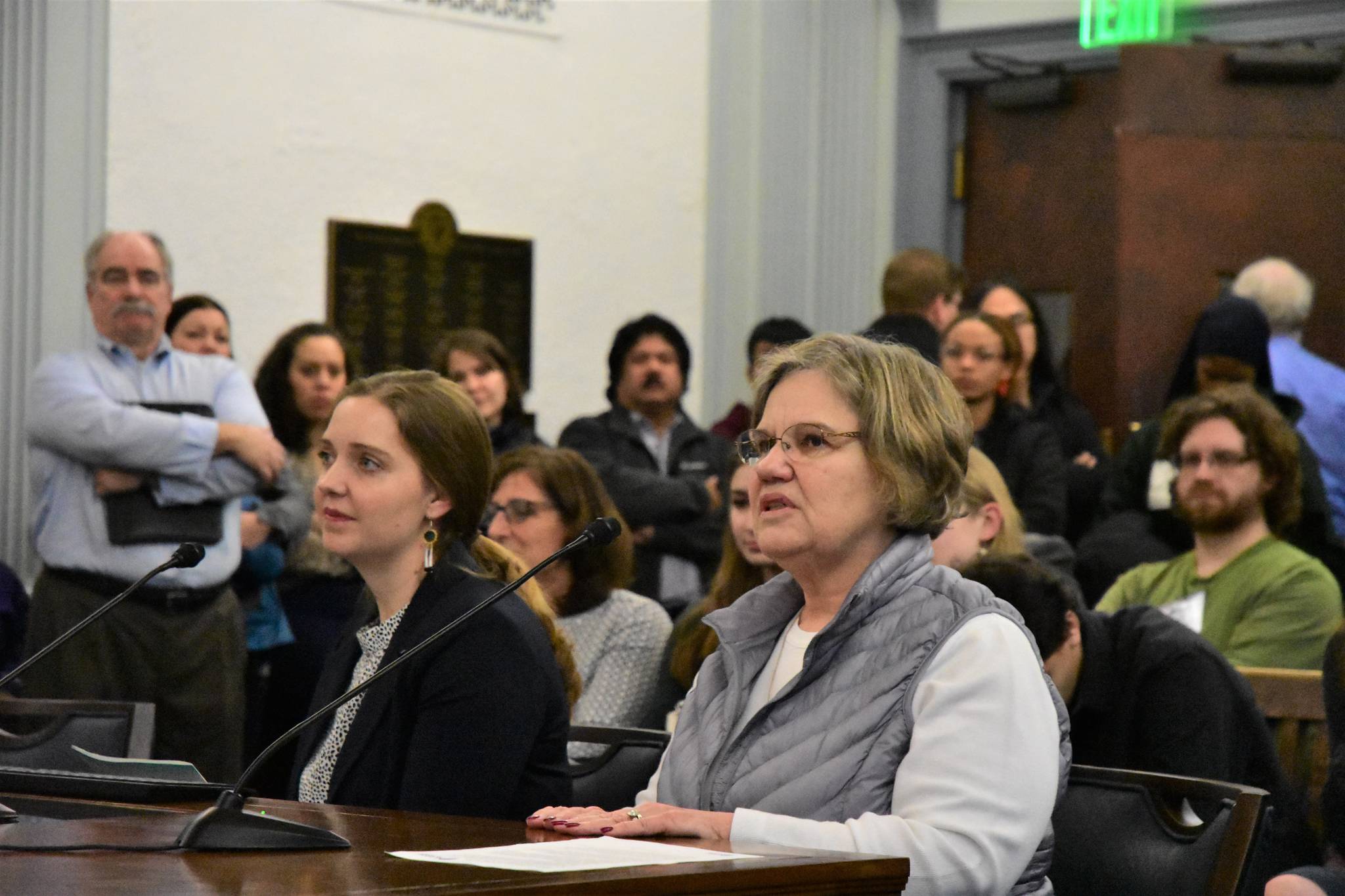
School representatives from around the state were at the Capitol Monday, meeting with lawmakers about the challenges schools face in their home districts.
“There’s so many different areas that involve education, not just the schools,” said Judy Carstens from the Board of Education for the Kodiak Island Borough School District. “It’s a group effort.”
Carstens and other school board members were in Juneau as part of the Alaska Association of School Boards’ Legislative Fly-in. The AASB holds fly-ins twice during the session to allow school board members to express their concerns directly to legislators.
One of the biggest issues Carstens said affected her district was teacher retention. Many teachers couldn’t afford the cost of living and in her words, “they just can’t succeed.”
Carstens colleague Katie Oliver, also with the Kodiak Island School Board, said 40% of the district’s teaching staff was non-tenured, meaning they had been with the district for less than four years.
“Alaska’s retirement system isn’t what it used to be. It makes it harder for teachers in Alaska to see their service in Alaska as a career service,” Oliver said. “Particularly with a nationwide teaching shortage, there are opportunities elsewhere.”
During the meeting, Carstens told the committee that several additional responsibilities had been placed on teachers without commensurate training or pay.
Sen. Peter Micciche, R-Soldatna, asked if there were exit surveys where leaving teachers were polled as to why they left.
“Give us some funding to do so,” someone said from the audience in response to his question.
Kay Andrews from the Southwest Region School District Board of Education told the committee that while the board supports the Legislature’s attempts to help Alaska’s schools, there were still concerns about overburdening teachers.
In reference to Senate Bill 6, the Alaska Reads Act, she said the board supports the legislation but wonders if the bill is too broad. SB 6 would set standards for reading and help districts pay for early education programs to try and reach those goals.
“Reading and pre-K are animals in themselves,” Andrews said. “I don’t know if that’s right for Alaska.”
Andrews said in her district logistics alone pose serious challenges and costs. That included getting food to the communities but also parts and supplies to maintain the schools in the area. Her district also lacks housing, she said, making teacher retention all the more difficult.
“We just happen to be one of the lucky (school districts) in that we don’t have the highest turnover,” she said. “We have a good team but in the smaller sites it’s very challenging. You have teacher-principals, you have teachers teaching multiple grades, multiple levels of students.”
Having listened to school representatives, Sen. Tom Begich, D-Anchorage, called the state of Alaska’s public schools, “good but guarded.”
Begich sits on the education committee and is the main legislative sponsor of the Alaska Reads Act.
“Teachers are working overtime but under budget, they’re feeling the strain,” Begich said. School representatives were concerned about their deficits and school bond debt reimbursement.
“They’re going to bond if they have to and if they don’t have enough to make ends meet, they’re going to drain their cash reserves,” Begich said he heard for district representatives.
However, Begich did say he was hopeful the Legislature would vote to pay back school bonds this session. He even suggested that might be included in the governor’s supplemental budget for the 2020 fiscal year.
Yet there were still a number of issues faced by schools Begich said he did not anticipate on hearing.
“The ferry system and the impact the ferry system is having on the school systems,” Begich said was something he hadn’t fully considered. “It’s about food and food security. The intersection of those issues I hadn’t thought about.”
Despite the many issues faced by the state’s schools, Carstens said she felt the meetings with legislators had gone well.
“They’ve been very receptive to our questions and they’ve asked for more information. I feel that we have given some meat to the subject,” she said.
• Contact reporter Peter Segall at 523-2228 or psegall@juneauempire.com.
