
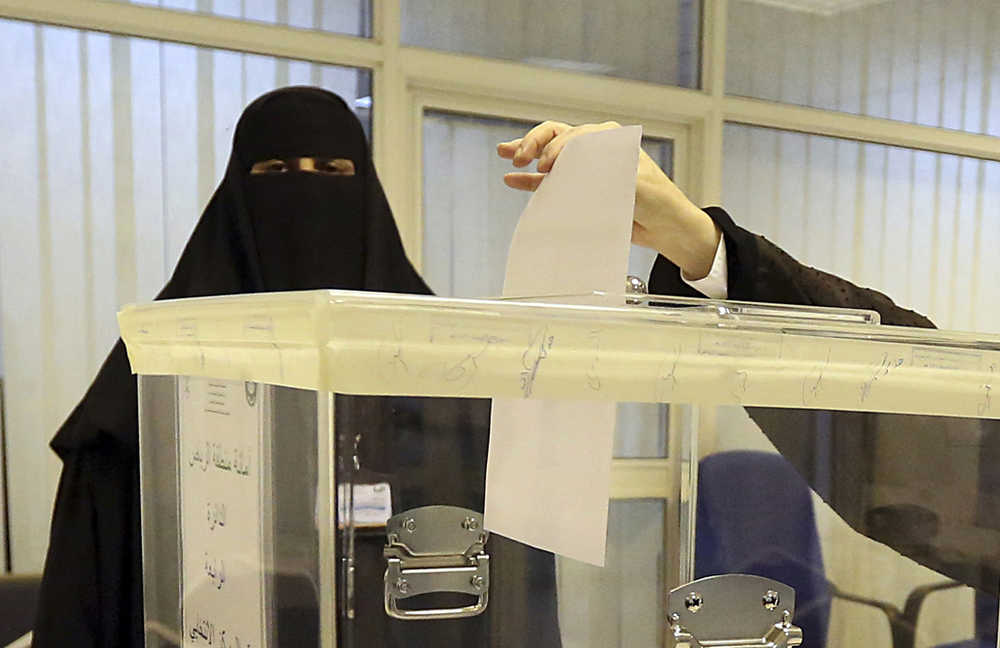
RIYADH, Saudi Arabia — Saudi voters elected 20 women for local government seats, according to results released to The Associated Press on Sunday, a day after women voted and ran in elections for the first time in the country’s history.
The women who won hail from vastly different parts of the country, ranging from Saudi Arabia’s largest city to a small village near Islam’s holiest site.
The 20 female candidates represent just one percent of the roughly 2,100 municipal council seats up for grabs, but even limited gains are seen as a step forward for women who had previously been completely shut out of elections. Women are still not allowed to drive and are governed by guardianship laws that give men final say over aspects of their lives like marriage, travel and higher education.
Though there are no quotas for female council members, an additional 1,050 seats are appointed with approval by the king who could use his powers to ensure more women are represented.
Around 7,000 candidates, among them 979 women, competed in the election for a seat on the municipal councils, which are the only government body elected by Saudi citizens. The two previous rounds of voting for the councils, in 2005 and 2011, were open to men only.
The conservative capital of Riyadh saw the most women candidates win, with four elected. The Eastern Province, where minority Shiites are concentrated, saw two women elected, said Hamad Al-Omar, who heads the General Election Commission’s media council.
Saudi Arabia’s second largest and most cosmopolitan city, Jiddah, also elected two women, as did one of the most conservative regions, Qassim.
The mayor of the city of Mecca, Osama al-Bar, told the AP that a woman won in a village called Madrakah, about 93 miles (150 kilometers) north of the city which houses the cube-shaped Kaaba to which Muslims around the world pray.
Another woman won in Medina, where the Prophet Muhammad’s first mosque was built.
Other women hailing from the kingdom’s northernmost areas won, with two elected in Tabuk, one in al-Jawf and another in Hail. Additionally, a woman won in Saudi Arabia’s southern border area of Jizan, another in Asir and two won in al-Ahsa.
Many women candidates ran on platforms that promised more nurseries to offer longer daycare hours for working mothers, the creation of youth community centers with sports and cultural activities, improved roads, better garbage collection and overall greener cities.
In October, the Saudi Gazette reported that harsh road conditions and long distances to the nearest hospital had forced some women in the village of Madrakah, where one female candidate was elected, to give birth in cars. The local newspaper reported that the closest hospital and the nearest university were in Mecca, prompting some students to forgo attending classes. The article said residents were also frustrated with the lack of parks in the village.
It is precisely these kinds of community issues that female candidates hope to address once elected to the municipal councils. The councils do not have legislative powers, but advise authorities and help oversee local budgets.
Most ran their campaigns online, using social media to get the word out, due to strict gender segregation rules that ban men and women from mixing in public. This meant candidates could not directly address voters of the opposite sex.
In an effort to create a more level playing field for women who wear the traditional full-face veil, the General Election Committee banned both male and female candidates from showing their faces in promotional flyers, billboards or online. They were also not allowed to appear on television.
Still, al-Omar said the historic election drew a staggering 106,000 female voters out of some 130,000 who’d registered. Out of 1.35 million men registered, almost 600,000 cast ballots. In total, some 47 percent of registered voters took part in Saturday’s election.
In Jiddah, three generations of women from the same family voted for the first time. The oldest woman in the family was 94-year-old Naela Mohammad Nasief. Her daughter, Sahar Hassan Nasief, said the experience marked “the beginning” of greater rights for women in Saudi Arabia.
“I walked in and said ‘I’ve have never seen this before. Only in the movies’,” the daughter said, referring to the ballot box. “It was a thrilling experience.”
