

For a 100-pound teenager to move the 40-foot-long trunk of a Western Hemlock that is ten times his weight, he must rig a series of pulley systems to gain mechanical leverage over the log by connecting it to several of the surrounding trees.
I watched with immense pride as KJ Santana, one of the students on my crew, worked the handle of the grip hoist, his back-and-forth motions mimicking that of an oarsman in a sleek rowing shell. But instead of propelling himself through water, Santana—a young man weighing just over 100 pounds—slowly dragged the half-ton Hemlock’s groaning trunk towards the bed of 7-Mile Creek, a mid-sized stream that feeds into Klawock Lake.
This watershed is a critical fish producing habitat for communities who depend on the rich, red flesh of salmon to thrive. Over the last century, the number of returning salmon has dwindled, from an estimated high of 65,000 sockeye in 1936, to an all-time low of 892 fish in 1983. The work in which Santana and his crewmates are engaged in is a part of a community effort to restore salmon rearing habitat that was damaged during historical logging.
Santana is one of five students on the 2022 Prince of Wales Alaska Youth Stewards crew. Founded in 2017 and originally referred to as TRAYLS (Training Rural Alaskan Youth Leaders & Students), AYS provides rural and Indigenous youth with opportunities to learn marketable skills and grow as leaders, while advancing community driven projects that span from trailwork and salmon stream restoration to gathering and processing wild foods for elders. AYS is region wide with active crews in Hoonah, Prince of Wales, Angoon and Kake. It is supported by the Central Council of Tlingit and Haida Indian Tribes of Alaska, the Sustainable Southeast Partnership, Spruce Root, the National Forest Foundation, Sealaska, the United States Forest Service, the Prince of Wales Vocational and Technical Education Center, Hoonah Indian Association, Chatham School District and various other program contributors.

AYS student Allison Mills operates a grip hoist at the 7 Mile Creek restoration project. (Courtesy Photo / Reuben Schafir)
As the crew lead for the Prince of Wales Alaska Youth Stewards team for two seasons, I have watched students overcome challenges, step into leadership, and radiate pride while working on projects that leave a positive impact for the communities that raised them. A core tenant of this program includes connecting youth stewards with healthy adult role models while exposing them to potential career pathways in their rural communities. For the Klawock Lake salmon restoration project, the crew worked alongside the Keex’ Kwaan Community Forest Partnership visiting from Kake, the Klawock Indigenous Stewards Forest Partnership, and scientists from the Juneau-based Southeast Alaska Watershed Coalition. The Klawock and Kake community forest initiatives encourage landscape level planning, data-informed decision making, cross-boundary management, local employment, and community capacity building on local lands and waters. Graduates from the AYS programs often find themselves working as part of community forest initiatives. Our collective goal on this particular project was to encourage 7-Mile Creek’s natural inclination to form the deep pools and areas of refuge around fallen logs that create critical habitat for spawning salmon.
The students on my crew are too young to know first-hand the connection between commercial clearcut logging and stream restoration work. Most of these clearcuts are from the timber heydays of the 1980s, when the region’s two pulp mills were fueled by commercial logging on the Tongass National Forest and on the lands of newly created Alaska Native corporations. Logging was the region’s primary economic activity. In those days, before stream buffers were put into place through the State of Alaska’s Forest Practices Act and the Tongass Timber Reform Act of the 1990s, logging operations went right up to the banks of salmon streams.
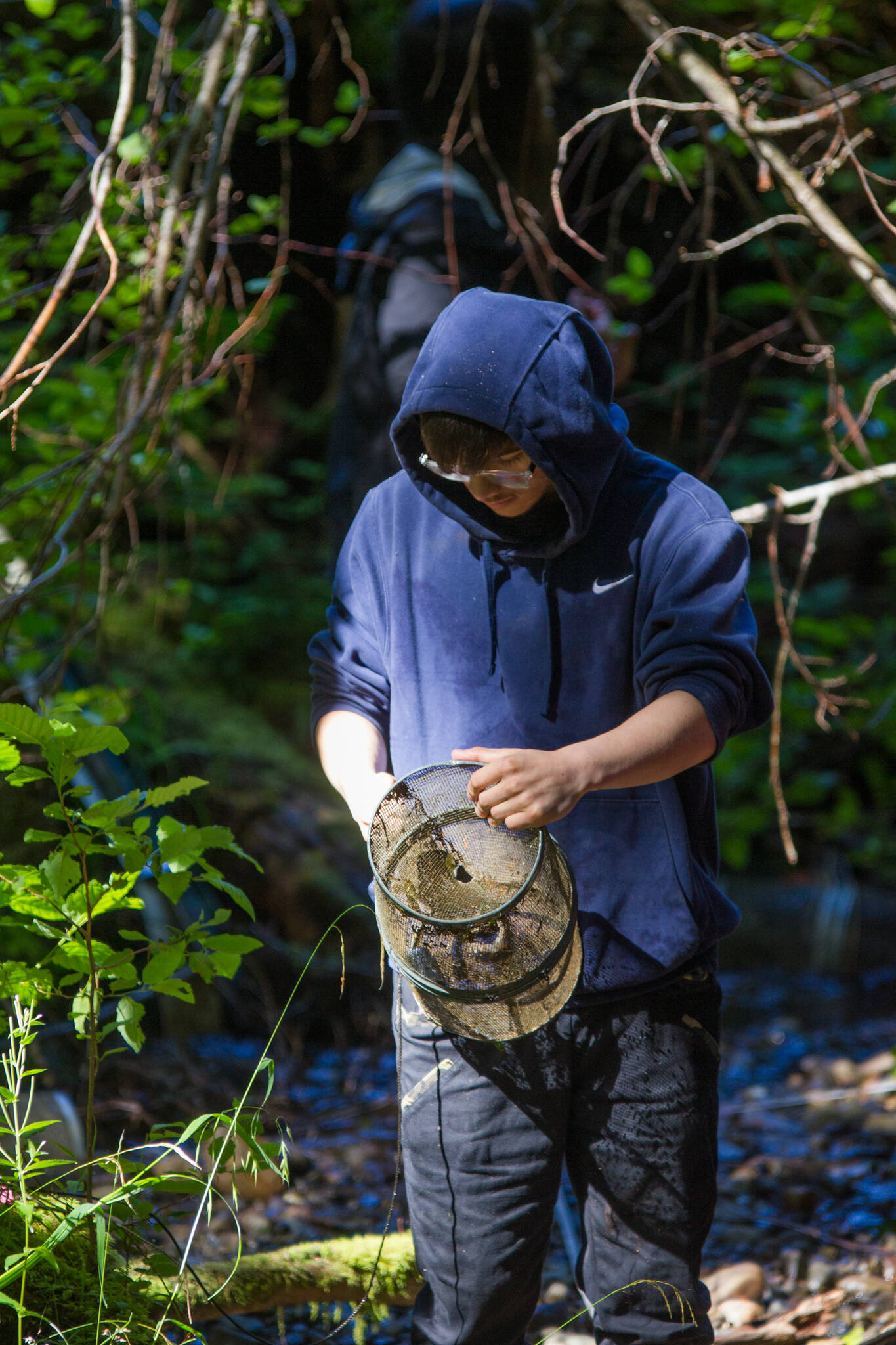
AYS student Ricardo Sanchez collects juvenile salmon and trout species from a minnow trap as a part of the AYS crew’s work with the U.S. Forest Service monitoring streams’ ability to nurture fish. (Courtesy Photo / Reuben Schafir)
Large trees are essential for rearing salmon. Fallen woody debris creates pools and eddies to protect eggs and young fish. The vast canopy created by standing trees also maintains stream temperatures. The massive mossy stumps that line the banks of their local streams are relics of the past, while the students working to heal this landscape are making investments in the future. The crew is studiously recreating the former natural conditions of these streams, in order to hasten the return of productive salmon habitat. For most of these students, their role as youth stewards affirms a right to the position their ancestors have held for generations.
“This will not happen again,” said Quinn Aboudara, the co-leader and field instructor of the KISFP crew, angrily pointing to the stump of an old-growth tree mere feet from the stream bank. Aboudara grew up in Craig and remembers seeing the area surrounding Klawock Lake in the years after it was clear cut. In a spontaneous moment of passion at the end of a workday, Aboudara told his peers that the work was not just about restoring the stream.
“This work is restorative, in a way, for me and also for our community” Aboudara said of the healing component of this work.
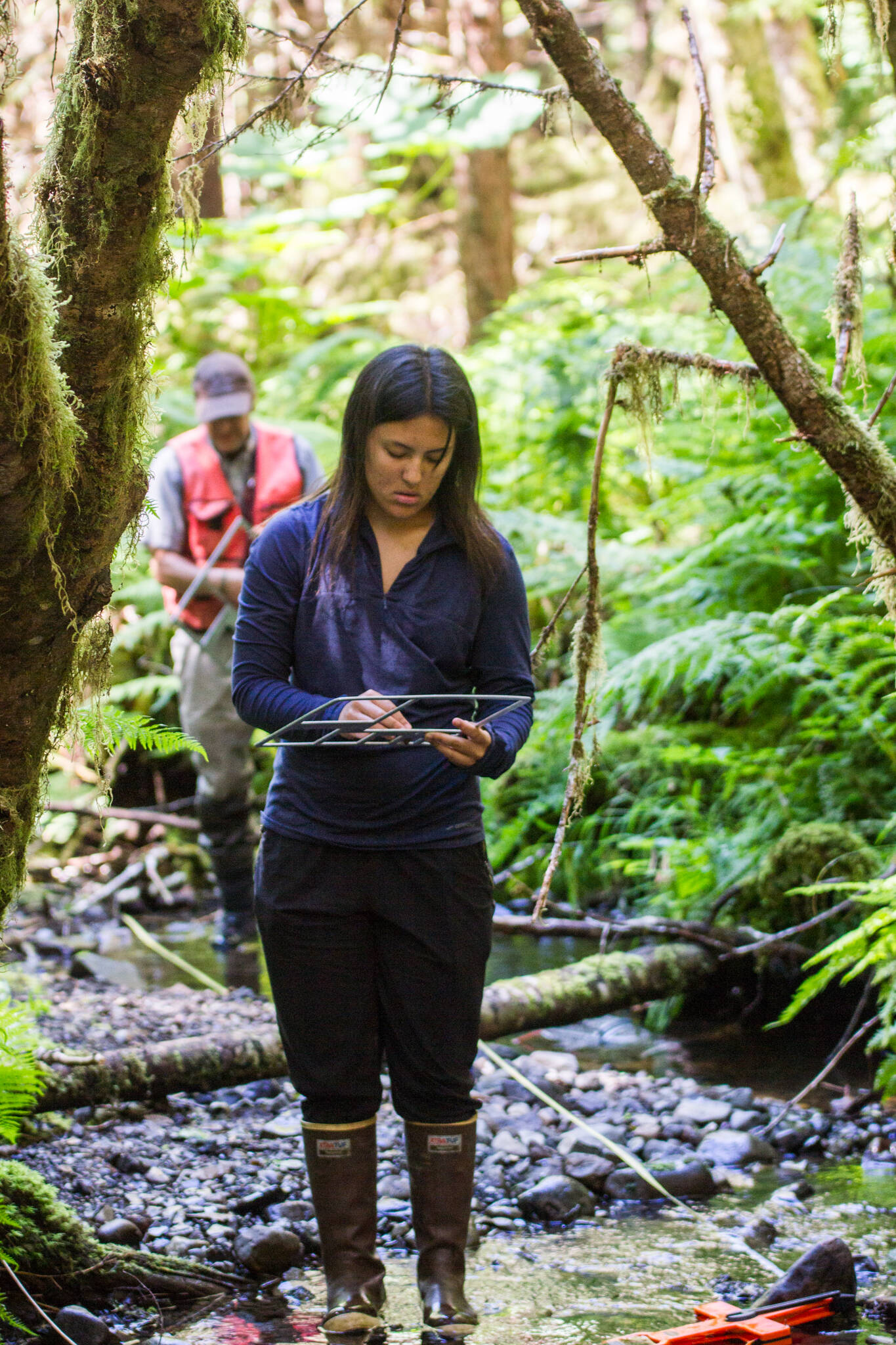
AYS student Allison Mills measures the size of sediments deposited in a tributary of Staney Creek as a part of the AYS crew’s work monitoring stream health with the U.S. Forest Service. (Courtesy Photo / Reuben Schafir)
Many of the people who logged this watershed are the family members, uncles, grandfathers and parents of the generation that is now restoring the landscape. The timber industry, once the economic mainstay of Prince of Wales, was how many fed their families and built their livelihoods.The restoration work now underway constitutes one part of a collective step away from commercial large scale old growth logging and toward rehabilitative and sustainable forestry management practices. Aboudara takes this healing work seriously: these sorts of lessons and conversations are frequent occurrences in our workplace.
Though they were not around when the decisions to log these watersheds were made, these students are in position to guide the next generation of land management decisions of the local corporations and the U.S. Forest Service. AYS students are gaining the skills and experience needed to step into natural resource management positions in the forests that they have always called home. They are compelled to do so by a sense of ownership and generational obligation. This sense of duty is cultivated by project partners and community members.
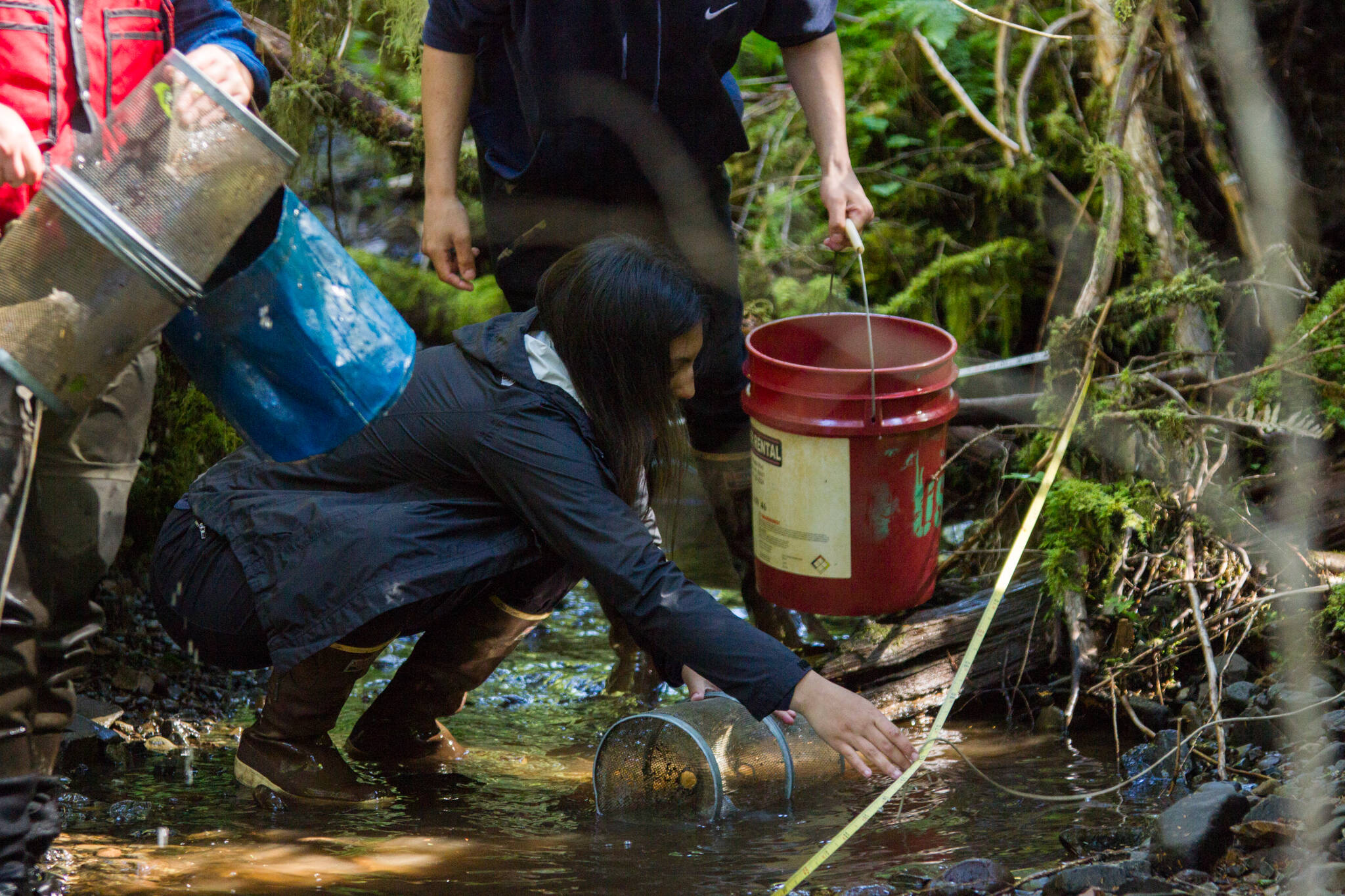
AYS student Allison Mills collects juvenile salmon and trout species from a minnow trap as a part of the AYS crew’s work with the U.S. Forest Service monitoring streams’ ability to nurture fish. (Courtesy Photo / Reuben Schafir)
On Prince of Wales this summer, the crew has helped restore 7-Mile Creek, build and maintain trails and other important recreational infrastructure, and more. In August they will be working with local carvers and artists to identify and document large timber that is suitable for carving dugout canoes and totem poles.
As I cross the halfway mark of my second season working with the AYS program, my conception of my work has shifted. My role is that of a facilitator — a facilitator of the growth of the students as leaders and thinkers. The success of our season is not predicated upon how many miles of trail we brush, the number of foot bridges we build, or sections of boardwalk we repair. Success will be determined by thoughtful experiences, and meaningful relationships built between those currently stewarding these lands and their heirs—the students of the Prince of Wales Alaska Youth Stewards crews.
Just as KJ Santana could not move a half-ton log without relying on the resources standing around him, the ongoing maintenance and restoration of these lands will not succeed without partnerships between local stakeholders. For some members of the next generation, those partnerships can begin while working the handle of a grip-hoist as an Alaskan Youth Steward.
• Reuben Schafir is working his second season as the crew leader of the Prince of Wales Alaskan Youth Stewards program. He is an avid outdoor recreationalist, as well as a historian and writer with a passion for stories that have the power to affect direct and local change. The Sustainable Southeast Partnership is a dynamic collective uniting diverse skills and perspectives to strengthen cultural, ecological, and economic resilience across Southeast Alaska. It envisions self-determined and connected communities where Southeast Indigenous values continue to inspire society, shape our relationships, and ensure that each generation thrives on healthy lands and waters. SSP shares stories that inspire and better connect our unique, isolated communities. SSP can be found online at sustainablesoutheast.net. Resilient Peoples & Place appears monthly in the Capital City Weekly.
