
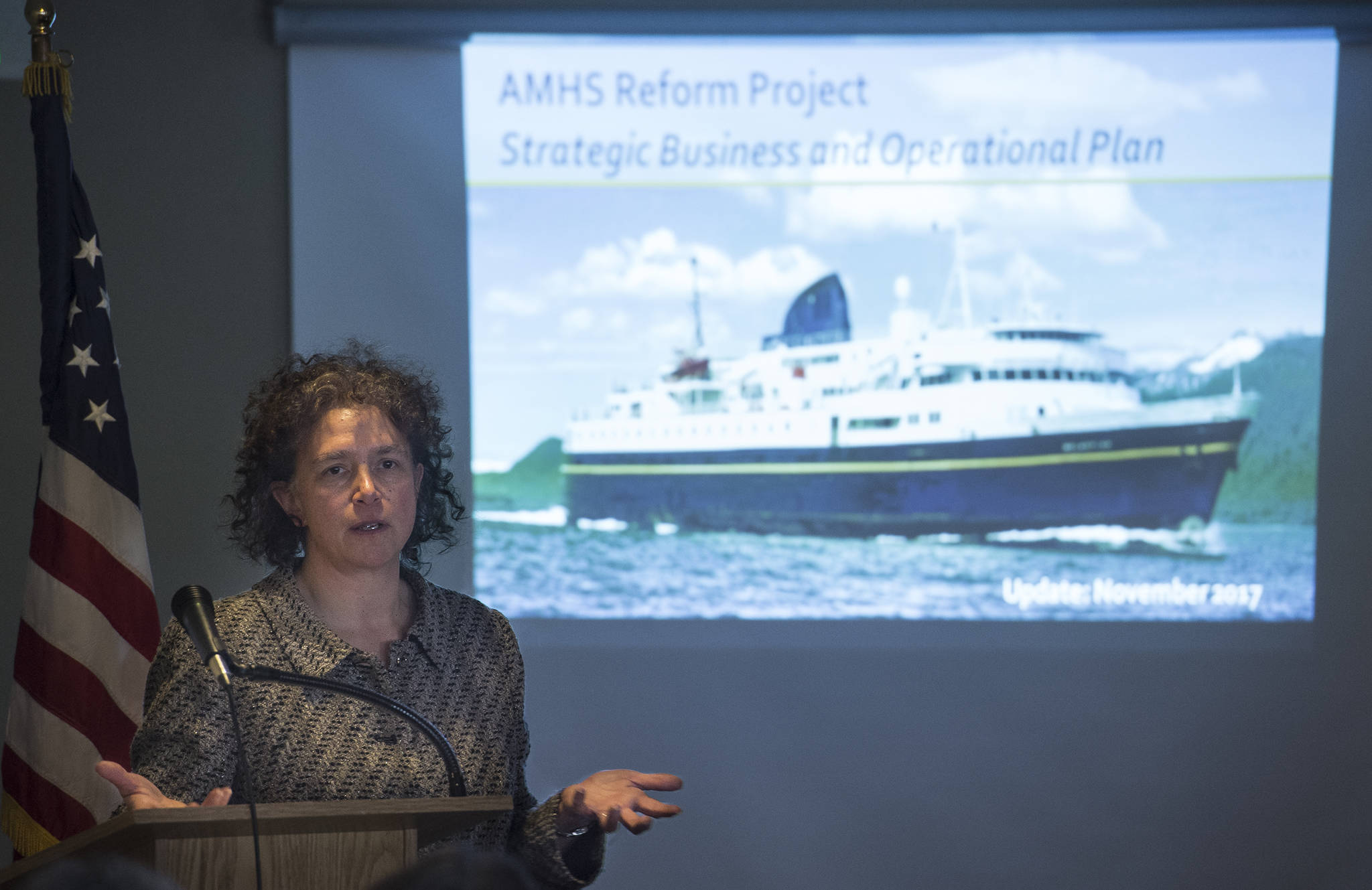
At the Southeast Conference in September, conference leaders announced a plan to reform the Alaska Marine Highway System, aiming to run it as a public corporation instead of as a part of the Alaska Department of Transportation.
Leaders of the reform project team, including the Southeast Conference, the Elliott Bay Design Group, the McDowell Group and KPFF Engineering, have been working recently to develop more of a strategic plan for the future. Susan Bell, principal at the McDowell Group, spoke at Monday’s Republican Women of Juneau luncheon about the plan, which is called the AMHS Reform Strategic Business and Operational Plan.
The plan is more about finding a long-term fix for the ferry system, suggesting the state pursue “forward funding,” which is planning budgets 18-24 months ahead of time. At the Southeast Conference’s meeting in September, Rep. Sam Kito III, D-Juneau, said he will write up a bill in support of forward funding and introduce it at the next regular session of the Alaska Legislature in January.
The AMHS might not have 18-24 months, though, as a lack of state funding could cause the system to shut down in April. A separate legislative action will be required to avoid that shutdown.
Bell spoke Monday about the main factors at play as the group does more research into the future of the ferry system. Introducing change to the system could be tough after decades of the AMHS running through the state government.
“There needs to be a signal that there can be change,” Bell told the group, “there can be a difference and the system can be viable.”
Converting the AMHS to a public corporation, Bell and others at Southeast Conference have said, won’t solve all the system’s financial problems. The move can make it easier to run down the road, though. One benefit of this plan is having the governor appoint a seven-member board that would include five members with expertise in business operations and transportation, the DOT commissioner and a member of a union representing employees.
Bell said that research, including examinations of other ferry systems around North America, has yielded three main takeaways for experts in recent months.
First of all, it’s imperative to modernize both the fleet and the governance system. Many of the ferries in action are decades old and are expensive to maintain. Updating these vessels makes the system more efficient and cost-effective, Bell said. Utilizing that seven-member committee will also increase efficiency.
Secondly, there are no scenarios where all operating costs can be recovered through fares alone. Researchers have tried to develop hypothetical scenarios for the future of the ferry system, but have found that there will probably always have to be some kind of government commitment, according to the plan.
Third, it’s important to keep the AMHS’s connection with Bellingham, Washington, as Bell said it “keeps the system viable.” Service to and from Bellingham, Bell said, results in 44 percent of the ferry system’s revenue. The AMHS generates about $50 million in annual operating revenue, according to the plan.
“There are opportunities for savings if we streamline the fleet and we can make some tweaks to the system,” Bell said.
That’s much easier said than done, as the AMHS has struggled to maintain its level of service in recent years.
State funding has been decreasing rapidly in recent years, and the ferry system has had to lay up the M/V Chenega in Washington and sell the M/V Taku in recent years.
The ferry system provides a valuable service in Southeast Alaska, but Bell said it’s clear from the public feedback they’ve heard that that service is becoming less and less reliable as funding has dropped.
“People are beginning to feel that and notice it,” Bell said.
• Contact reporter Alex McCarthy at 523-2271 or alex.mccarthy@juneauempire.com.
