
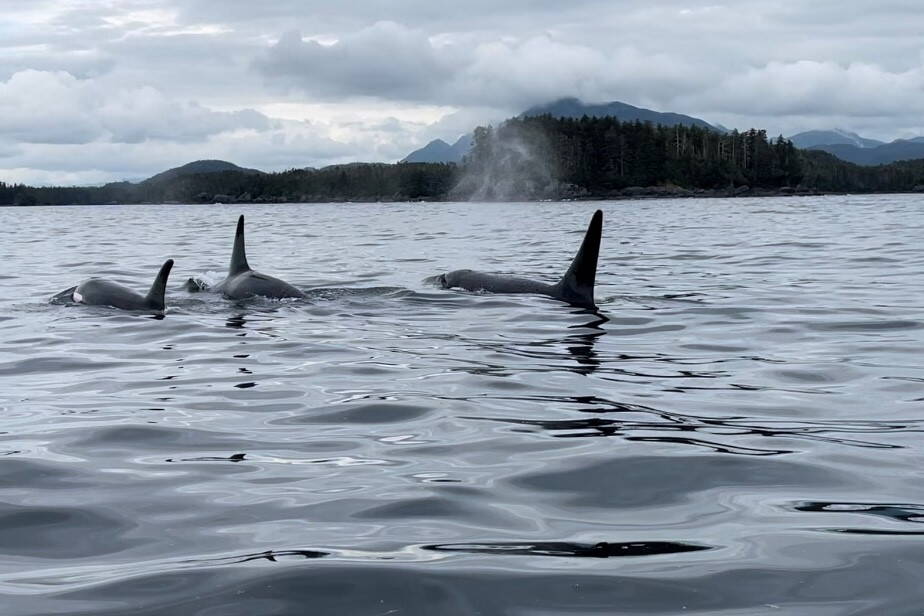
Over the last three decades, 37 killer whales were entangled in fishing gear in Alaska, which resulted in 25 deaths, according to a new report issued by the National Oceanic and Atmospheric Administration.
The report from NOAA Fisheries covers documented cases from 1991 to 2022. It does not include this year’s unusually high number of cases, in which 10 killer whales were found ensnared in fishing gear — mostly bottom-trawl gear — with nine of them found dead. Those events sparked a special examination by the agency.
The cases documented from 1991 to 2022 involved a variety of fishing gear. Trawl gear caused 20 of the entanglements, longline gear caused 10 of them and assorted other gear was implicated in other cases.
Killer whales, also known as orcas, are found in oceans around the world but generally favor colder waters. Several populations of killer whales swim in Alaska waters; some eat fish exclusively and some feed on hunted marine mammals. They are among the marine mammals that are occasionally killed by human activities in marine areas.
Killer whales are known to follow vessels to feed on the fish caught by net, hook, pot or trap, sometimes at their peril. Some die from asphyxiation because they become pinned in place underwater, and even if they escape alive, some wind up with serious injuries that could result in death later, the report said.
But there are gear modifications and devices that have the potential for reducing harm to the whales, the report notes. Barrier ropes that prevent whales from swimming into nets, sleeves that cover hooked fish being pulled up on longline gear, acoustic instruments that ward off whales and other devices should be further studied to see if they can effectively reduce the toll on killer whales, the report said.
Not all of the 37 reported entanglements over the three-decade period involved fishing or marine gear of any kind.
In two of the reported cases, the whales were determined to have been enmeshed in strings of kelp. Those determinations were based on analysis of photographs – demonstrating the importance of collecting photo evidence, the report said.
Killer whales and other whales are known to interact with kelp and have been observed playing with it. There is also evidence that rubbing against kelp sooths whales’ skin. It is likely that there were many more kelp entanglement cases than the two that were documented, the report said.
The affinity for kelp is a signal of a potential future problem as kelp and seaweed farming proliferates, the report noted. “Killer whales have the potential to interact with kelp farms’ anthropogenic material as well as crops,” it said.
Alaska killer whales are classified by stock and by prey type. Resident whales are fish-eaters, while transient whales hunt marine mammals. Multiple stocks are found in Alaska waters.
NOAA Fisheries scientists were able to identify the stocks of 12 of the entangled whales through genetic testing. Nine were from the larger Eastern North Pacific Alaska Resident stock, and the other three were from the Eastern North Pacific, Gulf of Alaska, Aleutian Islands and Bering Sea Transient stock.
NOAA Fisheries estimates that there are 1,920 animals in the Eastern North Pacific Alaska Resident stock, which swims in the Gulf of Alaska and Bering Sea, and 587 in the Eastern North Pacific, Gulf of Alaska, Aleutians Island and Bering Sea transient stock. Past analysis by NOAA Fisheries has found that the Eastern North Pacific Alaska Resident stock can withstand losses of 19 animals a year, while the smaller transient stock can endure losses averaging 5.9 animals per year.
• Yereth Rosen came to Alaska in 1987 to work for the Anchorage Times. She has reported for Reuters, for the Alaska Dispatch News, for Arctic Today and for other organizations. She covers environmental issues, energy, climate change, natural resources, economic and business news, health, science and Arctic concerns. This story originally appeared at alaskabeacon.com. Alaska Beacon, an affiliate of States Newsroom, is an independent, nonpartisan news organization focused on connecting Alaskans to their state government.
