
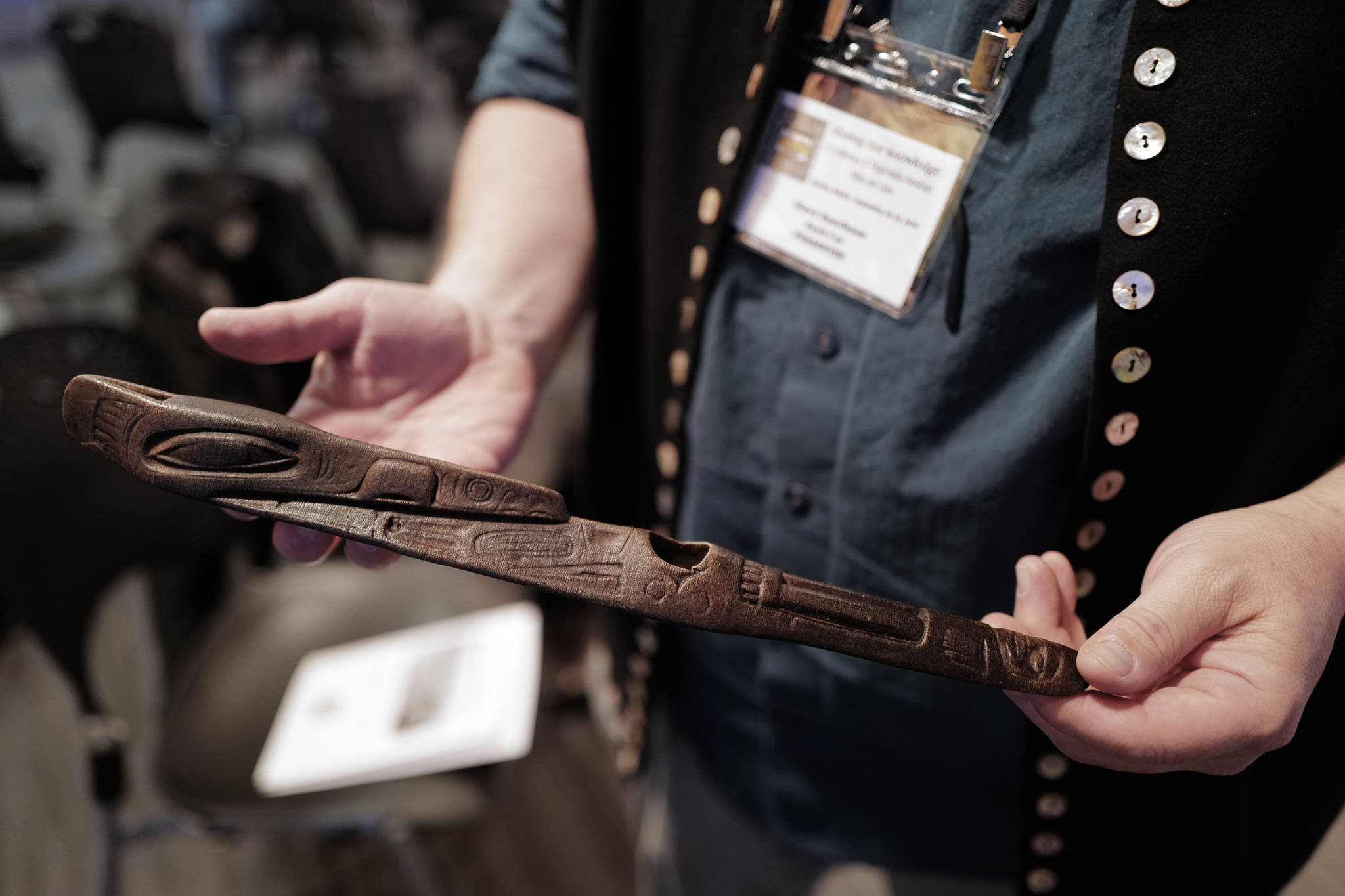
Printed plastic replicas are disproving old, prevailing ideas about Tlingit spear-throwing tools, researchers said.
Shee anns — projectile-throwing devices sometimes called atlatls, spearthrowers or throwing boards — were once thought to be shamans’ tools, said Steve Henrikson, curator of collections for the Alaska State Museum. But, a 3D-printed replica of one of the 25 confirmed Tlingit throwing boards demonstrates they are hunting tools.
“They throw darts just fine,” Henrikson said before a presentation about the tools during the Sharing Our Knowledge Conference.
Hands-on demonstrations Friday and Saturday afternoons that followed the presentation showed the tools work just as well as the similar-but-larger throwing boards commonly found, and sometimes still used, in the Arctic.
Richard VanderHoek, state archaeologist of Alaska Department of Natural Resources and Henrikson’s co-presenter, said the devices work as a rigid extension of the wrist and throw projectiles called darts — they’re closer to spears than what you’d find at a pub — faster and further than a person could using just their arm.
[Bonding over bones: Fossils draw artist and scientist together]
“That’s really important if you’re hunting big game,” VanderHoek said.
However, Henrikson and VanderHoek said exactly what Tlingit people used the devices for is unknown since few have been found and there is nearly no written record of their usage.
VanderHoek said shee anns would be capable of throwing darts designed with marine mammals in mind, and Henrikson said there is a theory that shee anns may have been used to hunt sea otters.
That would partially explain why the devices apparently fell out of favor, Henrikson said. Russian hunting of sea otters pushed the marine mammals to near extinction by the mid 19th century.
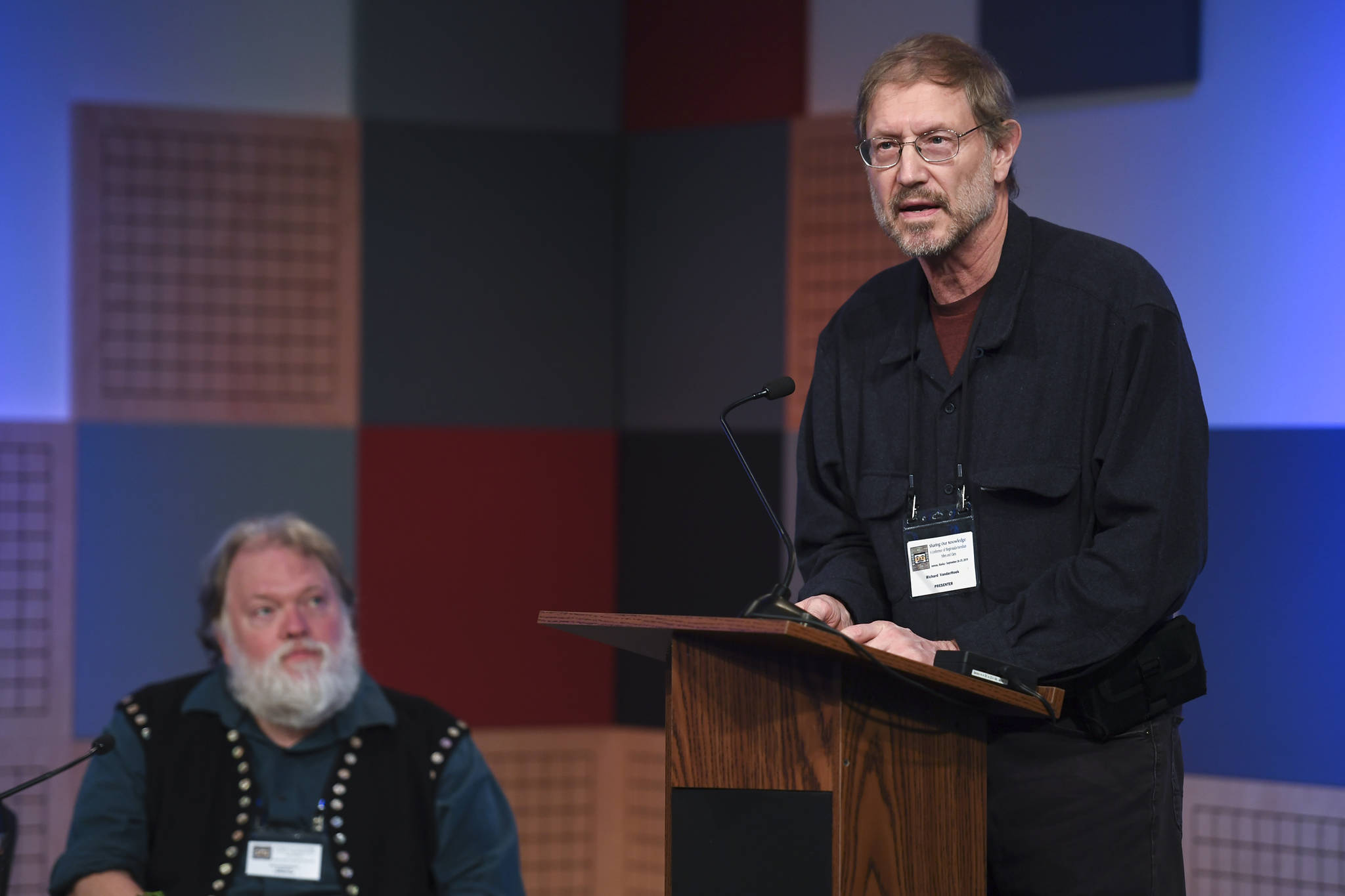
Richard VanderHoek, State Archaeologist with the Alaska Department of Natural Resources’ Office of History and Archaeology, right, and Steve Henrikson, curator of collections at the Alaska State Museum, give a presentation on spear throwing at KTOO as part of the Sharing Our Knowledge conference on Friday, Sept. 27, 2019. (Michael Penn | Juneau Empire)
Exactly what shee anns are made out of is also unknown. Henrikson said yew, maple or spruce limbs are all possibilities.
“It’s a very hard, dense wood,” Henrikson said.
A definitive answer for what the tools are made of would require a wood sample or possibly cutting one of the 25 know shee anns to study wood patterns, Henrikson said.
He said since all the known shee anns are from collections and stem from either trade or theft rather than recovered artifacts, some woods more prone to rot can’t easily be eliminated as possible building materials.
However, both he and VanderHoek said pacific yew is a strong possibility.
VanderHoek and Henrikson said the Tlingit tools aren’t only shorter than the throwing boards typically used by Alaska Natives in the Arctic, shee anns, they’re much more ornate.
“The level of decoration in Tlingit boards is pretty exceptional,” Henrikson said.
[Ballot propositions are high JACC-ing municipal election]
A plastic replica of one of the shee anns in the Smithsonian Institution’s that was passed around during the collection showed a level of detail — carved designs showing both a beaked and humanoid face — that was partly why the devices were once thought to be shaman’s tools.
“Some of the carvings we see on the Tlingit boards may be to provide the hunter safety and luck,” Henrikson said.
He and VanderHoek showed slides of some of the known shee anns, which showed wear over their intricate patterns where hunters had gripped their tools.
“They must have been used by generations of hunters,” Henrikson said.
• Contact reporter Ben Hohenstatt at (907)523-2243 or bhohenstatt@juneauempire.com. Follow him on Twitter at @BenHohenstatt.
