
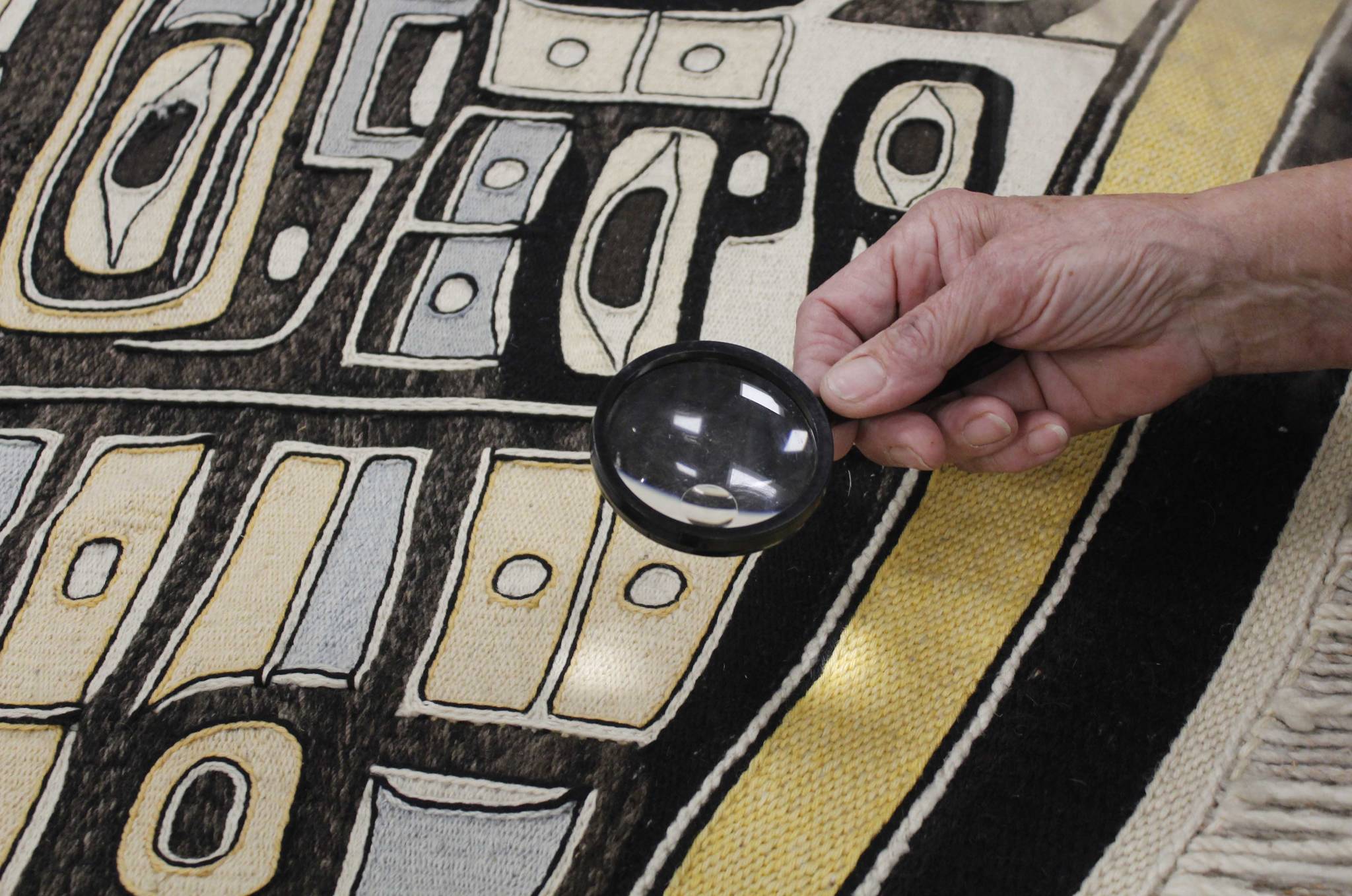
Haida weaver Delores Churchill’s hand hovered a few inches above the 100-year-old fabric, her finger outstretched.
She was pointing at a small circle woven into the middle of a rectangle on the back of a newly-donated Chilkat robe, admiring the craftsmanship.
“Those women were such geniuses to make a circle from a square,” Churchill said. “The only people in the world who achieved that when weaving. Nobody else ever achieved that.”
This robe, now located in the lower level of the Sealaska Heritage Institute (SHI) building in downtown Juneau, arrived in town Thursday night. It came into SHI’s possession in an unlikely and unconventional way, and has those at the institute beside themselves with excitement.
‘A large gift’
Estimated to be woven in the late 1800s or early 1900s, the robe was in the possession of Bruce and Gretchen Jacobsen in Seattle, who purchased the robe in the 1990s. Sara Jacobsen, their daughter, saw a picture of a Chilkat robe (also referred to as a Chilkat blanket) in her AP art history textbook.
Sara went back to her parents and lobbied them “vigorously” to return the family’s robe to its appropriate owners, according to a release from SHI. The attempt worked, and her father began to look for suitable options. He got in touch with Rosita Worl, the president of SHI, and reached an agreement that Juneau would be a fitting home for the artifact.
“It seems an important community and cultural item and we would like to see it returned as close as possible to its creators and original owners,” Bruce Jacobsen wrote in an email to the Empire.
The robe arrived Thursday night, and was made available to a small group Friday morning. There will be a public unveiling of it on Saturday, Aug. 26, where all are welcome at the Walter Soboleff Building.
Churchill and fellow weaver and teacher Kay Field Parker spent nearly an hour closely examining the robe and discussing the intricacies of it Friday morning. While a tape recorder ran, Churchill and Field Parker thought aloud.
“It is a large gift,” Churchill said. “Not just monetarily, but I think that the story and the history is important, you know?”
Almost every time the two weavers made an observation, the other nine people in the room leaned their heads in, craning their necks to get a closer look. It felt almost like two detectives breaking down evidence, as the two women recreated the process through which a weaver and apprentice went about piecing the robe together.
There’s still a great deal to learn about the piece itself, as experts have disagreed about what is even depicted on the robe. Renowned Northwest Coast art expert Bill Holm maintains that the design is that of a beaver, but both Churchill and SHI History and Culture Director Chuck Smythe agreed that they see it more as a bird than as a beaver.
They also quickly found that the robe is made from both mountain goat wool and commercial wool, which Field Parker said was a common practice during the time period. The mixture of fabrics made for subtle changes in parts of the robe, where different shades of black would run into one another.
“But it’s an absolutely fantastic piece,” Field Parker said. “The work on it is just wonderful.”
A sign of status
Churchill told a few stories Friday morning, from Haida legends to humorous encounters during her travels.
One Haida story she told centered around two chiefs who were trying to out-do one another after a gambling argument. One chief held an extravagant potlatch to try and shame the other, but his adversary showed up in an extravagant Chilkat robe, stealing the show.
The story represented the importance of these robes in Native history. In her 1986 book “Art of the Northern Tlingit,” author and Director of the University of Alaska Museum of the North Aldona Jonaitis wrote that “only the most elite could wear the high status Chilkat blankets, while lesser individuals donned less significant costumes like button blankets.”
The process of weaving a robe takes months, and tests a weaver’s patience. One of the essential texts on the art form, George T. Emmons, “The Chilkat Blanket,” was written in 1907 and delves into the intricacies of the design. Emmons wrote that the robe (or blanket) was “the highest development of the textile art throughout this region, and comparing favorably with the best productions of other lands.”
Now, that skill is dying. SHI considers Chilkat weaving to be “an endangered art practice,” according to a release, and is trying to promote the study of the art form.
SHI now has three of the robes, obtaining two of them in the past two years. The organization found and bought a robe on eBay in 2015, with the seller George Blucker settling on a $14,500 pricetag despite the robe being valued at much higher. He, like the Jacobsens, felt the robe should be in a public place where it can be appreciated and studied instead of hanging on a wall in someone’s home.
Churchill commented that it’s vital for the art form’s survival for people to examine the entire robe. With it hanging on a wall, only one side is visible. It’s the back side, Churchill said, that tells the robe’s story.
Lasting forever
After less than a minute of looking at the front, Churchill was ready to see the other side.
“Could you turn it over?” Churchill asked. “The back tells a bigger story than the front.”
Research Specialist Heather McClain and Archivist Jennifer Treadway carefully turned the robe over, wearing gloves and moving deliberately.
The back revealed more about the weaving techniques, giving Churchill and Field Parker a closer look at the specific fabrics, folds, colors and loom patterns. The two of them closely examined it all, searching strand by strand through the strands of wool hanging from the sides and even breaking out a magnifying glass. Field Parker snapped photos throughout, zooming in on all parts of the piece.
When they posed for a photo opportunity at the end of their examination, the weavers elected to pose with the back side of the robe instead of the front. It might not be the most photogenic side, but it’s the side that belongs to the weavers and tells the robe’s story.
This one has a unique story to tell, as Holm’s initial study on the piece in the 1990s claimed that the robe was “one of a kind.” Smythe, who was standing next to and conversing with Churchill for much of the examination Friday, is looking forward to hearing from more and more weavers about what they learn from this piece.
The techniques learned from this robe, Smythe said, will be passed on and will help influence weaving for years to come.
“It’s so much for the future,” Smythe said. “You think about all the people who might see it and learn from it. It’ll go on forever, as long as we have it.”
• Contact reporter Alex McCarthy at alex.mccarthy@juneauempire.com.
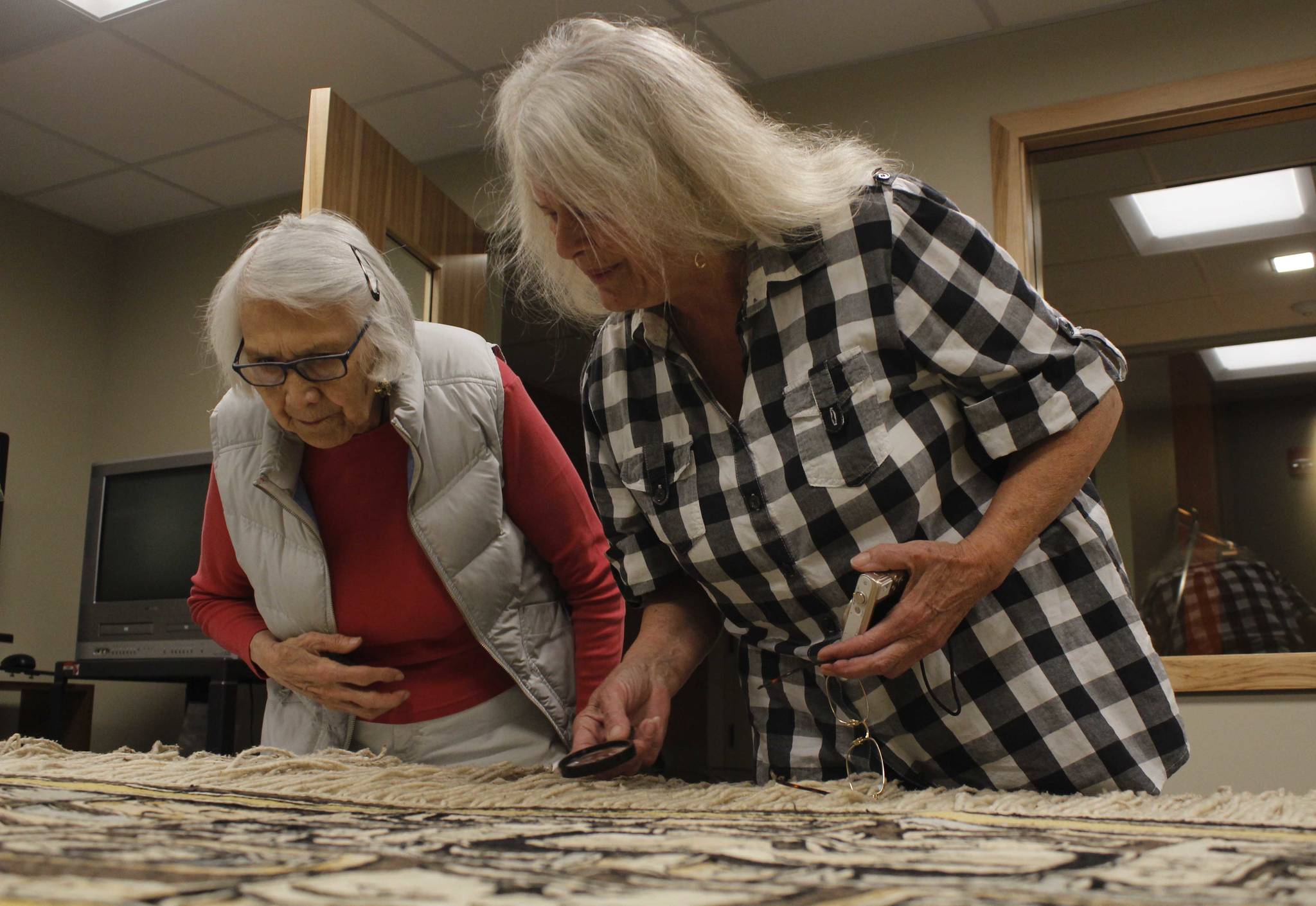
Weavers Delores Churchill (left) and Kay Field Parker examine a Chilkat robe that was donated to Sealaska Heritage Institute. The robe is estimated to be from the late 1800s or late 1900s and is expected to be an important teaching tool for weavers. (Alex McCarthy | Juneau Empire)
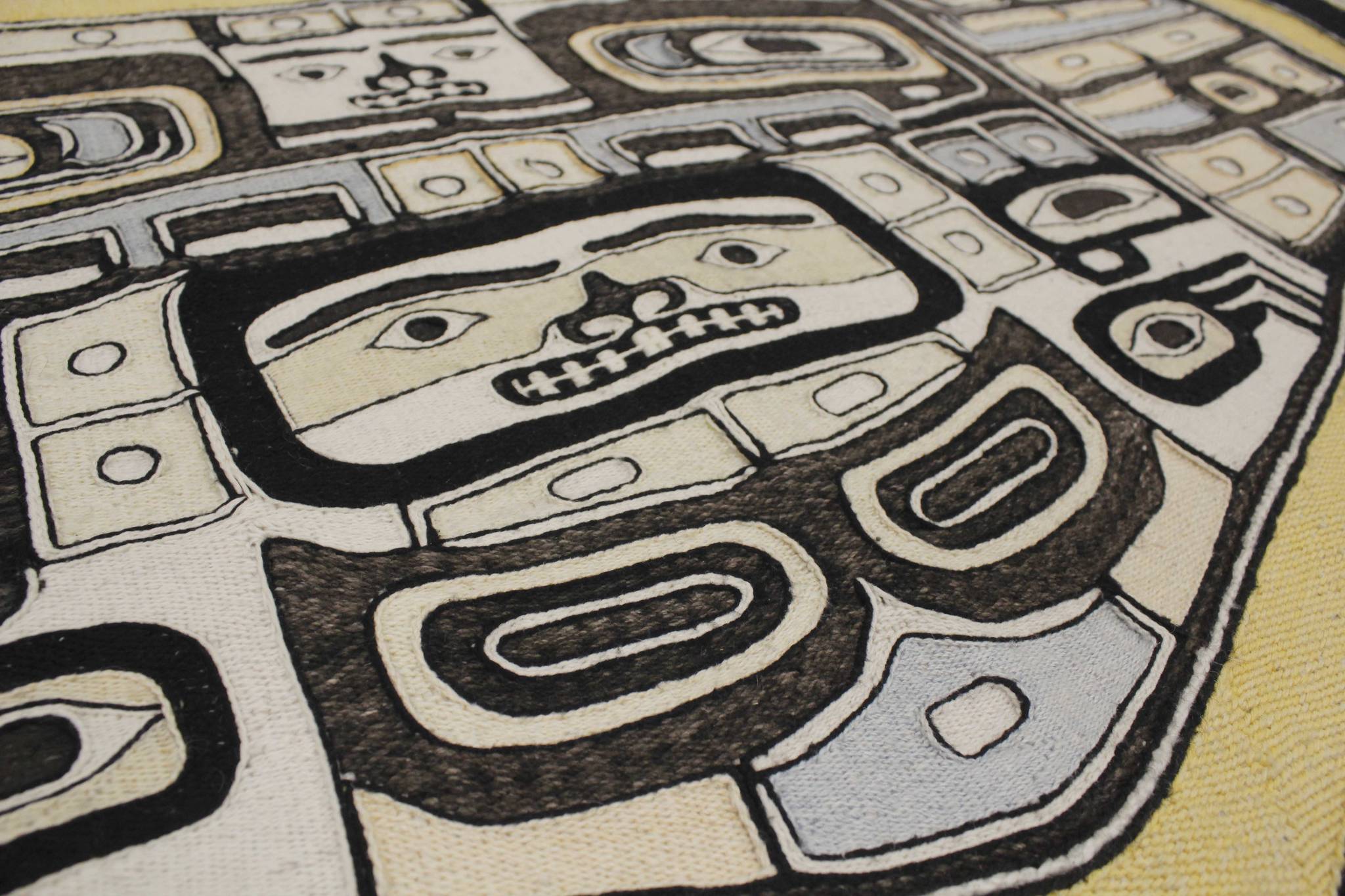
This Chilkat robe was donated to Sealaska Heritage Institute after a daughter in Seattle convinced her parents to donate it. The robe is estimated to be from the late 1800s or late 1900s and is expected to be an important teaching tool for weavers. (Alex McCarthy | Juneau Empire)
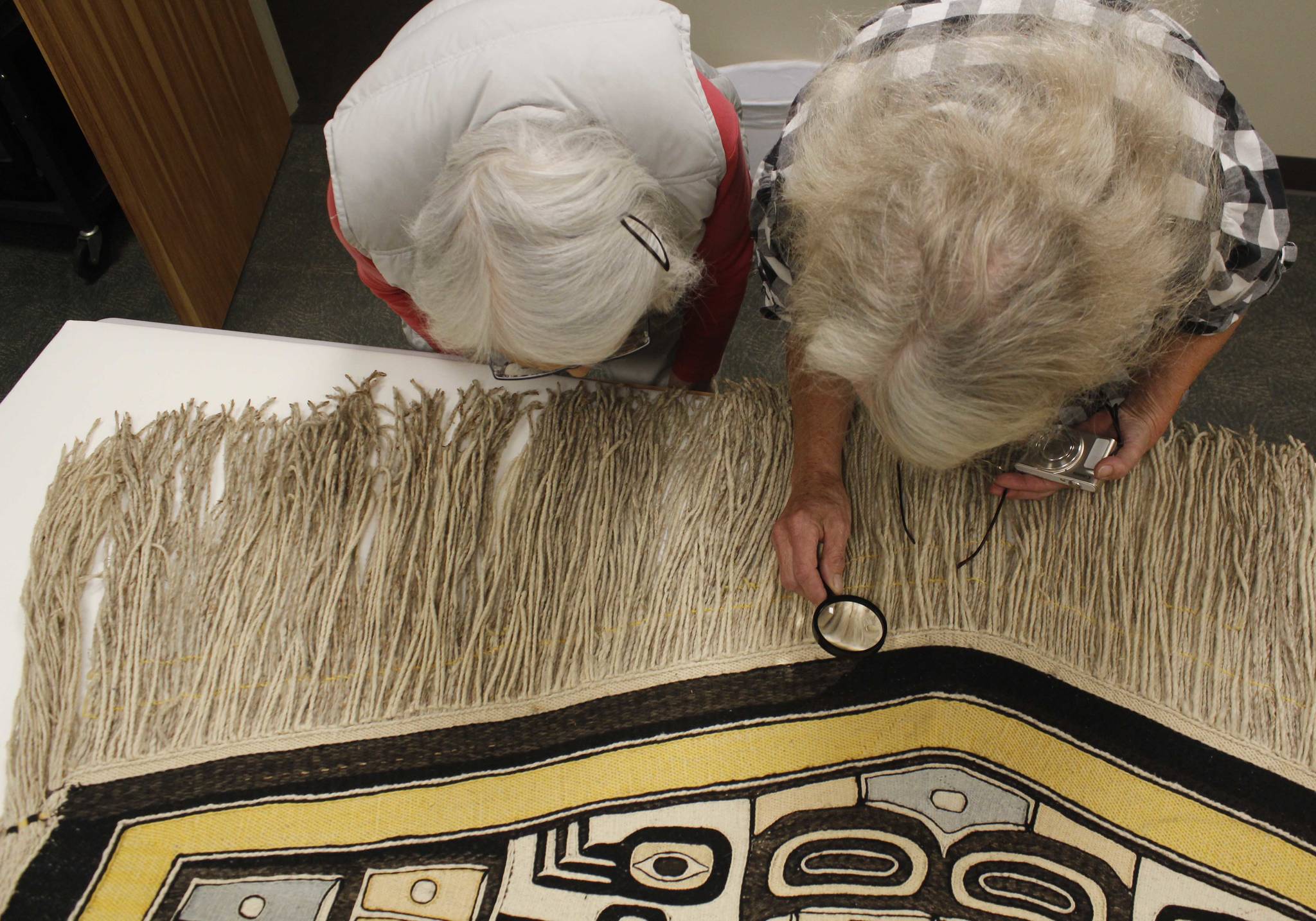
Weavers Delores Churchill (left) and Kay Field Parker examine a Chilkat robe that was donated to Sealaska Heritage Institute. The robe is estimated to be from the late 1800s or late 1900s and is expected to be an important teaching tool for weavers. (Alex McCarthy | Juneau Empire)
