
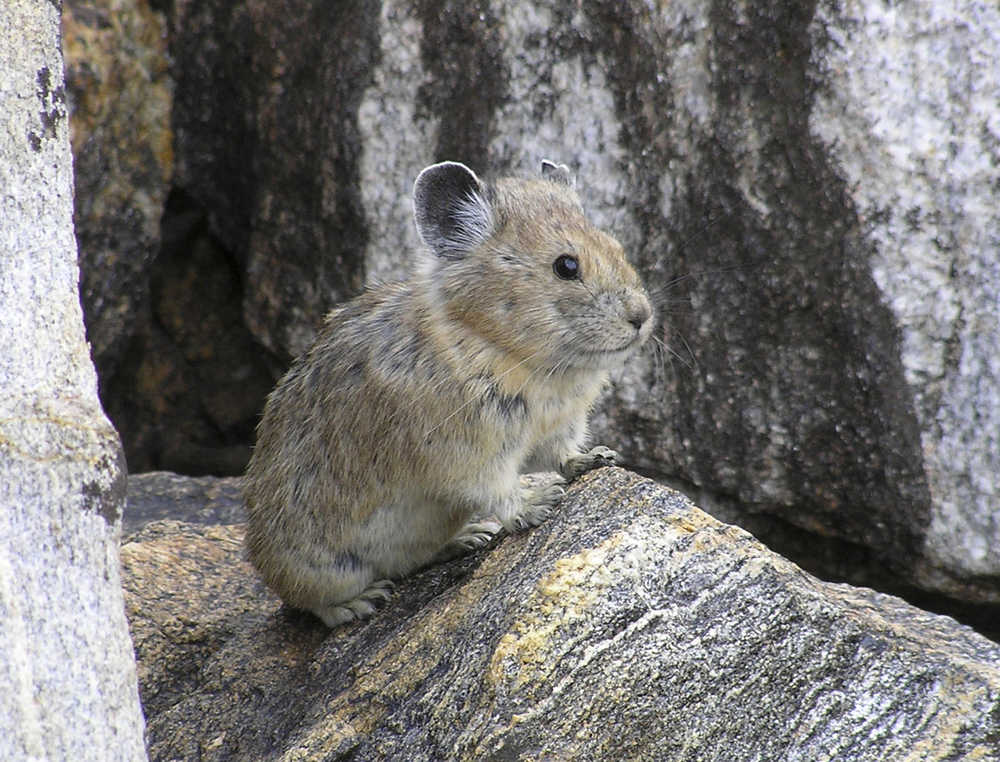
BILLINGS, Mont. — Federal officials on Tuesday rejected greater protections for four species including the rabbit-like American pika, which researchers warn is disappearing from areas of the Western U.S. as climate change alters its mountain habitat.
The pika’s range is shrinking across southern Utah, northeastern California and in the Great Basin that covers most of Nevada and parts of Utah, Oregon, Idaho and California, according to a U.S. Geological Survey study released last month.
Exposure to ambient temperatures of 78 degrees or higher can kill the mountain-dwelling mammals, wildlife officials say.
But the U.S. Fish and Wildlife Service said in documents released Tuesday that pika adapt to warmer temperatures by seeking refuge beneath rock fields in the summer. As a result, surface temperatures may not be the best predictor of population declines, the agency said.
The agency also said the most severe effects of climate change are felt at elevations below 8,200 feet (2,499 meters), which is near the lower limit of the pika’s range in the West. That suggests pika habitat “has not experienced the more substantial changes” of reduced snowpack due to climate change, the wildlife service said.
Last month’s Geological Survey study was not available when a student from New York petitioned the wildlife service in April to protect the animal under the Endangered Species Act, agency spokesman Brian Hires said, meaning its findings were not considered.
“We always try to use the best available science for our decisions,” Hires said.
The government denied a prior request for pika protections in 2010, saying not all populations were declining.
President Barack Obama mentioned the plight of the pika this summer when he spoke at Yosemite National Park about the damage inflicted by climate change. He said the pika was being forced further upslope at Yosemite to escape the heat.
The Fish and Wildlife Service is unlikely to pursue further action on pikas on its own, officials said, citing a heavy workload of other imperiled species.
Wildlife advocates will file a new petition in coming months to grant protections based on the Geological Survey study, said Noah Greenwald with the Center for Biological Diversity.
“The pace of determining whether species need protections is just not adequate to the task,” Greenwald said.
Wildlife officials also rejected petitions Tuesday to protect the Wyoming pocket gopher, a Caribbean iguana and the Fourche Mountain salamander of Arkansas. Further details on those decisions were not immediately available.
Officials declined to downgrade protections for two bird species in Alaska — the spectacled eider and Steller’s eider — and said the status of four species merit further review.
They are the Florida scrub lizard; the Joshua tree of Arizona, California, Utah and Nevada; an amphibian known as the lesser Virgin Islands skink; and the Lassics lupine, a flowering plant found at high elevations in the North Coast mountains of California.
For those four, the wildlife service invited scientists and others to submit information that could help the agency in its decision.
—
Read more news:
Feds: Plan addresses impact of ocean noise on marine mammals
Juneau Housing First project gets more money, but still in hole
Suspect detained in fatal shooting near Anchorage schools
SHI receives nearly $1 million to revitalize Alaska Native languages
