
Correction: An earlier version of this article spelled Rep. Tiffany Zulkosky’s name as Zulkoski. The correct spelling is Zulkosky. The article has been changed to reflect that.
Yupik artist Amber Webb is using a Sharpie to bring people face-to-face with a nationwide crisis.
Years ago, a family friend of Webb’s went missing, and saw that after a while, attention to the friend faded and she became just another missing person.
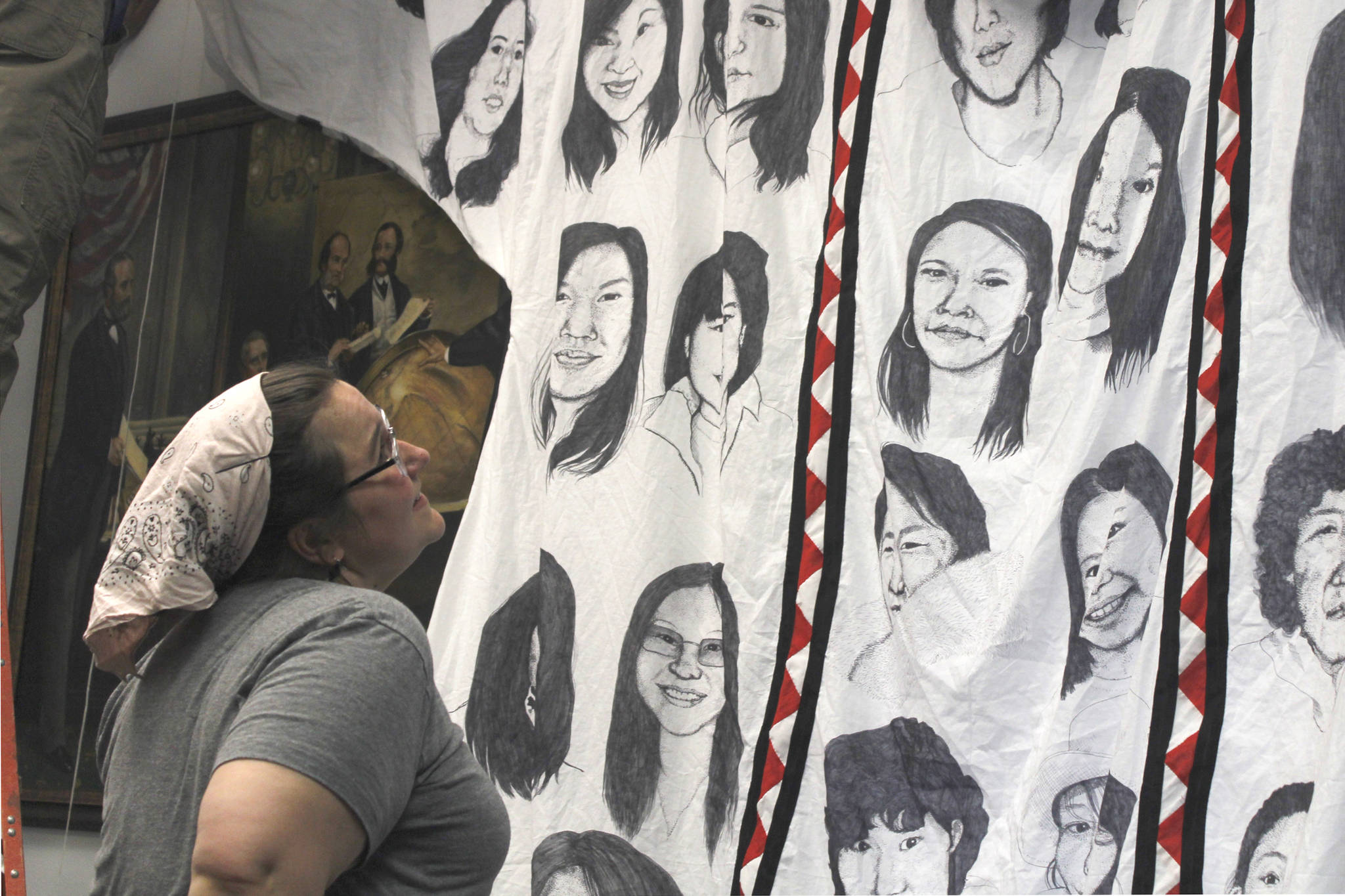
Webb began a project where she made an oversized qaspeq (which is sometimes spelled kuspuk) and drew portraits of missing and murdered indigenous women and girls. She made one, which the Anchorage Museum purchased a couple years ago. Now she’s working on another one, one that is over 10 feet high and currently carries around 90 portraits. She says it will eventually carry about 300.
“We’re not going to solve the problem unless people feel it,” Webb said, “so I was trying to do this kind of project to say, when you look at this many faces at once, you can’t just call it a statistic. These are people. These are people’s relatives. These are all of our relatives.”
On Wednesday afternoon, Webb watched as her in-progress qaspeq was raised in the Alaska State Capitol.
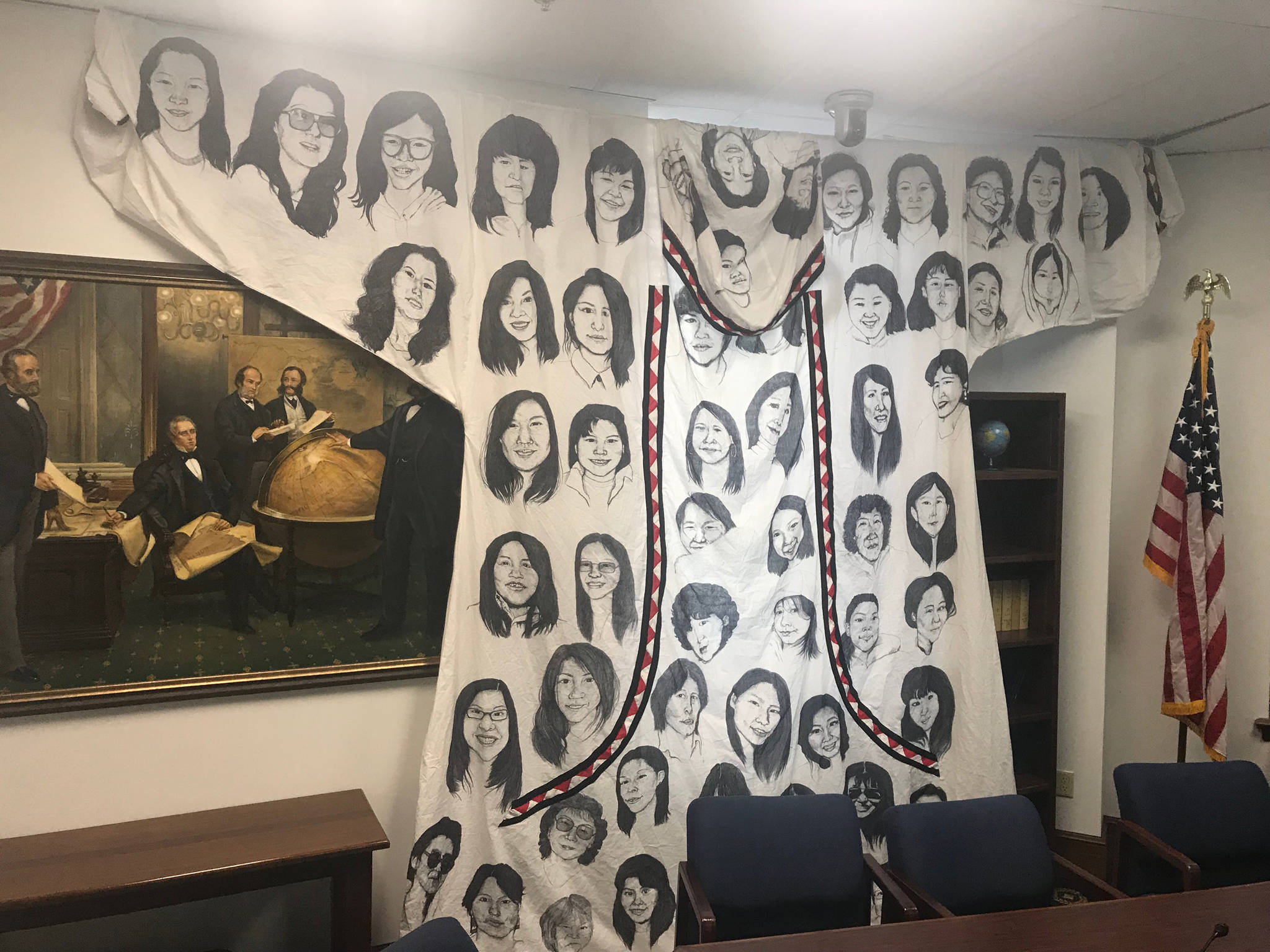
Amber Webb’s qaspeq hangs in room 106 of the Alaska State Capitol on Wednesday, May 1, 2019. (Alex McCarthy | Juneau Empire)
Capitol Building Maintenance employees hung the huge qaspeq in a committee room on the second floor, where the House Tribal Affairs Committee will meet at 8 a.m. today. The committee will review House Resolution 10, which urges the U.S. Congress to reauthorize the Violence Against Women Act of 1994 without an exemption for tribal government. The resolution also asks Congress to support Savanna’s Act and highlight the crisis of missing and murdered indigenous women and girls.
Rep. Tiffany Zulkosky, D-Bethel, has known Webb for years and has followed her work. Zulkosky said she reached out to Webb recently to bring her project to the Capitol. Zulkosky said there’s so much talk in the Capitol about what’s a crisis and what isn’t. Being stuck inside and looking over spreadsheets and Powerpoint presentations all day, she said, provides information but no insight into what the issues really mean.
“In the Capitol building, there’s a lot of discussion about statistics and numbers, and stuff that is very abstract,” Zulkosky said. “It’s really important to me, as someone who’s a visual learner and as somebody who comes from a culture that’s really grounded in storytelling, to really put faces and names to this crisis.”
[Missing, murdered, forgotten: Women’s March holds up indigenous women]
The faces aren’t just of Alaskans, Webb said. The qaspeq carries faces of women from Canada and many regions of the United States. The crisis isn’t limited to Alaska, Webb said, so the faces shouldn’t just be of Alaskan women.
Her work has made an impression on people throughout the state and beyond. Alaska-based band Portugal. The Man lead singer John Gourley wore a normal-sized qaspeq of Webb’s with missing and murdered indigenous women’s faces on it when the band played at Lollapalooza Brazil this year.
Both Zulkosky and Webb said they hope lawmakers and non-lawmakers who see the qaspeq — and more importantly, the faces on it — develop more of an understanding about the struggle indigenous women go through and the prevalence of violence in their world.
“It’s to honor that weight that we carry but also to make other people feel that,” Webb said. “A lot of people just don’t have to. They don’t have to walk around feeling that if you’re out in public late at night, or even during the middle of the day by yourself, something might happen to you and nobody might know what happened to you.”
• Contact reporter Alex McCarthy at amccarthy@juneauempire.com. Follow him on Twitter at @akmccarthy.
