
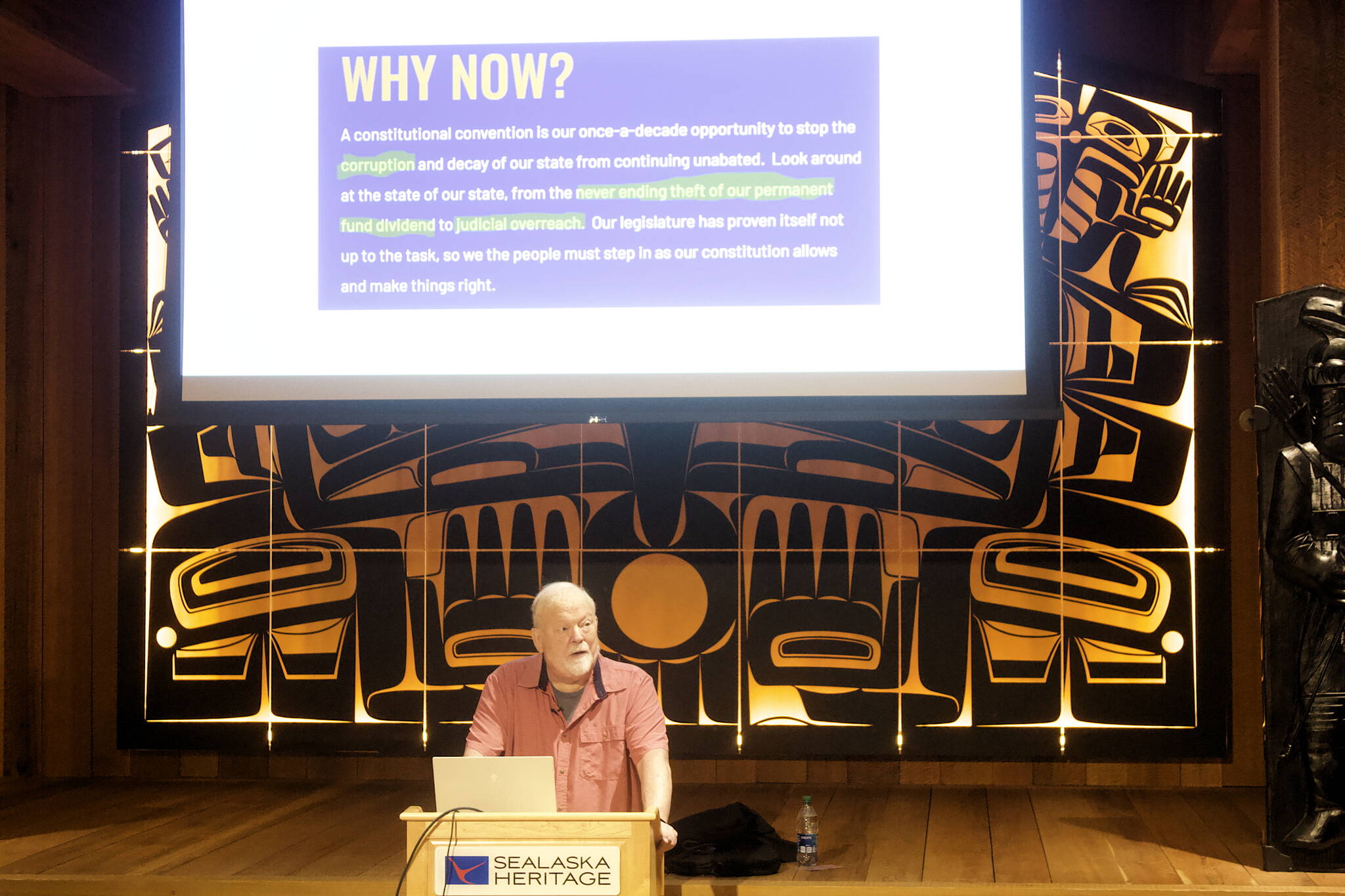
The upcoming vote on a state constitutional convention was much on the minds of people throughout Alaska on Tuesday — due in large part to it being “PFD Day” for eligible residents opting for direct deposit of the Permanent Fund dividend. Folks in a few places to the north rallied in favor of a convention while in Juneau former Mayor Bruce Botelho joined a long list of Southeast leaders opposing its impacts.
A vote on a convention is required by law at least every 10 years and has been resoundingly defeated almost every time since statehood, but this year’s general election outcome may be different, Botelho said during a noon-hour presentation as part of a Sealaska Heritage Institute Lecture series that’s available on the institute’s YouTube channel. His presentation, on what’s also National Voter Registration Day, focused on the long history leading up to Alaska’s first constitutional convention before statehood and why the political mood now is different than recent decades.

Mark Sabbatini / Juneau Empire Rosita Worl, president of Sealaska Heritage Institute, who attended Alaska’s first constitutional convention as a student in Fairbanks in 1955, asks how concerns about inequities for Alaska Natives in the criminal justice system can be addressed without resorting to a modern-day constitutional convention during a presentation on the issue Tuesday in Juneau. She said Native organizations are generally opposing this year’s ballot measure based on the arguments being made by the entities leading the effort in favor of one.
“There’s a national climate of distrust — I use disaffection — with government institutions,” he said. “I would say this disaffection permeates a lot of Alaska’s politics as well.”
The rallies in four Alaska cities elsewhere were sponsored by ConventionYES!, a Fairbanks-based group that on this occasion highlighted the PFD as a primary reason for people to support a convention since “the PFD has been a political football and distraction for too long,” according to an event announcement at the group’s website.
Botelho accused Gov. Mike Dunleavy — who’s made what he calls “full PFDs” a centerpiece of his political platform — of a series of proposals “knowing they have no chance with the Legislature.” But Botelho said because they’re populist ideas they’re likely to motivate a significant number of voters to approve a constitutional convention in the hope of implementing them via that process.
Among the items that seem to particularly resonate with convention advocates is “parents’ rights — vouchers and control over curriculum,” Botelho said. There’s also a number of secondary issues proponents will likely want to include in a constitutional convention including moving the capital from Juneau and restricting LGBTQ+ rights.
Another reason there may be heightened interest this year is plenty of people in other states are seeking constitutional conventions as well and Alaska “is a perfect test for it.”
“These issues may drive a lot of Outside money into Alaska,” Botelho said.
The only time voters approved a constitutional convention was in 1970, but a lawsuit by opponents claiming the ballot text was misleading led to a vote on a reworded question in 1972 that voters rejected.
Both sides will get a chance to weigh in at the same time during a debate about this year’s vote on a constitutional convention scheduled at 7 p.m. Sept. 29 in Anchorage that will be broadcast live online by Alaska Public Media.
A convention, if approved by voters, would likely take place in the fall of 2023 or 2025 because state lawmakers would want to be delegates, and wouldn’t be able to attend during the legislative session or while running for office during even-number years, Botelho said. He said an estimate provided to legislative staff during the most recent session estimates the cost of a convention at $17 million.
“That’s not a lot of money when you’re talking about an issue as weighty as a constitutional convention,” he said. “The real cost is uncertainty between approval and passage, and to the extent there are major changes there may be years or decades of litigation over what the terms are.”
“The outcomes are incredibly unpredictable. Everyone is at risk. It will cause a great deal of polarization in the state. We have a system that works and that is making use of the amendment process” via the legislature and voters.
Botelho spoke to a mostly agreeable audience of about a dozen people, but questions were raised about some issues of state policy seen as needing resolution, with one of the most notable being inequitable treatment of Alaska Native by the criminal justice system.
Rosita Worl, president of Sealaska Heritage Institute, said she attended Alaska’s first constitutional convention in Fairbanks in 1955 and “it showed me as a young Alaska Native lady to be very optimistic about the future.” But she said Alaska Native groups are “very alarmed” about the reasons current advocates are calling for a constitutional convention, even though there are relevant issues such as Natives representing more than 40% of the state’s incarcerated population.
“That’s a great concern for us,” she said, asking Botelho if it’s an issue where tribal courts might be able to exercise greater authority given recent changes in state and federal law recognizing tribal rights.
“I would say absolutely, yes, and I would say that’s the direction we’re evolving toward,” he said. “We have federal legislation now, but I think more steps need to be taken (and) courts need to be more receptive. That’s been the case for the past two decades.”
A wide range of other issues where “Southeast Alaska communities could have the most to lose under a newly written constitution” including the Alaska Marine Highway System, fishing access and management, hunting rights, subsistence, mineral and water rights, rural education funding, and government services to the rural areas were invoked in a resolution Southeast Conference approved during its convention last week in Ketchikan. The organization states a poll of 440 business leaders in the region found 84% were opposed to a constitutional convention.
A similarly one-sided sentiment was expressed by all six of the regional candidates for state Legislature participating in a forum during the Southeast Conference gathering. A couple of candidates said they supported the public vote on the issue even though they personally planned to vote against the measure, but both the two Juneau incumbents participating — state Sen. Jesse Kiehl and Rep. Andi Story — expressed some of the strongest opposition.
“We’re still healing from COVID,” Story said. “I see a potential constitutional convention at this time not helping us work together on the issues that need to be addressed at this time.”
Kiehl’s opposition was even more adamant, saying his vote will be “not just no, but hell no.”
“Back then Southeast members just barely kept the capital in Southeast,” he said. “A constitutional convention today starts with a capital move and then it goes to work on your rights.”
• Contact reporter Mark Sabbatini at mark.sabbatini@juneauempire.com
