
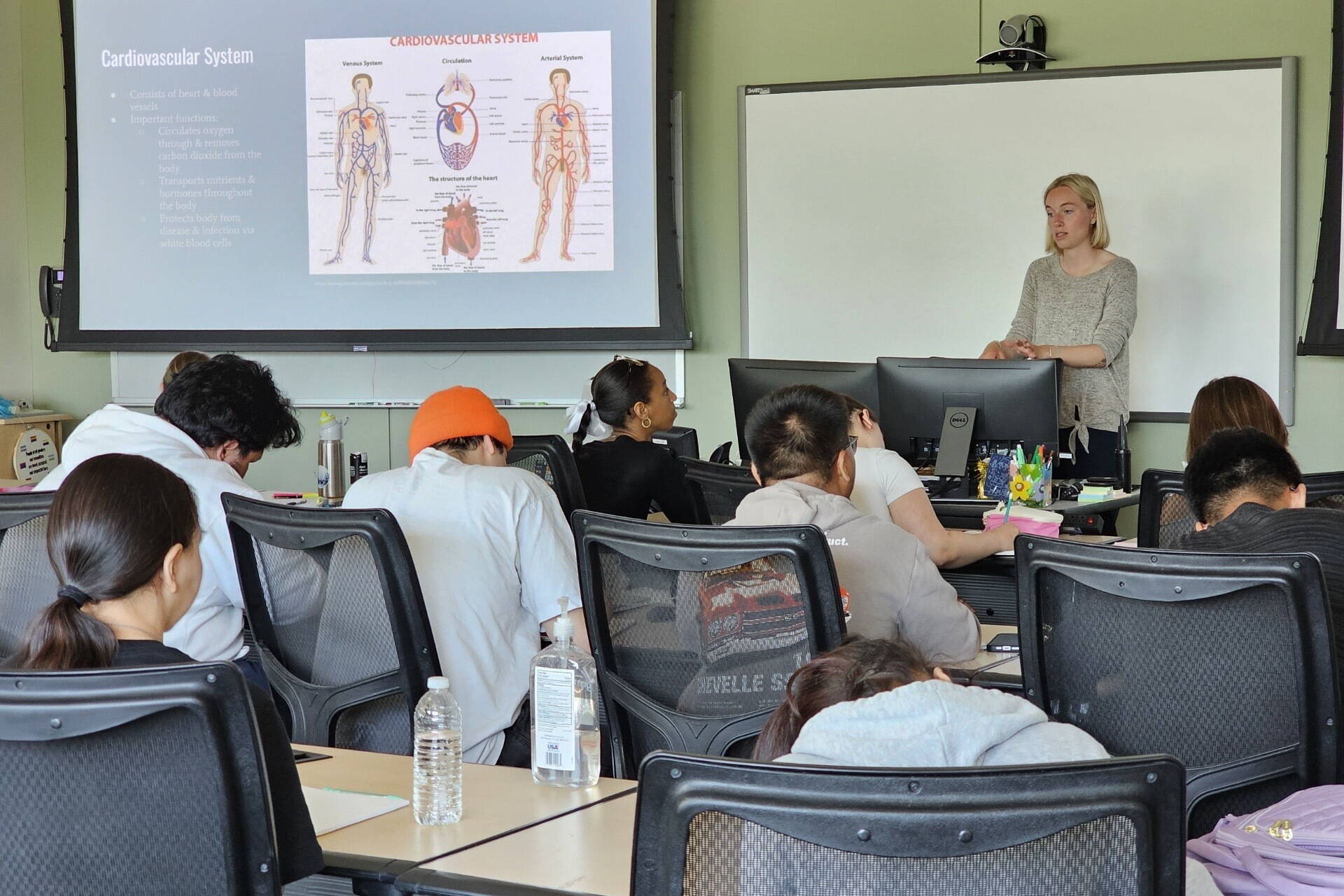
Of all the courses offered by the Della Keats precollege program, the three high school students in the University of Alaska Anchorage lobby were most struck by the cadaver lab in their Anatomy and Physiology course. It’s not the kind of opportunity students from rural Alaska usually get, which is the point.
Bristol Albrant, a 16-year old from Ketchikan, said the experience was indescribable. “That’s definitely not normal. Like, people just don’t get to have donors like that,” she said.
For Tanya Nelson from Napakiak, it was her first time seeing a cadaver. “Probably most of our first time,” she said with a smile.
Albrant wants to go to medical school, Nelson is interested in a nursing career and Cruz Kvaznikoff, an 18-year old from Nanwalek, said his interest in being an EMT was sparked by his father, who is in the medical field.
All three of them are living in Anchorage for a month as part of a program aimed at boosting the early college success of rural Alaska Native or otherwise underrepresented students interested in health-related careers. It is named after Della Keats, an Inupiaq traditional healer from the Noatak region.
The Della Keats program lapsed for six years due to a lack of funding, but is back for the first time since 2018. Halfway through the program, its organizers learned the initiative won a $1.3 million grant from the Indian Health Service that should keep it running for at least five more years.
The program aims to address a gap in health equity. Data shows that nationally, and in Alaska, Alaska Native and American Indian people are underrepresented in health careers. The program’s focus is on students considering careers in research, medicine, or health-related professions, so that Alaskans benefit from a more diverse healthcare workforce. The Della Keats reboot comes as the state grapples with a significant nursing shortage in the wake of the pandemic.
Gloria Burnett, the director of Alaska Center for Rural Health and Health Workforce at UAA, said several previous grant applications were unsuccessful, so this news is a relief. She said it eases the burden of solving financial problems, so administrators can focus on building the program.
“A lot of these students don’t have access in their home communities to these types of opportunities. So there’s definitely that culture shock of leaving their small home community and coming into a bigger place like the university,” Burnett said. “And what we’re trying to do is make that a more comfortable place and space for them while they’re still in high school, so that it’s easier for them once they graduate.”
Burnett said the new funds mean they will add new components to Della Keats, including outreach to K-eighth graders and creating an Alaska Native learning community for undergraduate students in the University of Washington’s multistate medical education program, known as WWAMI after the initials of the participating state’s names: Washington, Wyoming, Alaska, Montana and Idaho. The program has staff and courses on the UAA campus.
“Getting kids interested is one thing, and I think we’re doing a really good job of that in the state of Alaska, but not necessarily bridging into higher education,” she said. She said Della Keats bridges that gap by showing students what training programs look like, what requirements are, and introducing them to paperwork and financial aid. It also shows them how to live independently. Students live in dorms and are given a stipend that they must budget for things like daily lunches and weekend activities.
Students like Albrant, Nelson and Kvaznikoff experience college-like courses and independent dorm living with support from mentors who have been through the program and are now in medical school.
Chanmi Joo, a program alum who just finished her first year of medical school at University of Washington, participated in Della Keats twice. It is her fourth year as a mentor.
“Cadaver lab was also my favorite. And it not only solidified my desire to go into medicine, but I think it also helped me realize, like, this is how I can make an impact. Not just with patients, but also, like the future generation,” she said.
Joo said the program got her started on her path to being a surgeon by helping her decide which parts of the medical field were right for her, so she wants to be part of that for the next generation of health workers.
Nelson, who is interested in returning to Western Alaska for a nursing career in the hub city of Bethel, said the program has helped her decide which parts of medicine aren’t right for her, too. “I’m not into research,” she said. “I want to see patients.”
“Yeah, hands on,” Kvaznikoff added.
Albrant agreed: “I don’t love being in a lab. I kind of like more figuring out a problem and then solving the problem.”
After medical school, she said she wants to return to Alaska, too. “I think that for school, I might want to move around,” she said. “But then definitely come back to Ketchikan so I can try to give back as much as possible.”
• Claire Stremple is a reporter based in Juneau who got her start in public radio at KHNS in Haines, and then on the health and environment beat at KTOO in Juneau. This article originally appeared online at alaskabeacon.com. Alaska Beacon, an affiliate of States Newsroom, is an independent, nonpartisan news organization focused on connecting Alaskans to their state government.
