
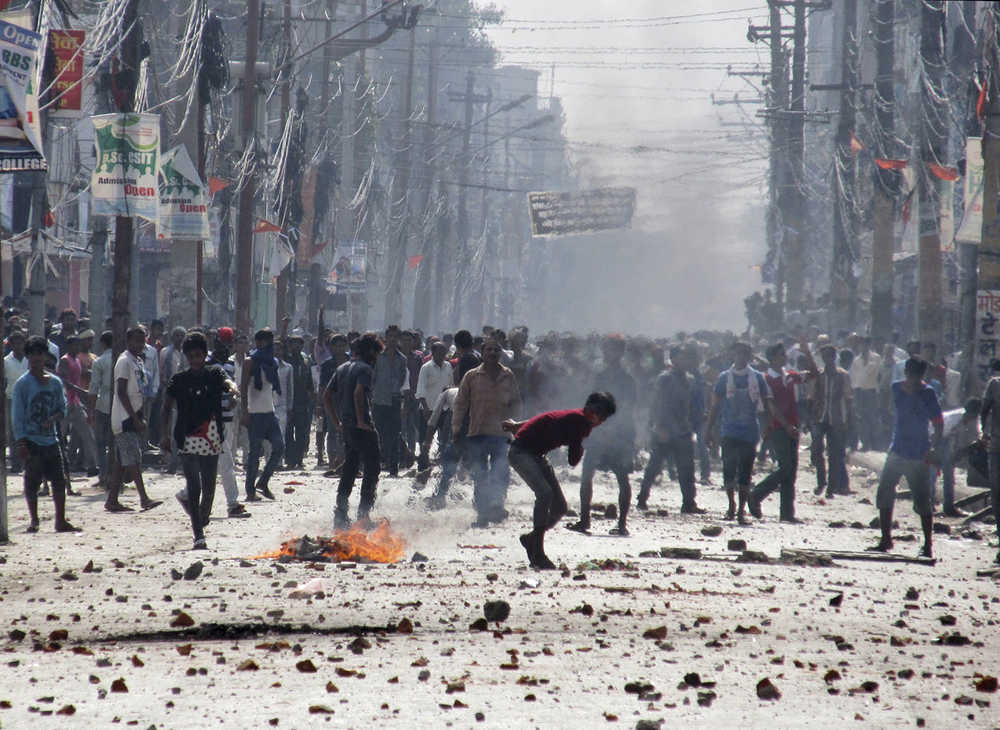
KATHMANDU, Nepal — Police shot Monday at ethnic protesters who attacked a police station with a gasoline bomb and stones on Nepal’s southern border, killing an Indian man who was among the attackers, Nepalese officials said.
Police official Raju Bahadur Shrestha said six officers at the police station were injured. “One of our officers was almost burnt to death, we managed to rescue him,” Shrestha said.
Shrestha said the man killed was an Indian involved in the attack, identified as Ashish Kumar Ram. Earlier, Indian police official Rakesh Kumar had said the man was on his way to the Nepalese town of Birgunj.
The attack happened about 980 feet inside Nepalese territory. People from Nepal and India are not required to have documents or visas to cross the border.
The ethnic Madhesi protesters say Nepal’s new constitution unfairly divides the group into a number of states, diluting their political power. They want a larger state and more political representation. The protesters have imposed a general strike in southern Nepal and blocked the main border crossing between Birgunj in Nepal and Raxaul in India, resulting in a severe fuel shortage across Nepal. At least 45 people have been killed in the protests since August.
The Madhesi ethnic group has close cultural ties to India, whose officials have raised concerns about the new constitution’s treatment of ethnic minorities.
Indian Prime Minister Narendra Modi called his Nepalese counterpart, Khadga Prasad Oli, to condemn the killing, an Indian government statement said.
Modi urged Nepal’s leaders to find an early solution to the crisis, it said.
“Issues facing Nepal are political in nature and cannot be resolved by force. Causes underlying the present state of confrontation need to addressed by the government of Nepal credibly and effectively,” Indian External Affairs Ministry spokesman Vikas Swarup said in New Delhi.
In Washington, State Department spokeswoman Elizabeth Trudeau said Monday the U.S. was encouraging all Nepalis to engage in the democratic process through peaceful means, and for security forces to exercise “appropriate restraint.”
She also urged Nepal’s leaders to reach an accommodation that builds the broadest possible support for the constitution.
Earlier Monday, Nepalese police were able to clear protesters from the border point, allowing more than 200 trucks and vehicles to cross over to India. However, hundreds of protesters were back at the bridge and completely blocked the border.
Police official Hobindra Bogati said five protesters were detained when police removed them and the tents they had pitched in the no man’s land between the two countries. He said that 205 trucks and other vehicles had crossed from Birgunj to Raxaul, India.
However, trucks bringing fuel and other goods to Nepal were still blocked by Indian customs officials.
An indefinite curfew has been imposed in Birgunj.
On Sunday, talks between the government and Madhesi representatives made some progress.
Deputy Prime Minister Kamal Thapa said the government would address the Madhesis’ demand for a larger state through discussions with other political parties.
Initially, the government insisted that the matter of the size of states be resolved through a government-appointed commission, but Thapa said it would be discussed as a political issue, as demanded by the protesters.
The government also agreed to the United Democratic Madhesi Front’s demands that families of killed protesters be given compensation, that the government pay for medical care for the injured, and that cases against the jailed be withdrawn.
___
Associated Press writers Indrajit Singh in Patna, India, Ashok Sharma in New Delhi, and Matthew Pennington in Washington contributed to this report.
