
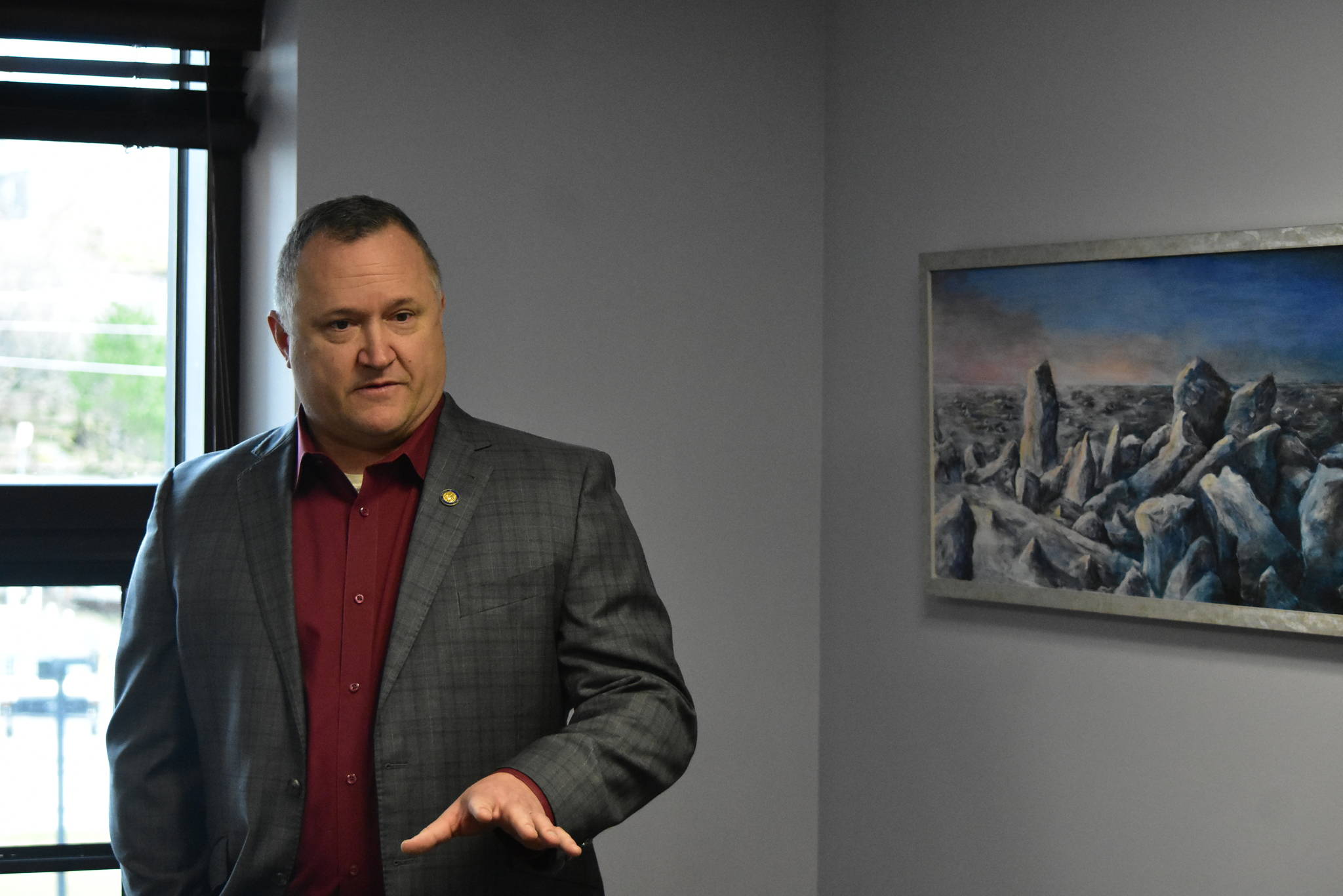
Sen. Mike Shower, R-Wasilla, introduced an updated version of a bill he said is meant to restore Alaskans’ faith in the country’s elections.
An earlier version of Shower’s bill was met with strong criticism for some of its provisions, and at a Thursday news conference, he told reporters the updated version was meant to address some of those concerns.
Shower insisted his bill was not meant to be partisan, but meant to address concerns about the integrity of U.S. elections coming from across the political spectrum.
“I see how it swings,” he said, referring to claims questioning the outcomes of both the 2016 and 2020 presidential elections.
“I’m merely trying to find a way to make it tighter and better so people will have faith in the results even if they don’t like them,” Shower said.
Shower said the Alaska Division of Elections has policies that leave the state vulnerable to various kinds of voter fraud and led to legitimate ballots being thrown out for technical errors. The bill would introduce a ballot-tracking system with notifications for when a voter’s ballot has been disqualified, he said, something which had been used successfully in states such as California.
[Security or suppression? Bill would change how Alaskans vote]
The bill would also add multifactor authentication and blockchain technologies to the state’s voting process to ensure a higher level of security, Shower said.
Lastly, Shower said the state’s voter rolls are not updated frequently which can lead to ballots going to people who no longer live in the state. Sending out large numbers of blank ballots poses a security risk, Shower said, as those could be used to cast illegitimate ballots. The risk was elevated by the fact the state had been the victim of data breaches, leaving voter information exposed.
The original version of Shower’s bill provoked strong rebuke from some critics who said some of its provisions, such as limits on the use of by-mail voting, amounted to voter suppression. Thursday, Shower repeated that his bill is trying to satisfy an array of concerns and will likely change drastically once it moves to the House of Representatives.
Shower’s updated version changed who would be able to deliver another person’s ballot but still limited that ability to immediate family members and caretakers. He is opposed to the practice of what he called “ballot harvesting” in which paid employees collect ballots in certain areas or from certain voters.
In an interview in January, Lt. Gov. Kevin Meyer told the Empire the state has a way of catching duplicate votes and belonged to the Electronic Registration Information Center, a multi-state project to ensure voters aren’t registered in another state.
But only 29 states are members of ERIC, which wasn’t enough to bring assurance to the voting system, Shower said, and the state does not currently forensically verify voter signatures. Shower’s bill would have Alaska’s voters rolls checked against multiple databases including ERIC but also the federal Department of Homeland Security.
The bill says the Division of Elections should follow nationally recognized best practices for voter roll maintenance from organizations like ERIC. However, one of the voter registration checking programs listed in Shower’s bill is the now-defunct Interstate Voter Registration Crosscheck Program, which was shut down in 2019 following a lawsuit for improperly exposing personal information, according to the Associated Press.
Shower said the Oct. 27, 2020 data breach of DOE illustrated the need for better data security and his bill was trying to bring Alaska’s elections into the 21st Century. But a November 2020 report from the Massachusetts Institute of Technology cautioned the use of blockchain technology in voting, saying there is limited research proving its effectiveness. Furthermore, the study said, research that had been conducted found “risks persist in blockchain-based voting systems, but blockchains may introduce additional problems for voting systems.”
In an email, DOE spokesperson Tiffany Montemayor said the state already has in place methods for informing voters about issues with their ballots but acknowledged the state has no way of verifying signatures. The Municipality of Anchorage does have those signature verification systems for its elections, but that is not part of the state’s election system.
There are several election reform bills both in Alaska and nationally, and Shower repeated several times his bill was meant to improve a system that had clear issues.
“We can do better,” Shower said. “There are so many exciting things we can and should be doing.”
• Contact reporter Peter Segall at psegall@juneauempire.com. Follow him on Twitter at @SegallJnuEmpire.
