
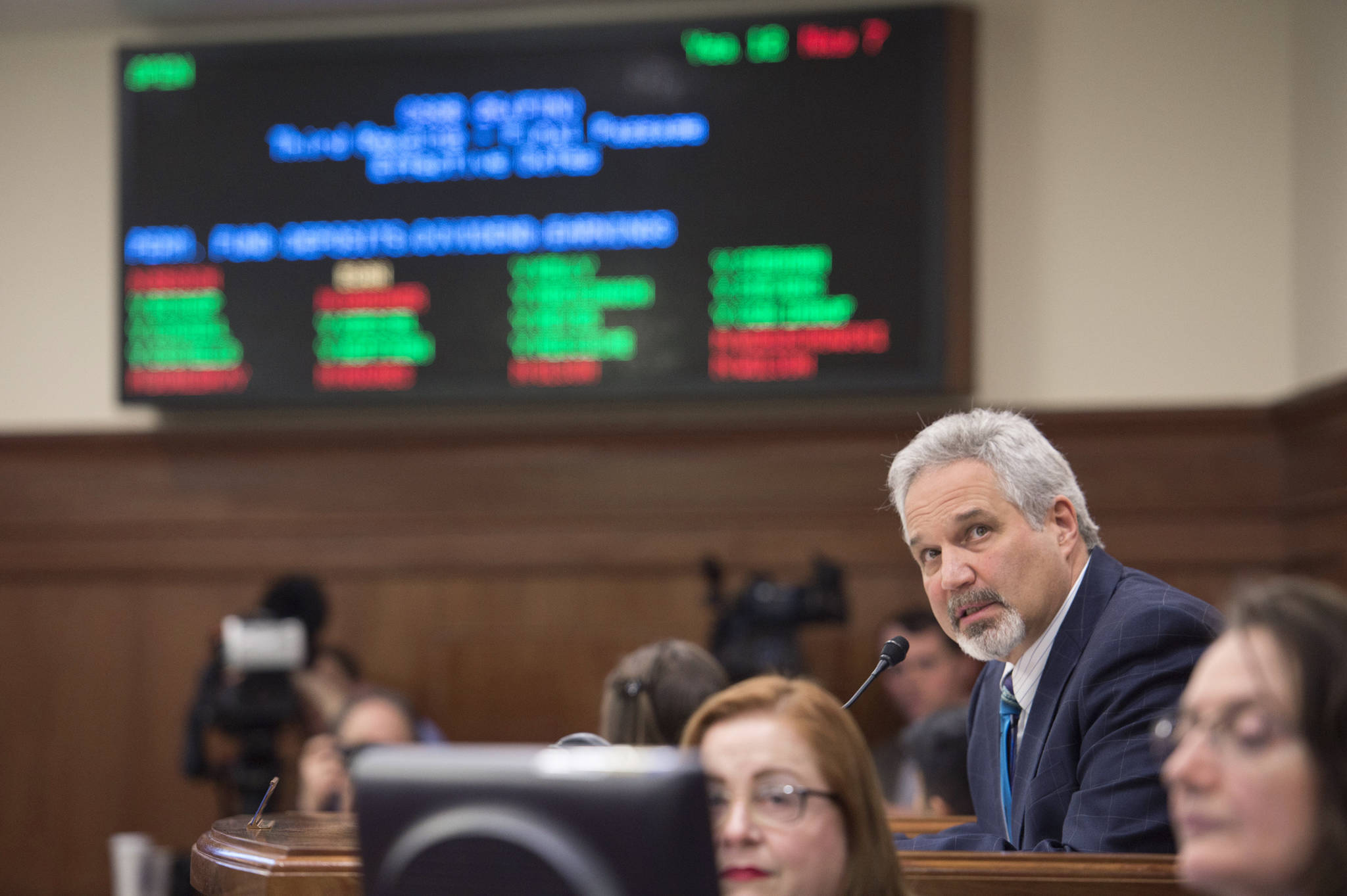
Lawmaker after lawmaker said the Senate does not relish the idea of touching what has long been a political third rail — the Permanent Fund — but they see no other alternative.
The Alaska Senate has approved a sweeping reformation of the Alaska Permanent Fund that generates billions to fix the state’s budget deficit but halves the Permanent Fund Dividend.
“Alaska has a problem, and that problem is that our revenue doesn’t meet expenses and we’ve been drawing from our savings account for the past five years,” said Sen. Anna MacKinnon, R-Eagle River and co-chairwoman of the Senate Finance Committee.
“We don’t have a lot of choices left,” MacKinnon said.
Opposition to the bill came from members of the Senate’s Democratic minority and from the Republican senators who come from the Matanuska-Susitna Borough.
Sen. Bill Wielechowski, D-Anchorage, who initiated a lawsuit against the governor back in 2016, offered an impassioned and lengthy speech about how SB 26 is a de facto tax of $1,000 on every Alaskan.
Because the same amount is taken from everyone, “this plan taxes the secretary at a much, much higher rate than the millionaire CEO,” Wielechowski said.
Wielechowski and Sen. Mike Dunleavy, R-Wasilla, proposed amending the bill on the floor, but no amendments passed.
Judging by the amount and volume of public testimony against the proposal, the idea of spending a portion of the Permanent Fund remains unpopular among Alaskans.
“The public has told us they want us to keep our hands off the Permanent Fund,” Wielechowski said.
“I think the people are not going to be real happy with this plan,” he added during a press conference after the bill’s passage.
In a special advisory vote held in 1999, the last time the Legislature seriously considered using the earnings of the Permanent Fund, 83.25 percent of voters said no. While the vote wasn’t binding, the Legislature retreated from the idea.
Business groups, meanwhile, have testified in favor of the proposal. Among those offering letters of support were the Resource Development Council, Associated General Contractors and Northrim Bank, which said in a letter, “Passage of this legislation will go farther than any other action to prove that we have the means to balance our budget and regain the confidence of the market.”
Details of the proposal
Senate Bill 26, which passed in a 12-8 vote, advances to the House for consideration. It will become law only if the House and Gov. Bill Walker also approve.
The bill does not touch the constitutionally protected principal of the Permanent Fund. Instead, it spends some of the money the Permanent Fund earns when that principal is invested, money that is currently deposited into the fund’s $10.6 billion earnings reserve.
If approved by the House and signed into law by the governor, SB 26 would take 5.25 percent of “the average year-end market value” of the Permanent Fund and its earnings reserve combined.
That average is calculated using five of the previous six years, a technique designed to moderate big swings in the investment markets.
In fiscal year 2018, that formula would generate $2.5 billion per year for dividends and government services.
Seventy-five percent of that figure would be applied to Alaska’s $2.7 billion budget deficit, dropping it to $819 million, according to calculations by the nonpartisan Legislative Finance Division. The remaining 25 percent would pay dividends.
The bill requires the Permanent Fund Dividend to be $1,000 in 2017, 2018 and 2019.
Speaking on the Senate floor, Sen. Gary Stevens, R-Kodiak, said that amount is close to the long-term average dividend amount.
Without the bill — or any vetoes by the governor — the dividend is expected to be more than $2,000 per person.
After 2019, the value of the dividend is expected to gradually rise above $1,000, but it would fall if the Permanent Fund’s investments do worse than expected.
That system would stay in place for three years, then the draw would decline to 5 percent of the average value. The Permanent Fund is expected to earn an average 7 percent return on its investment, and the reduction in the draw is designed to provide a safety measure and help the Senate create one of its longstanding wishes — a smaller government.
Spending cap included
In addition to the spending measures, SB 26 includes a $4.1 billion spending cap of dubious effectiveness. It’s dubious because one Legislature cannot bind a future Legislature through statute. It’s the same reason Legislatures have repeatedly violated the law calling for a 90-day Legislative session: The law isn’t legally binding.
Only a constitutional limit can bind the Legislature, and lawmakers have proposed an amendment that would strengthen the spending cap that already exists in the Alaska Constitution. That measure would have to be approved by voters to become effective.
Dunleavy, speaking in opposition to SB 26, said he feels the Senate is “putting the cart before the horse” by not requiring greater budget cuts and greater surety before its passage.
“I think immediately we have to work on the constitutionalization of that fund,” he said.
In addition to the spending cap, SB 26 includes a provision to automatically reduce the Permanent Fund draw if oil revenue tops $1.2 billion per year. For every dollar of oil revenue above that figure, a dollar will be removed from the Permanent Fund draw.
According to figures provided by the Alaska Department of Revenue, that limit will be reached in fiscal year 2019, when oil revenue is expected to reach $1.34 billion. By fiscal year 2026, oil revenue is expected to reach $1.56 billion, a figure that would reduce the Permanent Fund draw by some $360 million.
House action ahead
In the House, lawmakers are considering a similar but wider-reaching bill. House Bill 115, now in the House Finance Committee, calls for a 4.75 percent draw from the Permanent Fund, lower than the Senate’s proposal. In a significant difference from the Senate plan, HB 115 also includes an income tax, something the Senate has been reluctant to consider.
The Legislature has been in this position before. The Senate last year approved a Permanent Fund bill that died in the House during the Legislature’s extended summer special sessions. The Senate Bill 128 passed the Senate in a 14-5 vote on June 6.
“I’m still concerned the same thing will happen again this year,” said Sen. Dennis Egan, D-Juneau. Egan voted for SB 26 but changed his vote on reconsideration and will go into the books as a “no”.
HB 115 and other measures proposed by the House are intended to completely eradicate the state’s deficit within a few years. The Senate, which is expected to propose deeper budget cuts than the House, does not have a plan to eliminate the entire deficit.
That worries some lawmakers.
“If this bill passes, we in the Senate are going to wash our hands of this budget crisis issue and claim victory that we’ve fixed the problem,” said Sen. Donny Olson, D-Nome.
Vote tally
Yes: Bishop, Coghill, Costello, Giessel, Hoffman, Kelly, MacKinnon, Meyer, Micciche, Stedmans, Stevens, Von Imhof (12)
No: Begich, Dunleavy, Egan*, Gardner, Hughes, Olson, Wielechowski, Wilson (8)
*Sen. Dennis Egan, D-Juneau, voted for the proposal on the first vote, but upon reconsideration changed his vote to “no”.
The governor joined the crowd in the Senate gallery as the vote neared. “I was very pleased with the outcome,” he said after the fact.
• Contact reporter James Brooks at james.k.brooks@juneauempire.com or call 419-7732.
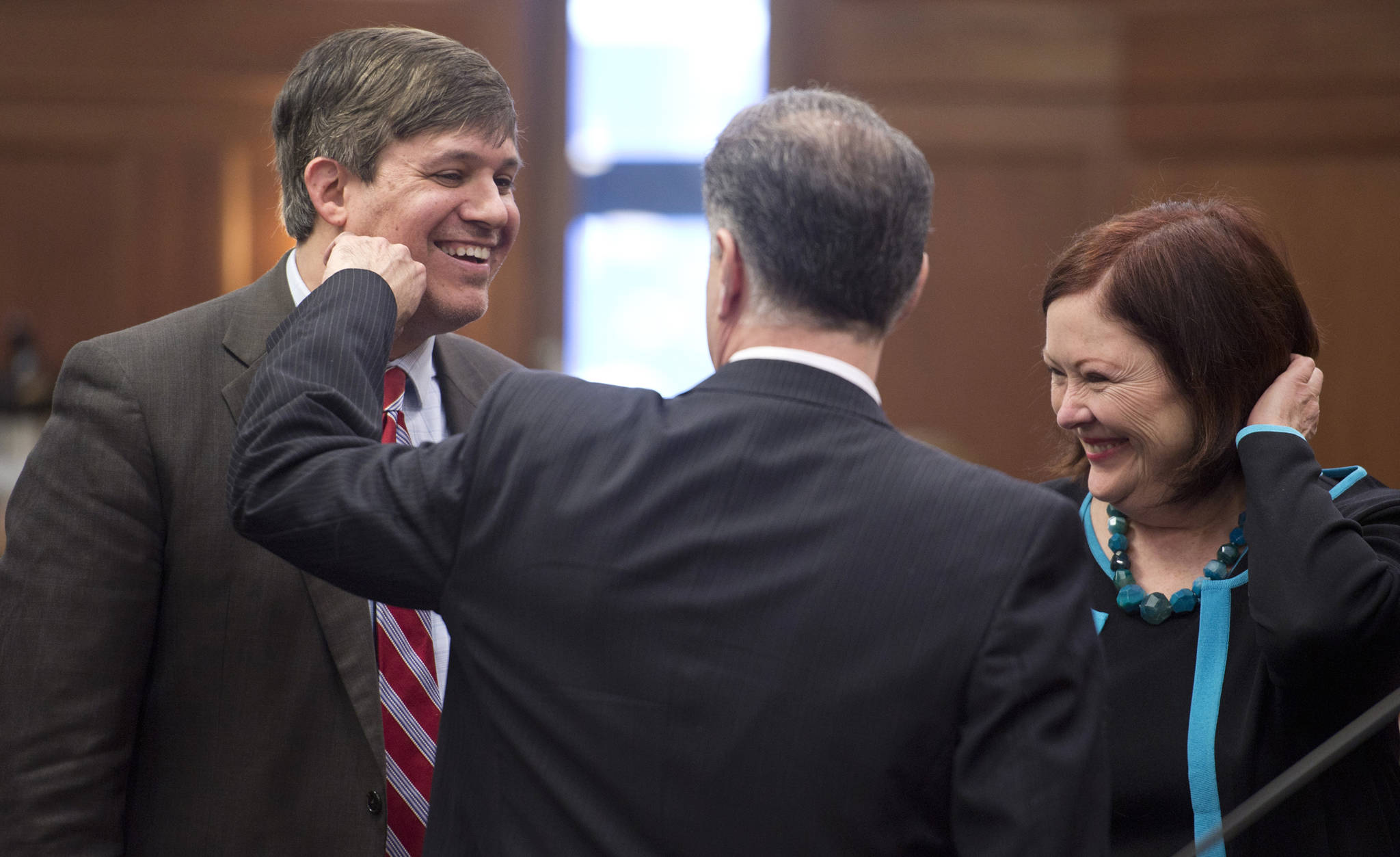
Sen. Bill Wielechowski, D-Anchorage, left, receives a lighthearted punch by Senate Majority Leader Pete Micciche, R-Soldotna, as Senate Minority Leader Berta Gardner, D-Anchorage, watches after Wielechowski’s three amendments to SB 26 were voted down in the Senate chambers on Wednesday. The Senate voted to use a portion of earnings from the Alaska Permanent Fund to fund government and cap dividends at $1,000 per person. (Michael Penn | Juneau Empire)
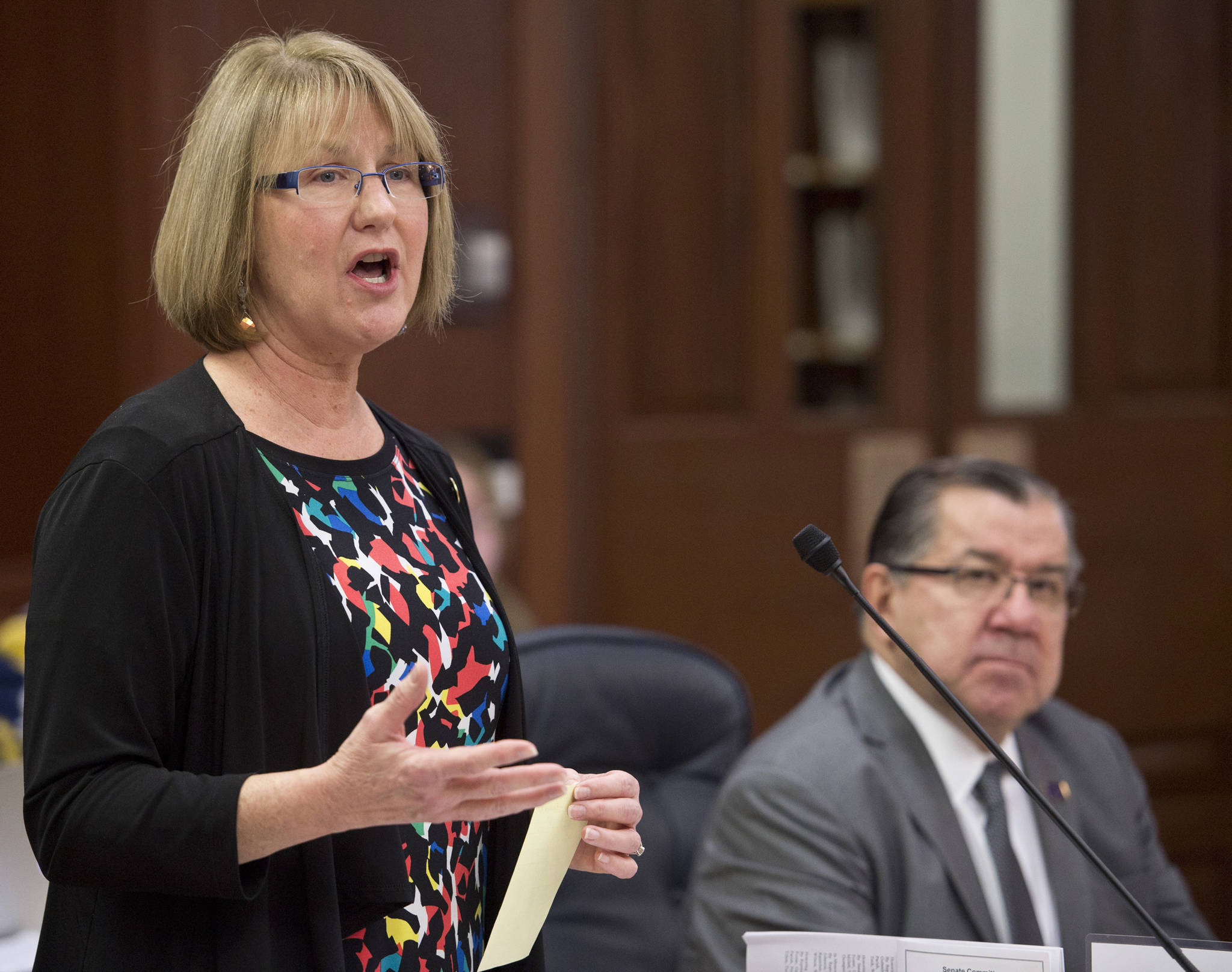
Sen. Anna MacKinnon, R-Eagle River, speaks in favor of SB 26 as Sen. Lyman Hoffman, D-Bethel, listens in the Senate chambers on Wednesday. The Senate voted to use a portion of earnings from the Alaska Permanent Fund to fund government and cap dividends at $1,000 per person. (Michael Penn | Juneau Empire)
