
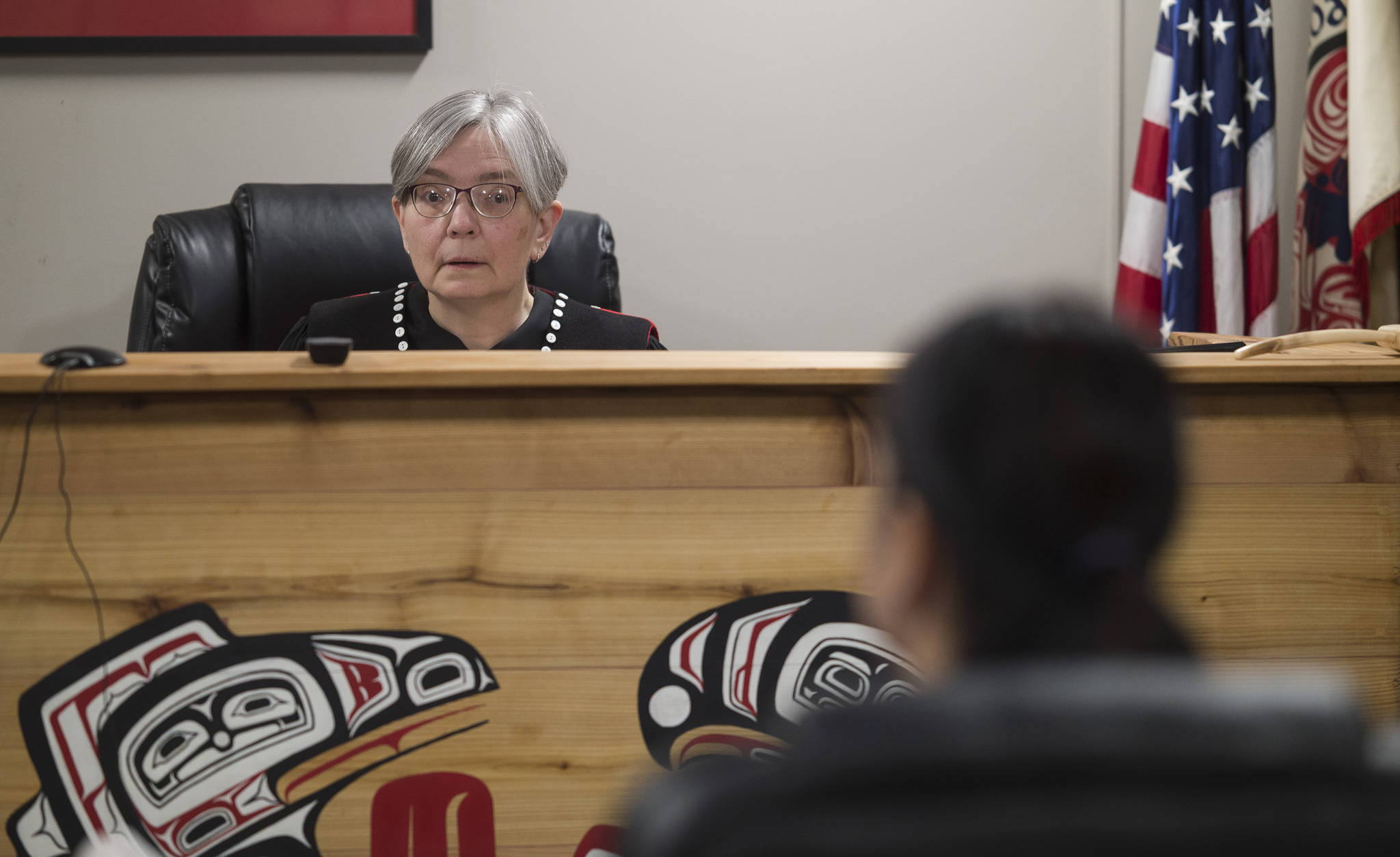
Tribal Court Presiding Judge Debra O’Gara walked into the courtroom on a morning in early April and took a seat at the front of the courtroom, within reach of three stuffed animals.
Many of the cases O’Gara deals with in Tribal Court, including this one, deal with custody or child support. There weren’t any children in the courtroom this morning, but she said afterward that the stuffed dog and seal near her seat come in handy.
“Some of the work that we do, we have to start really young and I want our children to not be afraid to come into this court,” O’Gara said. “If our children are not afraid, maybe their parents won’t be either.”
The feel of the Tribal Court is very welcoming, and O’Gara prides herself on being able to find the balance between making people comfortable while also taking the proceedings very seriously.
O’Gara comes from a family of lawyers and activists. Tlingit civil rights leader and Alaska’s first Native lawyer William Paul Sr. (seen as a pivotal figure in the history of the Alaska Native Claims Settlement Act of 1971) was her great-uncle. Other men in the family also went into law, and O’Gara ended up taking an interest in it as well.
“It was time for the women to take over, I guess,” O’Gara said with a laugh.
Prior to coming to the Central Council of Tlingit and Haida Indian Tribes of Alaska (CCTHITA) Tribal Court in 2007, O’Gara worked as a prosecutor, staff attorney, private practitioner and mediator. She was magistrate and chief justice at the Tribal Court before being hired as presiding judge in 2015.
She has worked all over the country, but one constant in her career is working with victims of domestic violence. O’Gara said it was “eye-opening” at first to see just how pervasive violence in the home is, and has worked for more than 20 years on domestic violence and sexual assault issues.
When she started working with the Puyallup Tribe in Washington, the tribe didn’t have a statute in place regarding domestic violence and the court didn’t have the ability to issue protective orders. O’Gara helped change that, and by the time she left, the tribal court was issuing protective orders and prosecuting domestic violence offenses.
The CCTHITA Tribal Court was established in March 2007, O’Gara said, which was soon after she arrived. When it began, the court also wasn’t able to enforce anything related to domestic violence. The court dealt solely with custody and child support, O’Gara said.
In 2012 or 2013, she recalled, the court got a grant from the Department of Justice’s Office on Violence Against Women that put the court on its way to being able to issue protective orders. O’Gara can do that now, though she said the court still can’t prosecute domestic violence offenses.
O’Gara said the welcoming nature of the courtroom helps make a difficult process for victims a little bit easier.
“I think our tribal citizens are a little more comfortable coming into this environment and telling their story, which they have to tell to get a protective order,” O’Gara said. “It’s a little bit more comfortable for folks, not just the victims but their witnesses to come into this court. It’s not informal that we just let anything happen, but it’s more accessible.”
When tribal citizens need to go to court, O’Gara explained, they have a choice of either going to state court or tribal court. There are far fewer people coming to Tribal Court, O’Gara said, so it’s easier to get a court date and there’s less time between hearings.
With so few Alaska Native judges in the state, O’Gara said she finds great value in setting an example for children while providing a bit of comfort for those in court. Having a judge who looks like you, she said, is a great service to people who find themselves in a courtroom.
“There’s also a difference to appearing before a judge who might know what your story is and feeling like it might be OK to talk to this judge,” O’Gara said, “a judge that looks like you or talks like you or is from a similar (background).”
• Contact reporter Alex McCarthy at 523-2271 or amccarthy@juneauempire.com. Follow him on Twitter at @akmccarthy.

Judge Debra O’Gara enters the Central Council Tlingit and Haida Indian Tribes of Alaska’s Tribal Court on Wednesday, March 14, 2018. (Michael Penn | Juneau Empire)
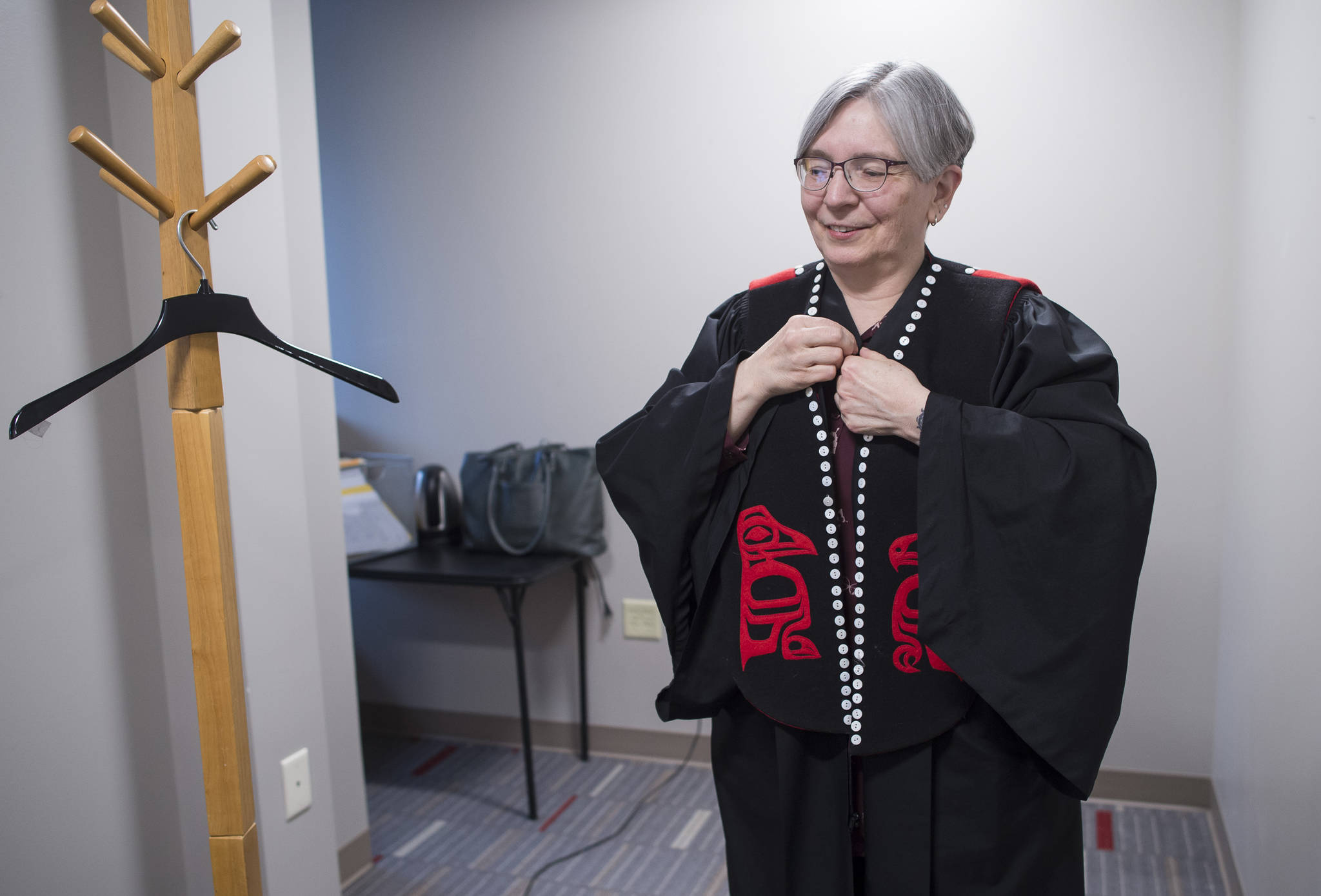
Judge Debra O’Gara puts on her robe before entering the Central Council Tlingit and Haida Indian Tribes of Alaska’s Tribal Court on Wednesday, March 14, 2018. (Michael Penn | Juneau Empire)
