
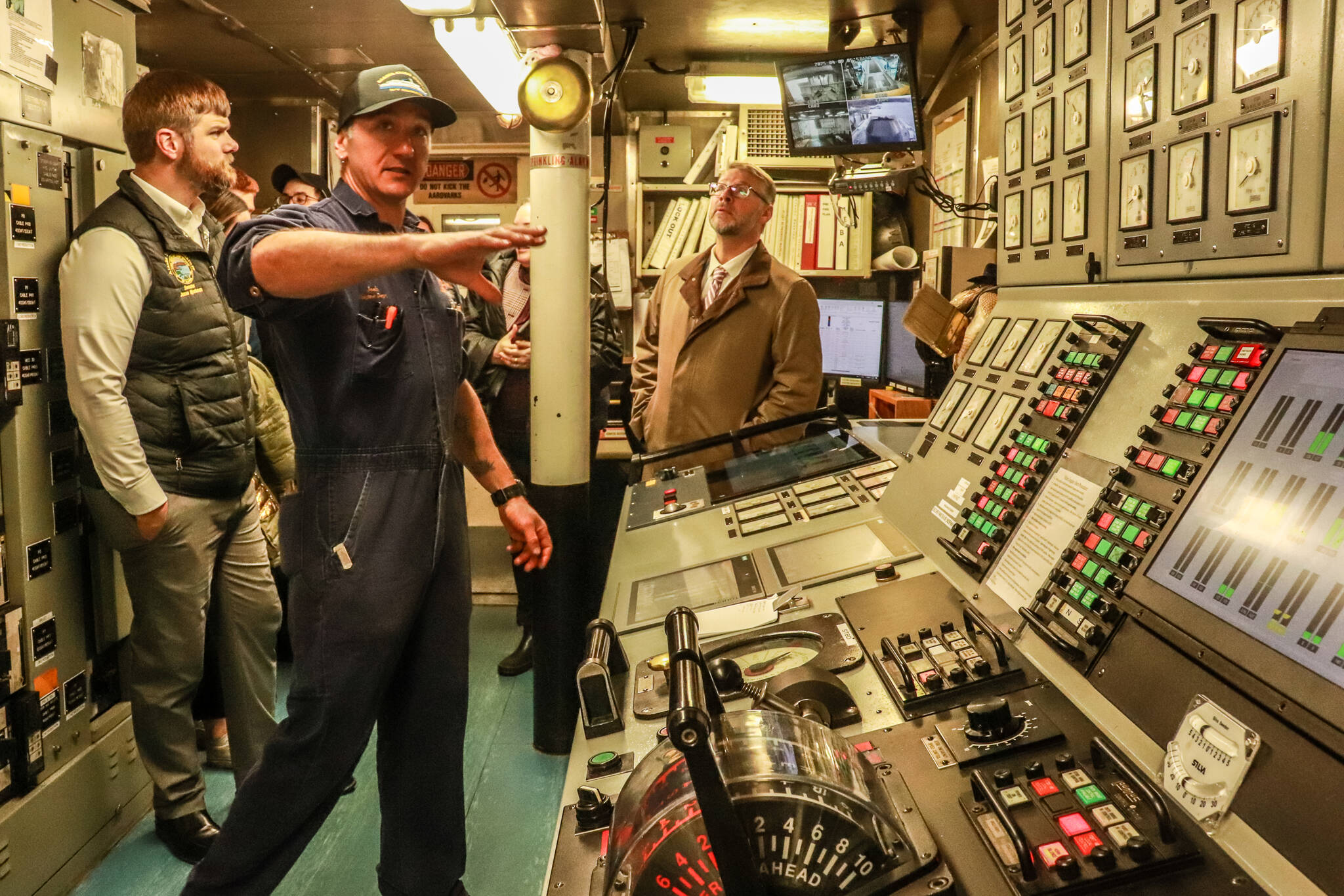
Josh Chevalier says working as the chief engineer aboard the MV Columbia is rewarding because there’s always a new problem to solve, but right now one of the challenges is finding other workers who share that enthusiasm.
He was among the crew members providing members of the Alaska State Legislature insight into a day in the life of working aboard the biggest and fastest ship in the Alaska Marine Highway System fleet.
Chevalier said it’s the first time in his 21-year career he witnessed this kind of exchange between engineers and legislators, since another challenge is finding time during the day when the vessels are at the dock long enough to conduct a tour.
“It’s nice to see them come out and look at the boats and find out what we do,” he said, guiding legislators to the engine room during the April 8 tour. “I think we’re responsible for a lot more than they realize. I get it, especially engineers, knowing we’re kind of out of sight, out of mind.”
Chevalier said growing up fishing in Sitka inspired him to pursue working on a boat. He emphasized that it took him 16 years to acquire his current position. He attended the Seattle Maritime Academy and worked his way up.
An online career pathways guidebook describes the career path for a wiper to chief engineer. AMHS has a capacity for 77 engineers and is missing 15, according to the Marine Engineers’ Beneficial Association (MEBA).
“We require the same credentials that a 1,000-foot container ship does,” Chevalier said. “It’s really hard to find people, especially around here with a small labor pool that have the credentials we need.”
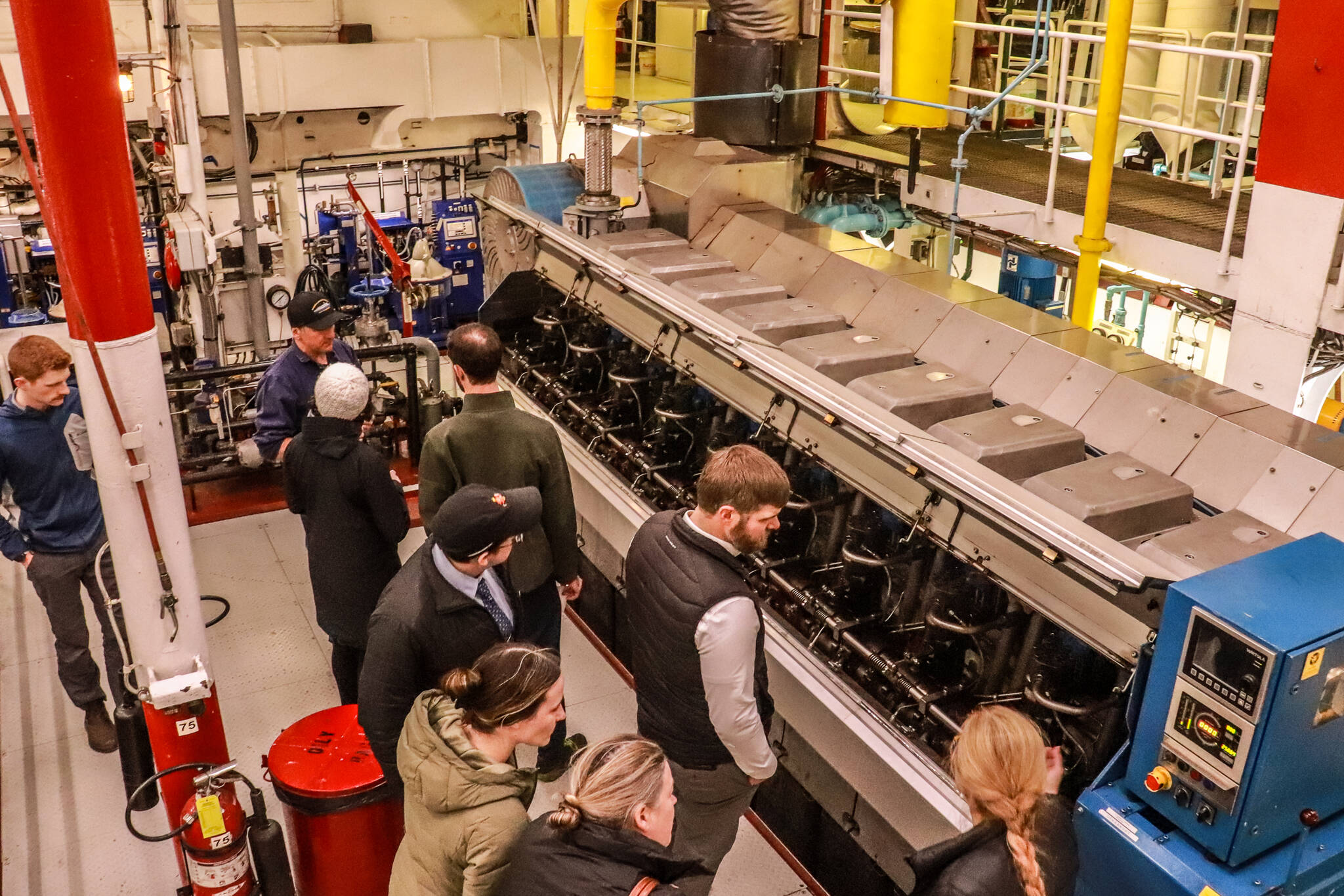
Josh Chevalier, chief engineer of the MV Columbia, opens “hot boxes” to show the legislators the fuel rack, its connection to the governor, and the individual fuel pumps to each cylinder of each engine, as well as the associated high-pressure fuel piping to the fuel injectors. Each cylinder has one injector, also accessed in the “hot box”. (Jasz Garrett / Juneau Empire)
As he welcomed legislators aboard the ship, he acknowledged the challenges of retaining staff. He said it’s a global industry, so competing with other maritime companies is hard.
“I think that people just don’t understand the challenges involved with fixing the staffing issue, it’s a small industry, it’s a specialized industry, and it takes a lot of time,” he said. “Most of us who have stayed care about the industry. It is satisfying. I’ve talked to people who have gone other places — more money, but the thing they miss is they don’t feel like they’re providing a service.”
Columbia has six engineer billets: one chief engineer, one first assistant engineer, one second assistant engineer, and three third assistant engineers. The vessel has two crews, so there are a total of 12 engineer billets for the vessel.
Chevalier told the tour group that the boat is like a floating city, making the engine room the heart of the beast.
The 52-year-old Columbia is 418 feet long and 85 feet wide, with a domestic gross tonnage of 3,946 and a service speed of 17.3 knots. The boat has three caterpillar generators and runs on diesel fuel. Two generators are always running and the third is a spare in compliance with U.S. Coast Guard regulations. The Columbia was out of service much of last year due to extensive corrosion in the ship’s fire suppression system.
In the engine control room, Chevalier said the crew is on a 24-hour watch. They check machinery daily. Every single week, they undergo emergency response training. In the case of a generator fire, which Chevalier has responded to, they utilize an emergency saltwater cooling system. The crew is expected to be aboard for two weeks, but due to the lack of staffing that’s often extended by another four weeks.
“How does that impact morale?” Sen. Löki Tobin (D-Anchorage), vice chair of the Senate Transportation Committee, asked.
Erik Cook, third engineer, discovered on April 5 he wouldn’t have relief, meaning he’d be staying aboard a total of six weeks. He said it’s hard, but he understands the importance of the ferry system because he grew up in Haines.
“If you miss a ferry there’s another one a day or a two later, back and forth,” he said. “It’s sad what’s happened.”

Josh Chevalier, chief engineer of the MV Columbia, shows legislators the engine control room, and explains the control and monitoring systems on Tuesday, April 8, 2025. (Jasz Garrett / Juneau Empire)
Claudia Cimini, the Alaska-Seattle representative for MEBA, said sometimes staff holdovers can give the appearance that AMHS is not suffering a severe workforce shortage since the ferry still operates. Other times, ferry service is limited. Engineers work 12 hours a day, seven days a week, in a high-stress, high-noise, high-heat environment. Their skill set includes working on diesel engines, plumbing, piping, and bathroom repairs.
She said a holdover should be used in an emergency, but it’s becoming increasingly common, which is unsustainable.
“Those two engineers who were expecting to have their two weeks off could not have their two weeks off,” she said. “They had to stay on board so that the ship could run. If they left, the ship would have not even been able to leave the dock.”
Cimini is working with the union representing AMHS ferry engineers, who are bargaining for more competitive wages to address workforce shortages and the impending retirement of a number of senior mariners. She said as many as 30% of engineers either are currently eligible for retirement or will be in the next five years, and depending on wages and working conditions, some people may want to retire sooner.
“I thought it was an excellent opportunity for education,” Cimini said about the legislators’ visit. “We’re invisible to most people. They know what captains are, they know what captains do. No one hardly ever sees an engine room, let alone goes into one. We have this really broad range of skills. We’re responsible for the operation, maintenance and repair of all the ship’s propulsion and auxiliary machinery. Literally everything it takes to keep a ship running and keep the lights on.”
She noted the ferry system is critical infrastructure connecting communities in Alaska, and “these are the people who make it happen.”
“The marine highway connects communities and supports commerce and the economy the same way as the paved highway,” she said.
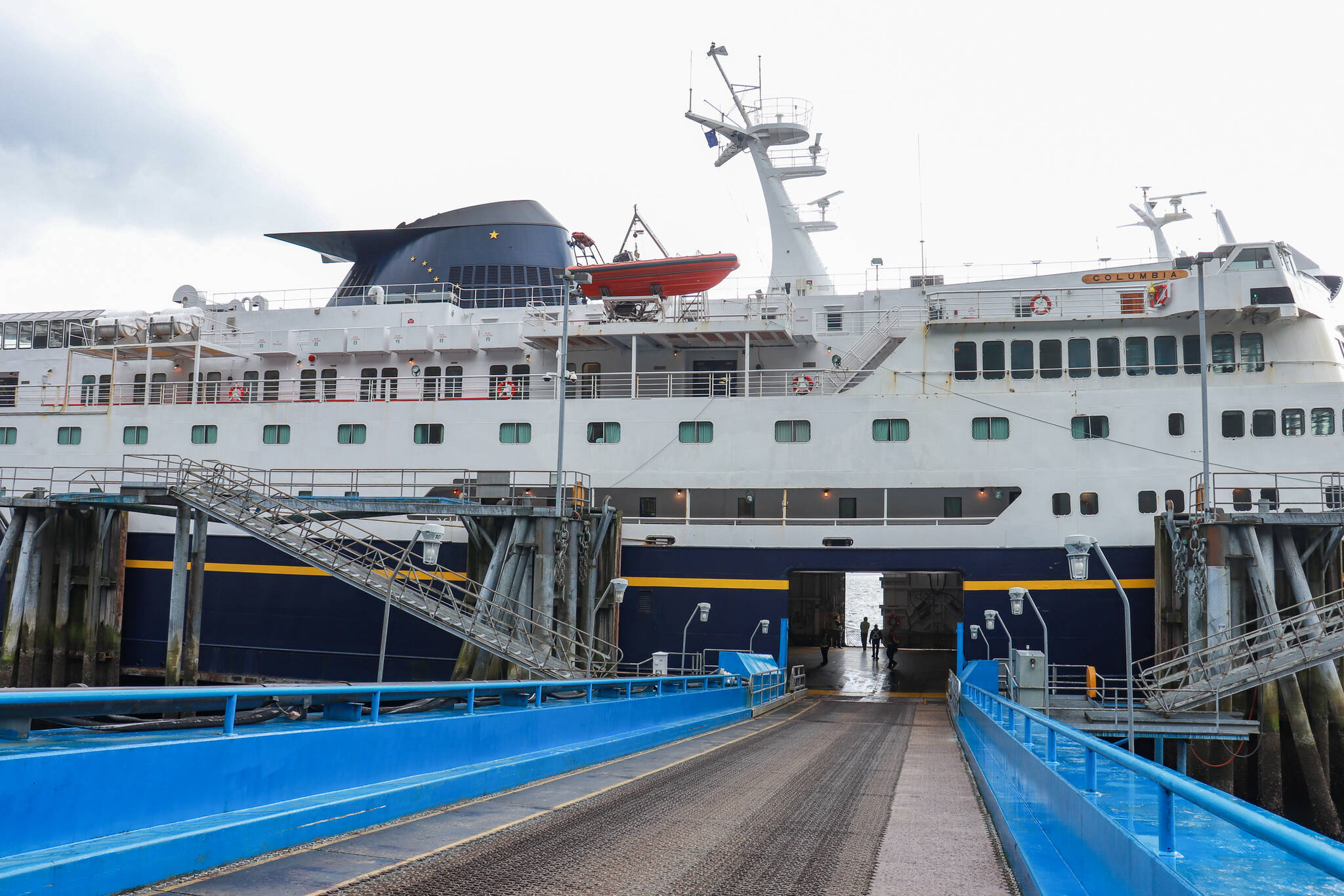
The MV Columbia awaits passengers in Juneau on Tuesday, April 8, 2025. (Jasz Garrett / Juneau Empire)
A petition online asks for competitive compensation to retain and recruit the AMHS crew members needed “to restore safe, reliable ferry service.”
AMHS Marine Director Craig Tornga often rides on ferries, talking with crews to better understand their needs. He said the goal of the tour was for legislators to see what engineers do and the work it takes to acquire a license. Many of the crew have degrees in marine engineering, which is a concentration of mechanical engineering.
“To get a license, you’re more than a mechanic, you’re an electrician, you’re a technician,” he said. “We do compete nationally for all the same licenses. Until we produce more out of academies and train more, it’s quite a bit hard. There’s no way we could keep this going without them. It’s great to recognize what they do.”
• Contact Jasz Garrett at jasz.garrett@juneauempire.com or (907) 723-9356.
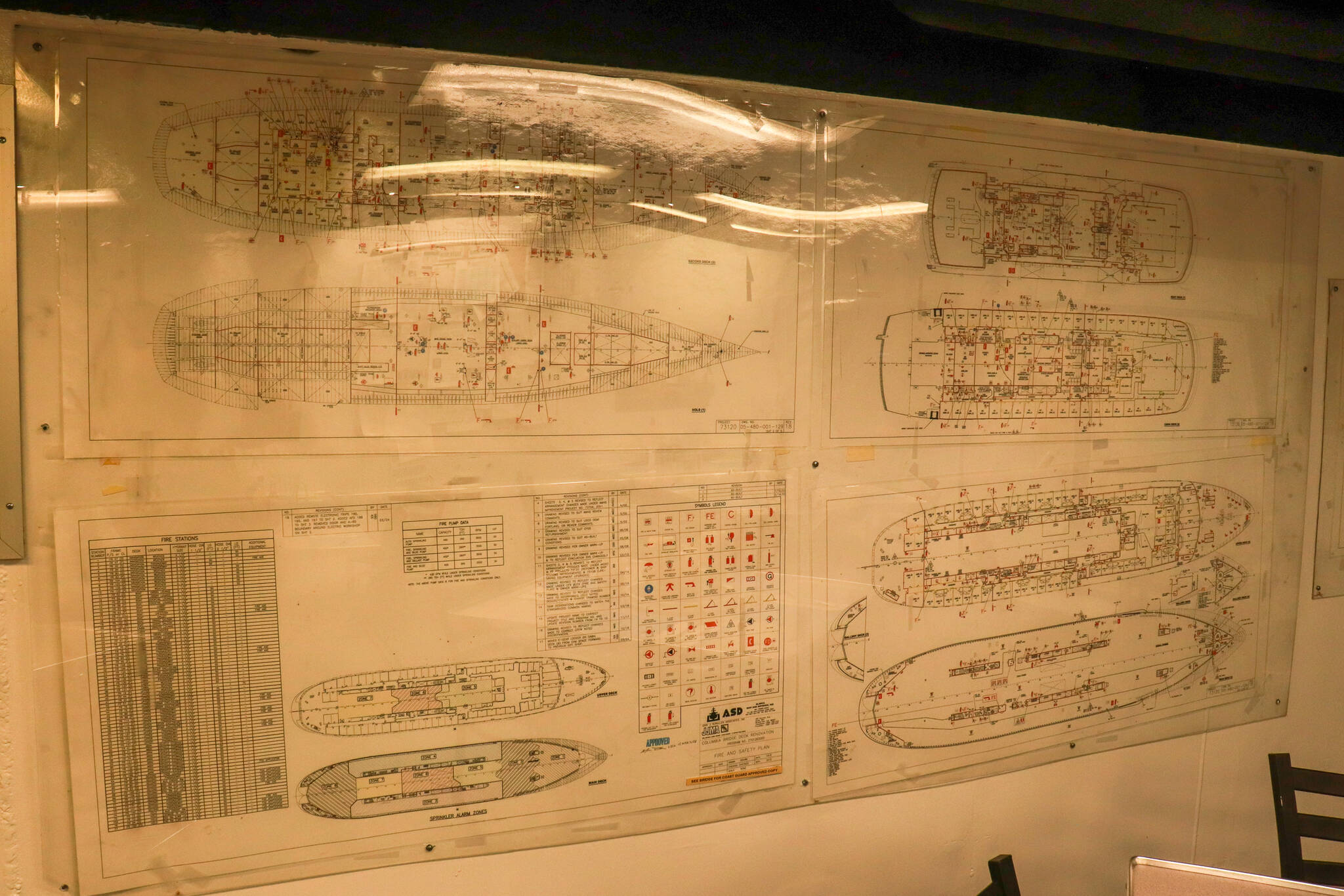
Piping diagrams of the MV Columbia are seen in the ship’s mess hall. Engineers are expected to understand the piping system and many say they know it like the back of their hand. (Jasz Garrett / Juneau Empire)
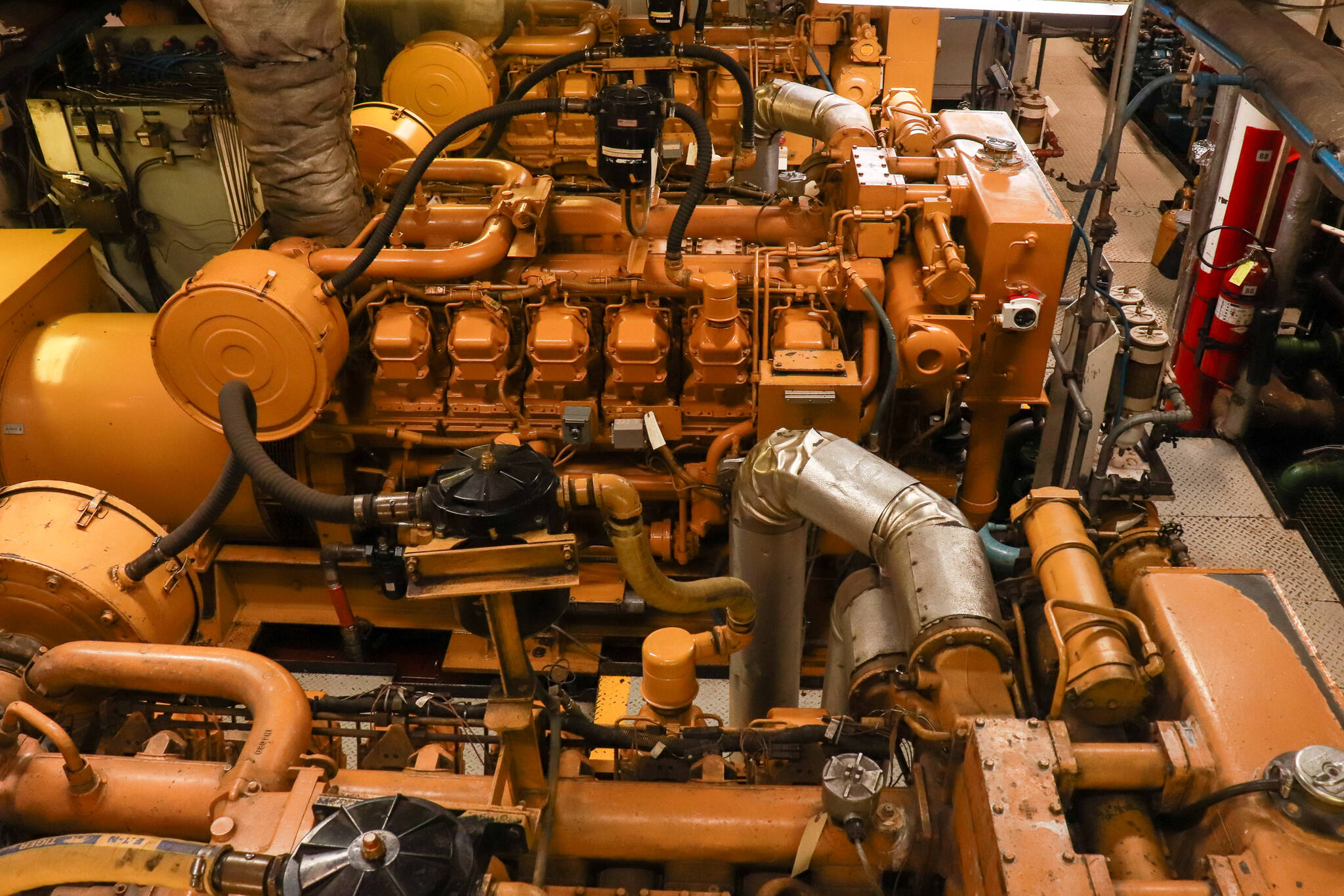
The MV Columbia’s three generators. (Jasz Garrett / Juneau Empire)
