
A range of options for preventing major flooding from Suicide Basin — including a drainage tunnel through a mountain into Mendenhall Lake, and massive blasting around the basin to partially fill it with rock — were presented to the Juneau Assembly on Monday night.
But skepticism about how practical such ideas are was voiced by some officials, while residents affected by record flooding last year and earlier this month say they’re seeing little to suggest any action can prevent a similar disaster by this time next year.
“I just wanted to plead, really, for you guys to take some kind of immediate action to get answers on this,” said Sam Hatch, a resident on Meander Way, one of the streets where flooding was unexpectedly severe this year. “This is the sort of thing we can’t let happen every year.”
“Right now you’re just looking at the eventual destruction of all these neighborhoods. And I don’t think that’s acceptable to anybody and I don’t think anybody should have to go through that.”

An illustration shows two possible routes for boreholes drilled through Mt. Bullard to allow for drainage that prevents massive flooding from Suicide Basin. (City and Borough of Juneau)
This year’s flooding that peaked on Aug. 6 damaged nearly 300 homes, compared to the roughly 40 suffering damage or destroyed last year. Both resulted from glacial outburst floods from Suicide Basin that have been an annual occurrence since 2011, but experts forecast the recent severity of them as probable in future years.
Gov. Mike Dunleavy issued a state disaster declaration — allowing people to apply for individual disaster assistance that covers up to $22,000 of damage to residences and $22,000 for belongings inside homes — but officials and residents have said damages to many homes goes well beyond those sums.
Federal Emergency Management Agency officials are scheduled to arrive next week for an assessment to determine if federal disaster relief is warranted. Such relief would double the funding provided to individuals through state disaster aid, but members of Alaska’s congressional delegation and other officials have said limited FEMA funding means Juneau may not qualify due to larger disasters elsewhere.
The immediate cleanup and repair measures undertaken by residents and a multitude of agencies were quickly followed by officials asking what preventative measures are possible in the future — a question that also was prominent last year. Deputy City Manager Robert Barr presented a memo based on experts’ analysis detailing prevention and mitigation ideas to the Assembly Monday night, noting “all the conceptual ideas in this memo require a broad coalition of support and regulatory exemptions.”
“Through usual processes, federal projects at this scale take many years,” he wrote. “The (glacial lake outburst flood) in Mendenhall Valley is an exceptional situation that will require exceptions to the usual processes that can only be secured through political mandate. Our federally elected representatives — all have visited and toured the impacted areas — are aware of this challenge and have committed to assist.”
A typical process for mitigating recurring flooding of the magnitude that occurred this year involves a study period of up to five years — after Congress gets through the process of approving funding, Barr noted.
Options detailed in the memo presented by Barr include:
• A borehole drilled through Mt. Bullard so Suicide Basin slowly drains into Mendenhall Lake. Two different paths, each about 2.45 miles long, are proposed. Among the questions/unknowns are dealing with tailings from excavated rock, the proper tunnel diameter for a controlled flow, addressing ice/rock blockages at the basin, and “whether Nugget Creek could conceivably accommodate the volumes necessary and the environmental + economic impacts at the creek and lake.”
• Two new trench channels in the Mendenhall River to divert water and allow it to flow into the ocean quicker. Among the questions raised are impacts on land parcels near the channel locations, the amount of earth to be moved, and “unintended consequences that we have not yet seen due to the natural slowing (and flooding) that currently occurs.”
• Using Mendenhall Lake as a reservoir by “draining some portion of the lake, either by pump or by siphon, as the basin fills so that when the basin releases, the lake is able to absorb a fraction of the basin’s total output.” Among the potential issues is “the napkin math from the engineers on this concept indicates this would require many large pumps operating 24/7 for weeks or months to pump sufficient water out of the lake to blunt a basin release.”
• Controlled release/dikes/dredging around the lake to increase its capacity.
• Filling Suicide Basin with rocks — by “blasting the areas around the basin” — to reduce its capacity. Reducing the capacity of the basin by one billion gallons (this year’s release was about 14.6 billion gallons of water) would take about five million cubic yards of rock (“or around 350,000 dump truck loads”). However, “the potential for unintended consequences is high” and “1 billion gallons of displacement is not likely sufficient to prevent major floods.”
• Flood prevention measures such as sandbags, raising structures, and reconstructing first floors with floodproofing methods.
Doubt about the mitigation measures in the basin area was voiced by Dave Hanna, owner of Alaska Concrete Casting, who said the proposals making major drainage or water flow changes would affect only Suicide Basin — which experts have noted will disappear as the glacier recedes, with other similar basins emerging.
“Why would we spend our time drilling a tunnel that might plug up (or) a permanent siphon that may not work when it would only solve the problem for Suicide Basin?” he said.
Workable solutions may include straightening the stream channel for the Mendenhall River — with perhaps some overflow channels — or a levee system around Mendenhall Lake, Hanna said.

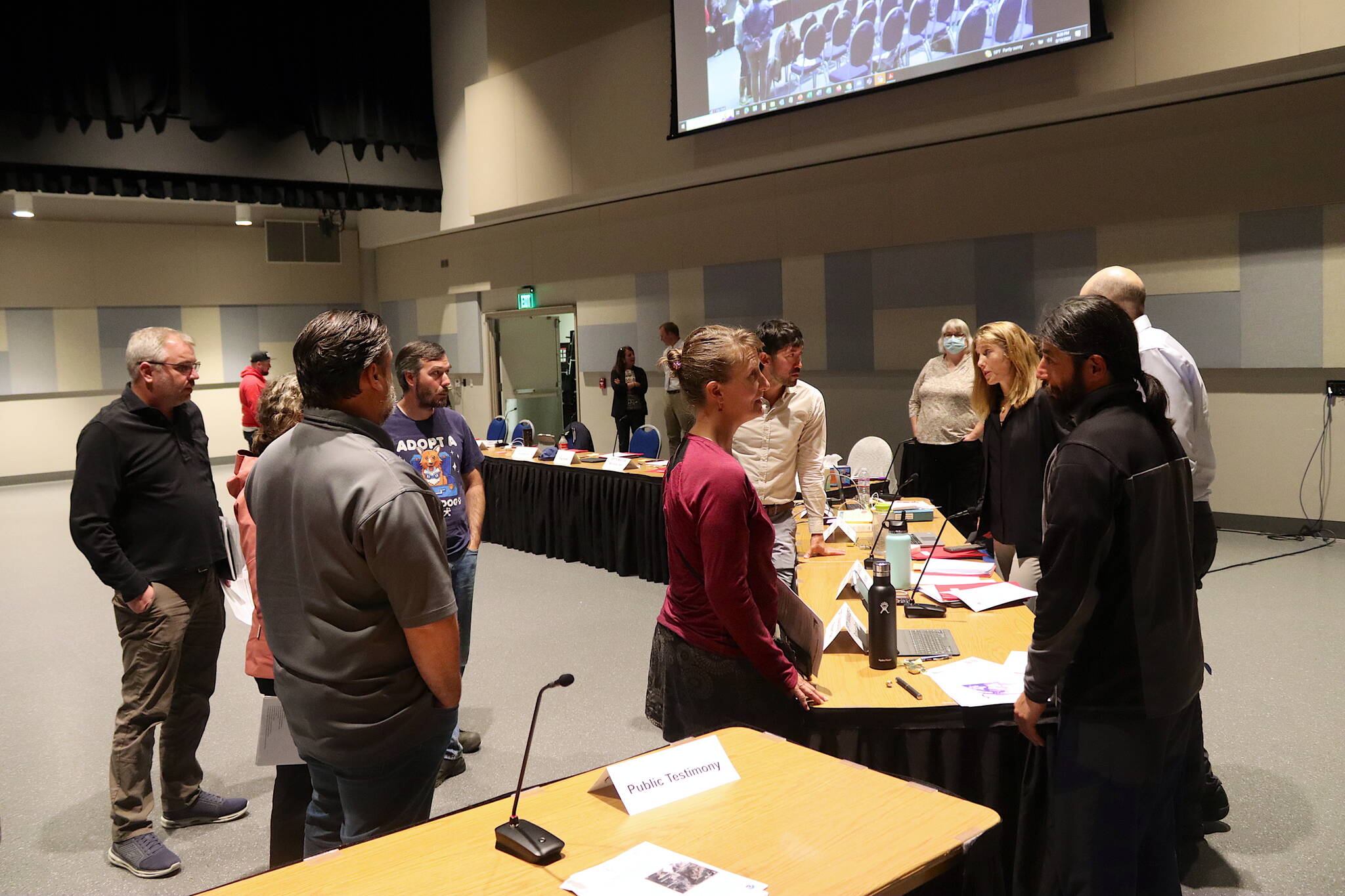
Residents talk to city leaders and other officials about the response to this year’s record flooding from Suicide Basin during a Juneau Assembly meeting Monday night at Centennial Hall. (Mark Sabbatini / Juneau Empire)
Meanwhile, the problem for residents affected by this year’s flood is nothing significant was done to prevent such damage since last year’s flood, and it’s likely many people won’t be able to repair their homes before winter weather arrives, said Malachi Thorington, an electrician who lives on View Drive, which saw major flooding the past two years.
“The construction force that we have in Juneau last year was not capable of keeping up with the people who were flooded out last year and (now) those numbers are tenfold,” he said. “Not only that, do we not have housing to house contractors to come in from out of state to even attempt to get these people back in their homes? So not only is our lack of housing hurting our community, but it’s also hindering the repair of our community as well.”
The Assembly unanimously approved $1.055 million in emergency flood-related spending at the meeting. The funding includes $150,000 for removal of debris and waste, $400,000 in emergency repairs to the Mendenhall Wastewater Treatment Plant, $355,000 stormwater system damage, and $150,000 to begin evaluating the feasibility of mitigation measures against future floods.
Concern about the expectations people might have for mitigation measures was expressed by Assembly member Christine Woll. She noted there’s a range of complicating factors — such as federal land restrictions where the basin is located, unintended consequences and legal liability, costs, and years-long development processes — so a remedy is unlikely in a year, or possibly several.
“I just worry that we are setting false expectations to our community members who are going to have to be making decisions soon about what to do about their properties,” she said.
Woll said she’d like to be “proven wrong — that there is a solution out there — but my gut tells me there isn’t on any timeline that we be able to fix this before the system changes completely. And so I just want us to go into this clear-eyed that we need to not throw a bunch of energy and time into something that’s going to keep people’s hopes alive if you really are looking at something that is extremely challenging to change.”
Assembly member Ella Atkison said she agrees city leaders can’t falsely get people’s hopes up, but it is necessary to attempt solutions.
“I do think this is one of those instances that we kind of have no choice but to keep pushing on it because this cannot be an annual issue,” she said.
• Contact Mark Sabbatini at mark.sabbatini@juneauempire.com or (907) 957-2306.
