
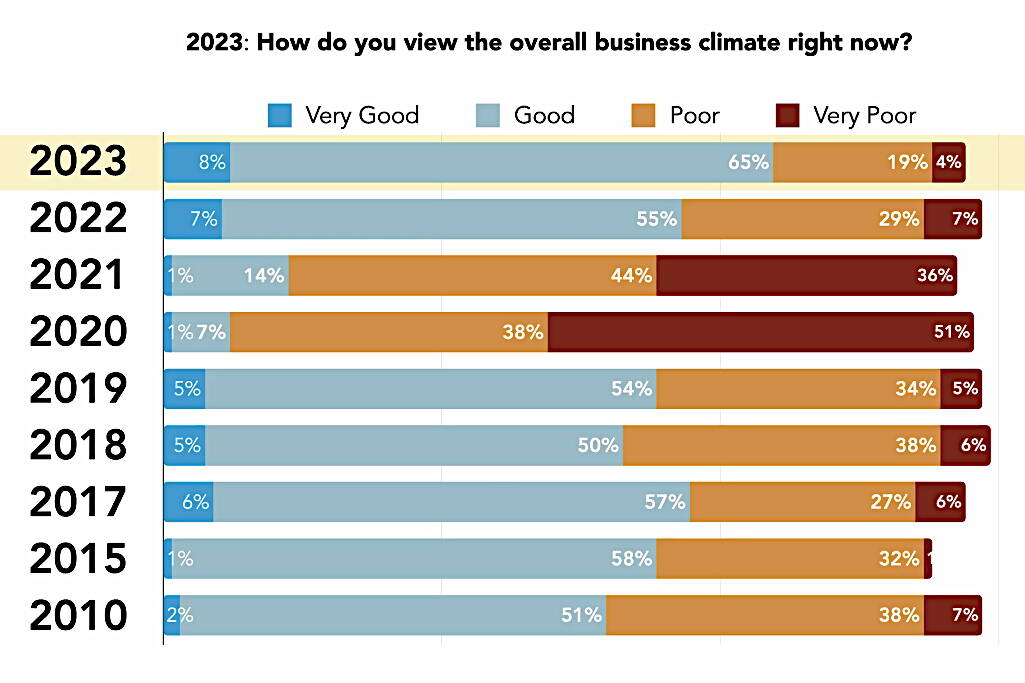
Southeast Alaska businesses are so optimistic that hardships of the COVID-19 pandemic are over that their responses to an annual business climate survey are the most positive since the studies began in 2010, the survey’s author said Wednesday.
“Overall 73% of all business leaders said the business climate was good or very good,” said Meilani Schijvens, owner and director of Rain Coast Data, during a presentation of the survey to the Sitka Chamber of Commerce. “It’s not just a little bit better. It’s really substantially the best business climate we’ve ever had.”
But those results vary widely within communities and industries, she said. Communities with major tourism activity such as Sitka and Hoonah are among the most optimistic, according to the survey. Juneau was fifth highest among the 11 communities surveyed, but its 80% positive response rate put it among the communities above the regional average.
The most drastic shift occurred in Skagway, which moved from last place with a 96% negative view of the economy in 2021 to an 85% positive view in 2023.
Also notable was Alaska Native organizations, which were among the most favorable respondents.
“They’ve done a really good job of bringing funds to Alaska,” Schijvens said, adding the state’s congressional delegation is also a major factor in securing funding for those organizations.
Expressing the most pessimism are towns without major tourism activity such as Wrangell, and industries such as seafood, non-tourism transportation, logging and social services. Furthermore, housing and child care woes are cited throughout Southeast Alaska as the biggest causes of workforce shortages, with slightly more than 50% of respondents calling them a factor in the lack of recruitment and retention.
“To be successful in Southeast Alaska I feel like we need to be attractive to families and that’s an area where I feel like we’re falling short, especially since the pandemic,” Schijvens said.
Two years ago 80% of business leaders called the region’s business climate “poor” or “very poor,” since Southeast Alaska was one of the areas affected most by the pandemic, Schijvens said. But those numbers rebounded strongly last year and the 79% of respondents saying they expect the upward trend to continue during the coming year is the second-highest ever.
The web-based survey in April 2023 received 370 responses by unnamed regional business leaders, representing nearly 10,000 employees, according to the report featuring the results. In addition to a detailed breakdown of statistics, the report notes comments by respondents who range from individuals to government agencies.
Juneau’s 94 respondents, the most of any community, varied considerably on their impressions of economic conditions and the factors affecting them.
One person representing the “professional and business” segment, stated there are plans to hire additional “highly paid professional positions to my team.” However, “it is unlikely that any of them will be (from) Juneau.”
“I rarely, if ever, have qualified candidates in this community, let alone this state,” the respondent stated. “Despite my preference to hire locally, I find myself hiring out of state more frequently now out of necessity. I believe the weakening of our university system and the general brain drain as younger, promising professionals exit the state is a major factor. Five years ago, I did not have these same challenges.”
Among the other comments by Juneau respondents:
— “The City and Borough of Juneau is not proactive for the businesses in the historic district. Despite years of requesting a Circulator (bus), the tourists will still have to walk all the way to the shops in the historic districts. They won’t make it which denies the shop owners of a lot of revenue. Also, there are many empty stores in the area, and yet property taxes have been increased. Also, CBJ made it very difficult to add housing on the second floor of the Glory Hall.”
— “Unknown salmon futures and continued restrictions make it more difficult to make money and invest back into my own business. Inflation of the cost of materials and fuel has made it harder to be profitable. Inflation has caused many families to not be able to afford buying as much of my fish as they used to buy.”
— “Since the pandemic is under control business has picked up this year. Electric outboard sales are off to a good start this year compared to the last two years.”
— “Firm has never been so busy. We turn down work often because we lack the workforce to do it and increasingly the work my team does comes from outside of Alaska. The state simply no longer has the capacity or desire to take on the large-scale, innovative projects that we used to work on here. Other states are much more exciting to work with; Alaska feels like it is falling flat.”
• Contact Mark Sabbatini at mark.sabbatini@juneauempire.com.
