
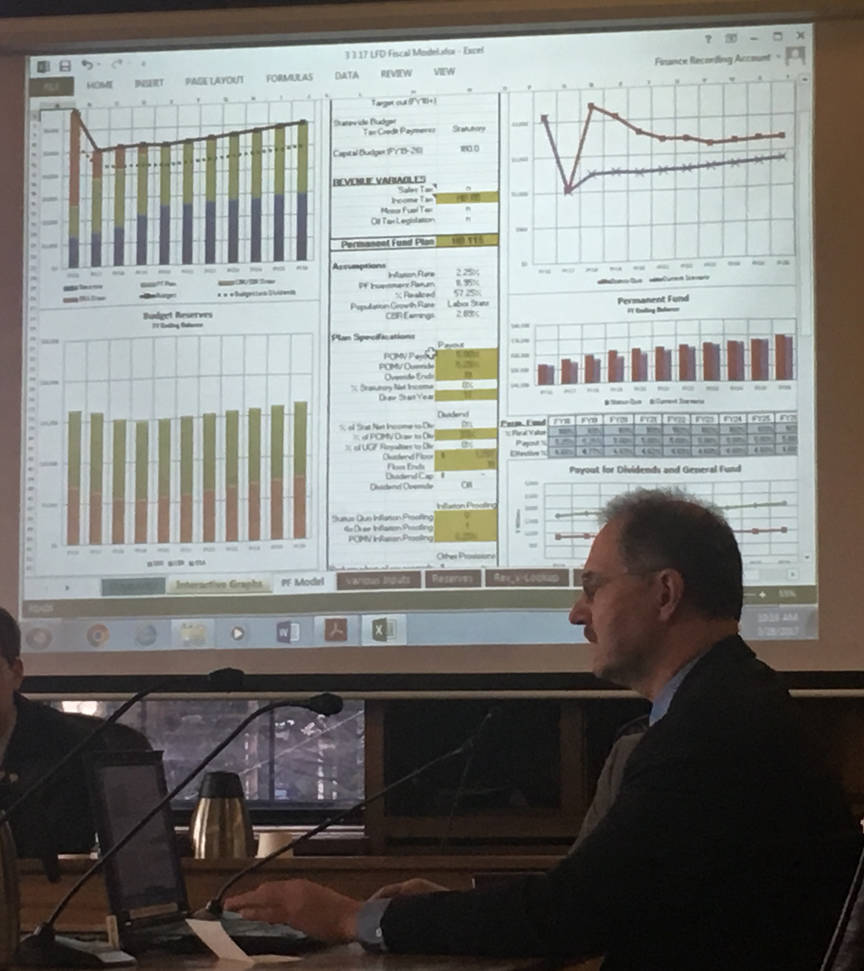
Kenai Peninsula Borough Mayor Mike Navarre sat confidently in front of the House Finance Committee on Tuesday morning and presented the perfect plan to fix Alaska’s $2.8 billion budget deficit.
It was a blank PowerPoint slide.
“So we’ve developed a perfect plan, and this is it: There isn’t one,” he said.
This week, the House committee is hearing from experts as it considers two significant ways of addressing Alaska’s budget crisis. Starting at 1:30 p.m. today, it will hear from the public. The committee will open the door for what is expected to be an extended session of public testimony.
Juneau residents can visit the top floor of the Capitol to add their thoughts on the budget fixes proposed in the Legislature, and those who can’t reach the Capitol can call 465-4648.
Testimony starts at 1 p.m. and continues through at least 8 p.m. The last testifier must register at 7:30 p.m.
Before the state’s residents chime in, Alaska’s municipal governments have been pleading with lawmakers. They’re asking for a comprehensive, complete fix to the deficit, something that includes a broad-based tax (an income tax or sales tax) to spread the deficit.
If the Legislature chooses to balance its budget with significant cuts, those cuts will be passed on to voters by their municipalities, Navarre warned.
That’s because much of the state’s spending — on education and community revenue sharing in particular — goes to municipalities first. Cuts there mean municipalities have to come up with the money instead.
“I think it’s actually better to (balance the budget) at the state level rather than try to shift it to local governments,” he said.
The Alaska Municipal League, the joint organization of more than 150 Alaska municipal governments, has already had its say.
“The Alaska Municipal League supports a Legislative adoption of a sustainable budget plan that does not rely primarily on cuts, but on new sources of revenues,” it declared in a resolution ahead of this year’s Legislative session.
Kathie Wasserman, director of the League, said following Tuesday morning’s hearing that the League isn’t advocating for a particular bill.
The City and Borough of Juneau, Skagway Borough, Petersburg Borough and City and Borough of Sitka all issued resolutions last year in support of a comprehensive budget fix. Haines Borough did not. None have yet backed a particular bill.
According to polls, Alaskans support a sales tax more than any other approach to solve the deficit. Despite that support, lawmakers are not considering a sales tax measure — largely because of the effects it would have on Alaskans already under a local sales tax.
Instead, lawmakers are considering two principal plans to fix the deficit: One comes from the House majority and the other comes from the Senate majority.
The House majority’s plan is centered around HB 115, which imposes a progressive-rate income tax on Alaskans and spends investment earnings from the Alaska Permanent Fund. Another bill, HB 111, would increase taxes on oil companies and reduce the state’s subsidy for oil and gas drilling.
Together, those two bills are expected to eliminate the deficit.
The Senate majority’s plan is centered around Senate Bill 26, which would spend the earnings of the Permanent Fund, as does HB 115. Either HB 115 or SB 26 would generate about $1.9 billion per year for state services from those earnings. That would still leave a deficit, which the Senate majority is proposing to address with $750 million in budget cuts. The cuts would be spread across three years but at predicted oil values wouldn’t completely solve the deficit. It also is not clear what those cuts would include, and the uncertainty in that approach was a turnoff for Navarre.
“When you leave a gap in the fiscal plan, everybody knows that at some point, they’re going to be asked to contribute,” he said.
A business owner before becoming mayor, Navarre said he wouldn’t invest in a business unless he knew how that remaining budget gap would be filled.
Gov. Bill Walker also offered a comment against the Senate majority’s proposal on Tuesday through Twitter.
“SB 26 is only a part of a complete fiscal plan,” the governor’s Twitter account said, adding that the governor looks forward to working with the Legislature to “totally address our fiscal crisis.”
• Contact reporter James Brooks at james.k.brooks@juneauempire.com or call 419-7732.
