
On a sunny day in early March, a friend and I went to Eagle Beach, despite windy conditions and a forecast of 30-40 mph gusts. The weathermen had it right. The north wind was roiling up sizable whitecaps on Lynn Canal. The beach was covered with snow, untouched by the recent low tides, and obscured by billows of drifting snow. Instead of heading north on the beach, as I usually do, we cleverly decided to turn our backs to the wind and, hoods up, we walked down the beach and tide flats toward Eagle River.
Across the canal, the snowy Chilkats gleamed in the bright sun. A gang of gulls and crows concentrated at the distant edge of the tideflats, near the water’s edge. Perhaps surprisingly, given the stiff gusts of wind, a couple of groups of gulls were swooping over certain places in the estuary, as if there might be some prey stirred up by the churning waters.
But that was all the wildlife sign we saw, until we’d post-holed over the big meadow to the forest edge. My companion heard pine siskins and we then saw them, working over the cone crops in some tall spruces. There were squirrel tracks and a chattering squirrel. A vole had traipsed across a small open area, leaving footprints and tail-drag.
Best of all: lying on the snow near a big spruce, we found dozens of clipped spruce branches, mostly branch-ends with two or three twigs, all the needle tips neatly nipped off. That porcupine had spent a long time in this spot, clipping all those branches and needles, leaving greenish urine stains here and there, and packing down a well-used trail back and forth across our path. It left some fresh porcupine tooth-work on the base of a nearby hemlock, too.
A bit farther on, we noticed several trees patched with old scars of sapsucker foraging. Material had oozed around the edges of each bird-pecked opening and congealed there, making a rough surface over every opening. The scars on each tree were conspicuously concentrated in dense patches, just above our eye-level, not lower, not higher. Perhaps once a feeding site was started, the flow of sap was greater or at least more accessible there, rather than in a new place. But why did the birds choose those particular trees and those specific parts of the trunks to start feeding?
Returning to the car, it was more post-holing through snow drifts, almost knee-deep. Well-buffeted by those gusty winds, I staggered along, ready for the hot tea that was awaiting us in a handy thermos. Not a long walk today, but a productive one.
The next day was bright and clear again, and very windy, at least in open areas. Four friends met near the visitor center and looked for a packed-down trail along the east edge of the lake. No luck; blowing snow had drifted well over that. So we opted to go toward Nugget Falls on a narrow, packed trail over the flats where the terns usually nest. But that, too, meant post-holing through knee-deep drifts. So we cut over to the usual beach trail and then to the main trail, where we noticed wind-blown alder seeds all over the snow.
Arriving at the base of the falls, sharp-eyed observers spotted two mountain goats on the far side of the creek. One perched on a little rock outcrop and one stood at the edge of a brush thicket. Neither one was moving much, so I had a hard time picking them out. Those two were the first of the year, for me.
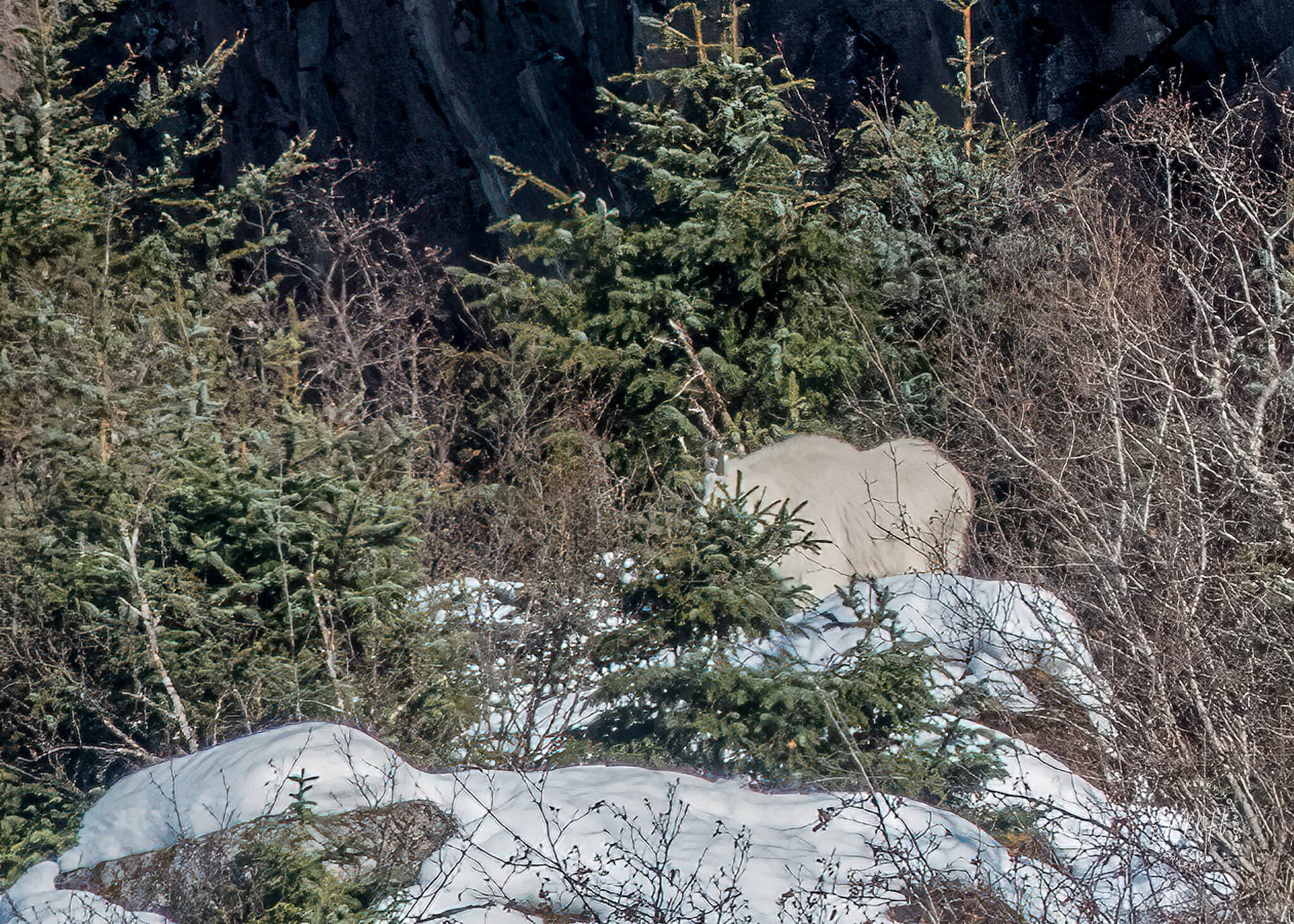
A very shaggy mountain goat stands on a rocky outcrop, partly obscured by brush (Courtesy Photo / Kerry Howard)
As we approach the vernal equinox, day-length is rapidly increasing; the daily rate of change is greatest near the equinoxes (and slowest near the solstices). Humans and other organisms notice the lengthening days — eagle start tending their nests, magpies start leaving for the Interior, buffleheads begin to be seen in pairs, and there’s an occasional song of wren or song sparrow. Red squirrels in my neighborhood have been doing a lot of vigorous chasing lately, and food is not the principal focus. Although these squirrels are strongly territorial for much of the year, when females start coming into oestrus, territory borders are commonly crossed in the search for mates. Both sexes often mate with several other individuals, and so litters may have several fathers. Roughly five or six weeks after mating, litters of up to seven young ones appear in the females’ nests.
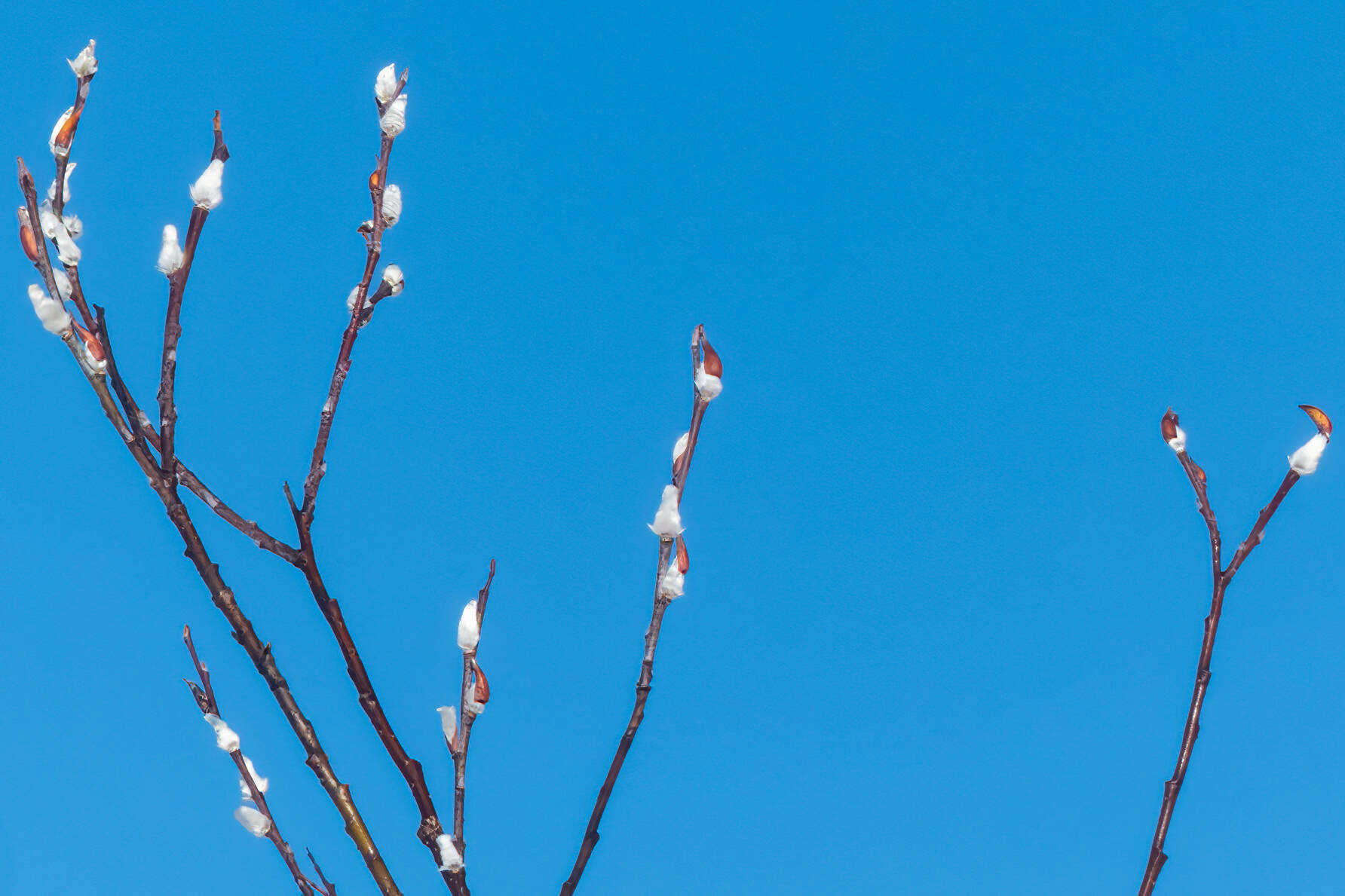
Although some of the felt-leaf willows have fat buds, other plants lag behind. You can be sure that they have noticed the longer days, but other factors, such as soil temperature, are not yet right for gearing up in ways visible to us. As the longer days gradually warm the soil, more and more plants will show signs of activity, some of them waiting to flower until well after the summer solstice when days are shortening again.
Seasonal transitions are always fun, as we notice each new sign of activity. After a slow start in late winter, the signs speed up through the spring and into the summer. Although skiers may revel in the persistent snow and longer days, others eagerly await the beginnings of green-up and the first flowers.
• Mary F. Willson is a retired professor of ecology. “On The Trails” is a weekly column that appears every Wednesday.
