
By Mary F. Willson
For the Juneau Empire
On a murky day toward the end of February, I went with a friend on the Boy Scout Camp Trail.
Rain and warm temperatures had turned the snow to unpleasant deep slush and puddles in some places. As usual, we were just looking to see what we could see—and it wasn’t much. There were some crows picking through the wrack on the beach, a tiny group of bufflehead moving farther offshore, and a few geese on the far side of the big meadow. Not even any curious seals popping up to inspect us, no sea lions cruising by. A bit disappointing!
We cut through some of the groves on the big berm behind the beach, where the mosses were happily showing off their many shades of green. One spreading tree sheltered several duck decoys. Then, as I was stepping over a few roots, a movement near the toe of my boot made me stop. A small white head with bright black eyes was peering up out of squirrel-size hole in the ground. I signaled to my friend (who walks faster than I do) to come back. Meanwhile the white head disappeared, but briefly, only to re-emerge once more for a quick look-see. The owner of the head did not like two monsters looking at it, so even though we backed well away and waited, it did not reappear. With its wintry white coat, the ermine — aka short-tailed weasel; called a stoat in the U.K. — would have been very conspicuous on the snowless ground under the trees. We don’t see ermine very often, and this was the highlight of the walk that day.
[On The Trails: Considering the many ways animals carry their lunch]
The same day, in the afternoon, three female mallards arrived on my icy home pond. One of them had scouted the place two days earlier, and now brought along a couple of friends. They were out of luck, though; no open water and no seeds on the ice. The ducks weren’t the only critters that were anticipating spring, however. The previous week, a bear had crossed the ice into my yard, no doubt allured by the aroma of the peanut butter feeders, and left dirty footprints on my downstairs windows. That was not the only bear report for the Mendenhall Valley — Alaska Departmenr of Fish and Game tells me that there have been other early risers (or poor sleepers) this winter.
Some recent reading included a book called “White Feathers,” by famous naturalist Bernd Heinrich. It’s about tree swallows, those beautiful aerial acrobats that also sing sweetly—some birds seem to have it all! They are cavity nesters, using natural tree holes and readily using nest boxes.
Among many other observations, Heinrich noted that the tree swallows using his nest boxes had a strong interest in white or light-colored feathers, sometimes collecting them from some distance away. Male swallows were especially interested, although females sometimes showed interest too. Small feathers might make a cozy nest, but they had a special use for long, whitish feathers, chiefly during the later stages of egg-laying and the incubation period.
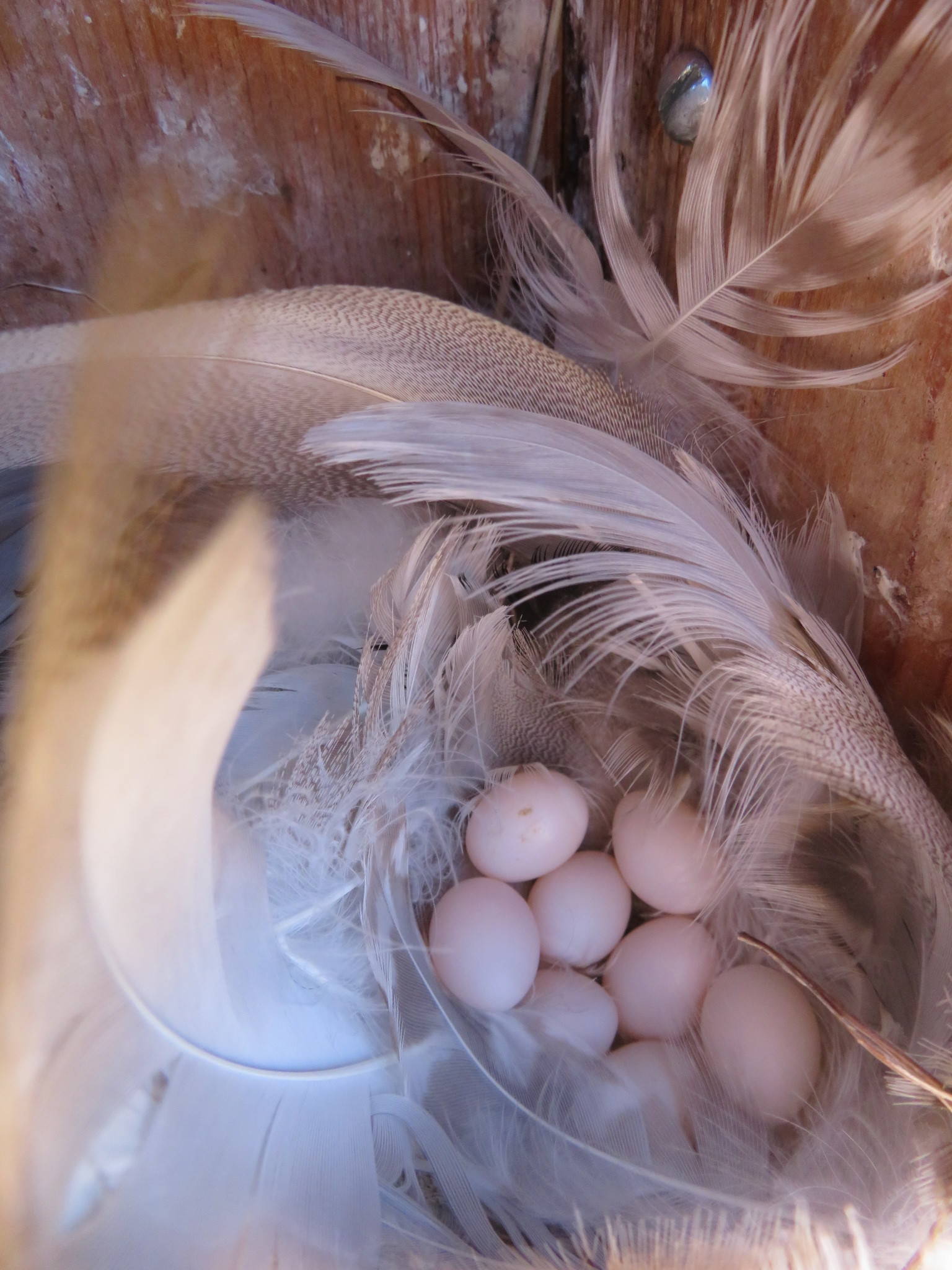
Of course, I wanted to know if our local tree swallows collected white and light-colored feathers too. And they do: inspection of nest boxes here and in Gustavus found white and whitish feathers around the clutches of eggs.
Those long, white feathers are arranged around the edge of the cup that holds the eggs, placed with the quills poked into the bottom of the nest around the eggs, so that the plumes stand up and arch over the eggs. The feathers clearly are not a cuddly cushion for the eggs, and not a snuggly blanket around them; smaller feathers might do that. They might conceal the eggs, but feathers of any color could do that. So why white ones? Are tree swallows the only species that adorns its nests in this particular way?
Tree swallows are fiercely territorial, aggressively defending an area and sky-space near the nest, sometimes engaging in knock-down-drag-out fights that end in injuries. They defend a chosen nest cavity against other tree swallows and other cavity-nesting species, including wrens, woodpeckers, bluebirds, starlings, chickadees, and others. The supply of suitable cavities is generally limited and competition for them can be ferocious. In some cases, tree swallows even oust chickadees that have already laid eggs and appropriate the cavity.
The long, whitish feathers, arranged to arch over the eggs, would show up well in dark cavities, easily visible from the nest opening. Heinrich suggests that they might possibly be a visible signal that tree swallows occupy that cavity. When the adult swallows are out foraging, such a signal could be useful in turning away other cavity-seekers and thus avoiding injurious battles. More observation and research needed!
• Mary F. Willson is a retired professor of ecology. “On The Trails” appears every Wednesday in the Empire.
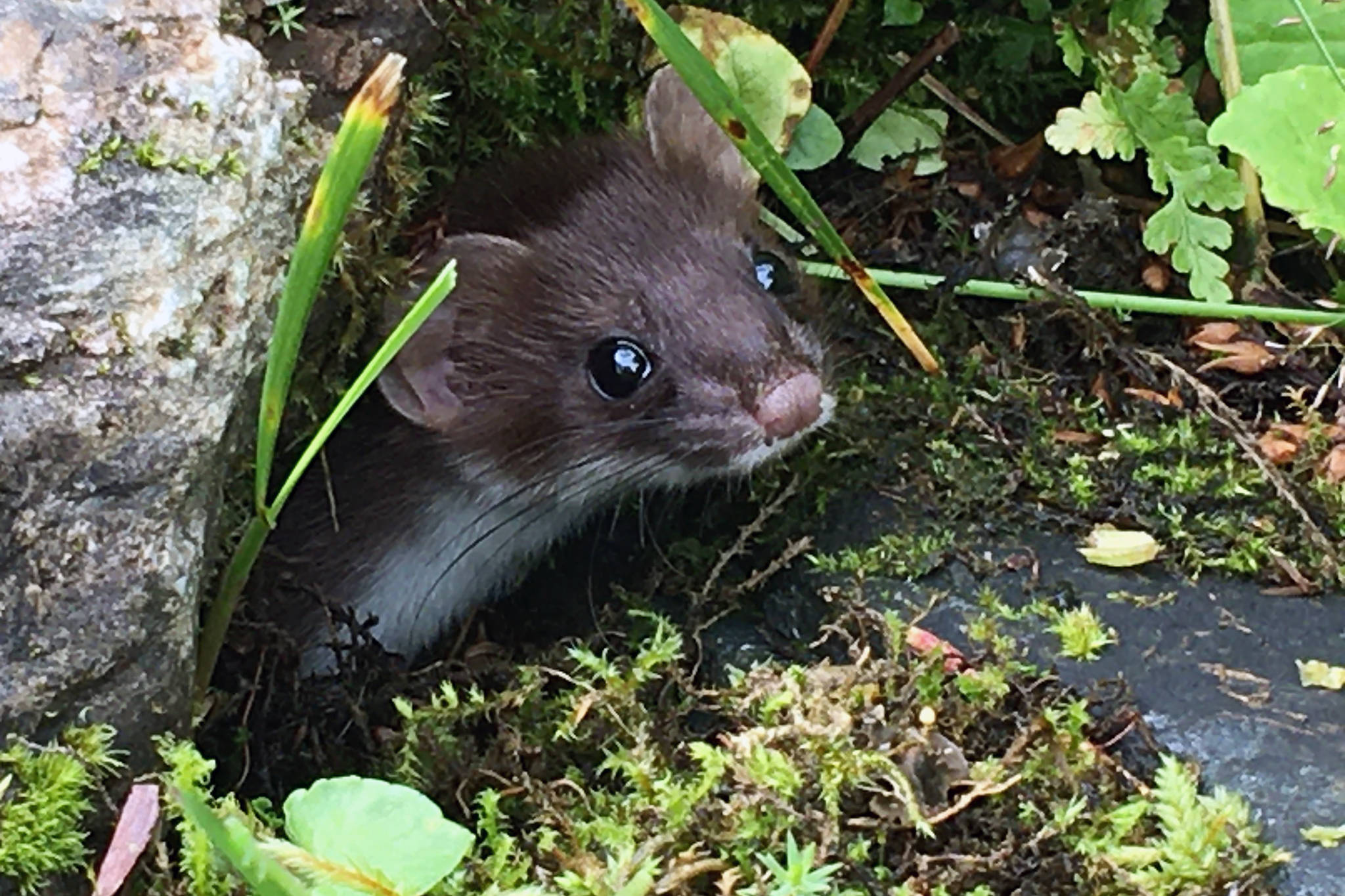
This photo shows an ermine with a brown summer coat seen on Perseverance Trail on Aug. 19, 2020. (Courtesy Photo / Marsha Squires)
