
By Mary F. Willson
For the Juneau Empire
A female hairy woodpecker visits my suet feeder regularly, and I’d bet any money that she is the same one that came all summer long, as a juvenile, in the company of a male, presumably her father. She learned well from her dad, and she still comes.
One day in mid-December, I spotted her wrapped around the suet feeder, her tail curved around one end as she pecked away at the other end. A sudden fluttering caught my interest, as another woodpecker landed briefly, to snatch a quick bite. The new arrival stayed just long enough that I could see her small bill and also see that she was much smaller than the hairy woodpecker. So there was no doubt about it; it was a downy woodpecker. I’m told that they seldom nest in our area, but we sometimes see them in the off-season.
On a gray and foggy day, I turned on to the road by the Pioneer Home, where the line of young cottonwood trees is often used for perches by eagles scrounging from the nearby dump. On this day, half a dozen eagles were hanging out on the cottonwood branches. In the fog, the eagles were black, the graceful branches were black, the whole array artistically displayed like silhouettes on a silvery backdrop. Splendid!
A few days later, I wandered down the east shore of Mendenhall Lake, then cutting over to the Moraine Ecology Trail. Some post-holing, some bush-whacking, a wet foot from finding a soft spot in the ice—but the quietness was pleasing. The sound of Nugget Falls and scattered raindrops tapping on my cap—that was it. Aaah—maybe a red squirrel chattering over in the woods. I found a thriving, bright green patch of stiff clubmoss, poking perkily up out of the snow, still bearing immature cones. Surprisingly, there were no hare tracks, but beavers had been busy in a couple of places, packing down a trail between ponds, dragging a few branches over the snow, and starting new cuts on some big cottonwoods. An ermine had bounded from one clump of brush to another. The only observable activity was provided by two small, flying insects, maybe midges.
Seeing those little fliers reminded me of other “bugs” that come out on the snow, at least on days of mild weather (although some caddisflies spend the whole winter as winged adults). Several kinds of arthropods, from many different taxonomic groups, can be active in winter; here are some of them: a variety of tiny flies known as midges are active in winter; most fly about but others are flightless. Males of a moth called Bruce’s spanworm fly in late fall and early winter, mating with wingless females that lay their overwintering eggs in protected sites such as bark crevices. There are winter-active craneflies that dance in swarms, mostly in fall and spring but also in winter, and stoneflies that emerge in late winter, crawling onto land to mate. A fungus gnat can tolerate very low temperatures because it has an antifreeze protein in head and thorax (but not the abdomen, which can freeze and apparently thus reduce evaporative water loss). The famous iceworm (it’s really a worm, somewhat related to earthworms) lives on glaciers, crawling down into cracks and crevices where the temperatures are said to stay about thirty-two degrees Fahrenheit; so they don’t freeze and can go on feeding on microscopic algae and detritus.
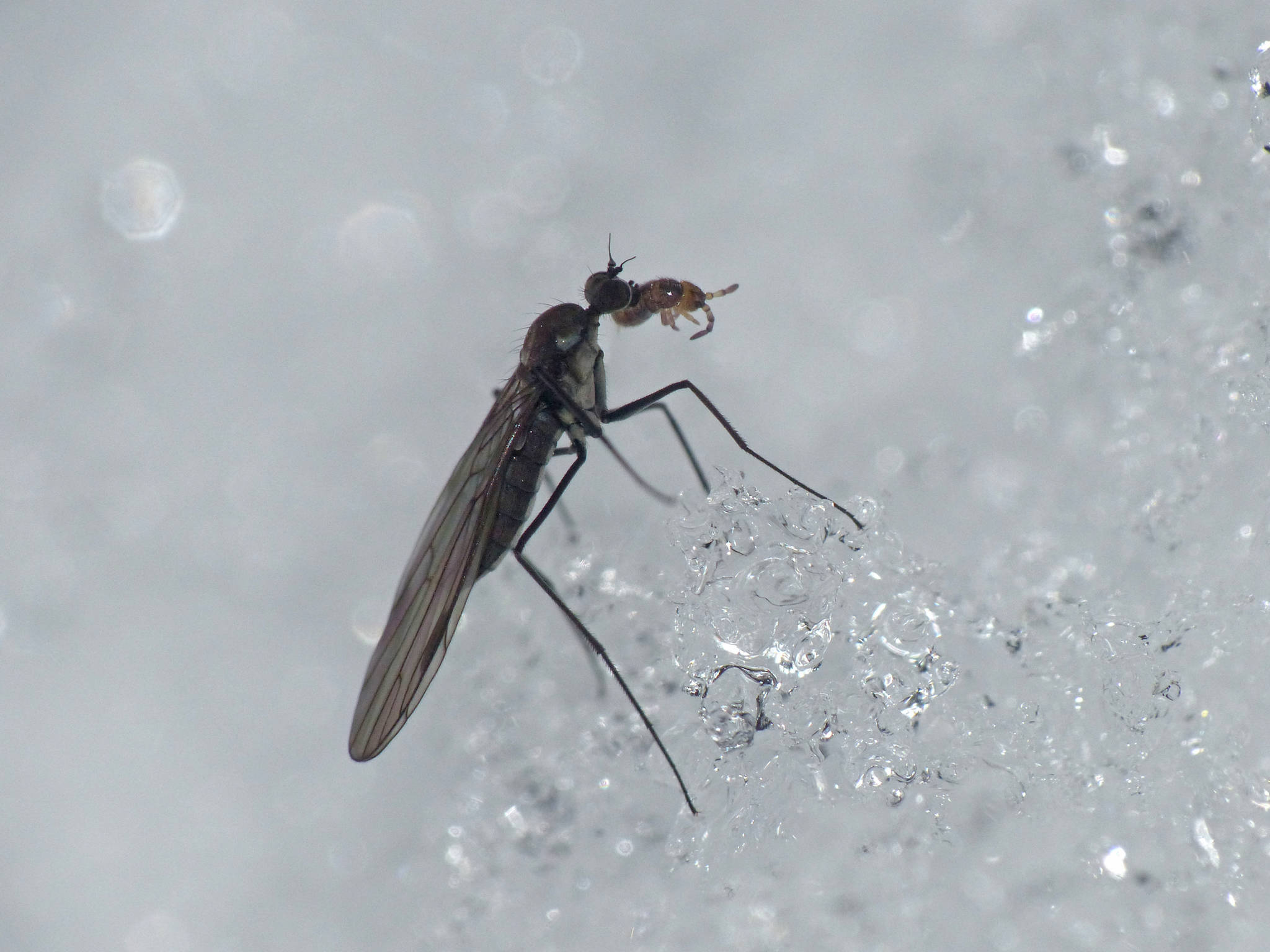
A dance fly holds a springtail in its jaws. A study of one kind of dancefly found that males swarmed near selected landmarks on sunny, windless days in winter, at temperatures as low as eight degrees centigrade. The males carried captured insects to lure females to the swarm, presumably eventually using the prey as a courtship gift. (Courtesy Photo / Bob Armstrong)
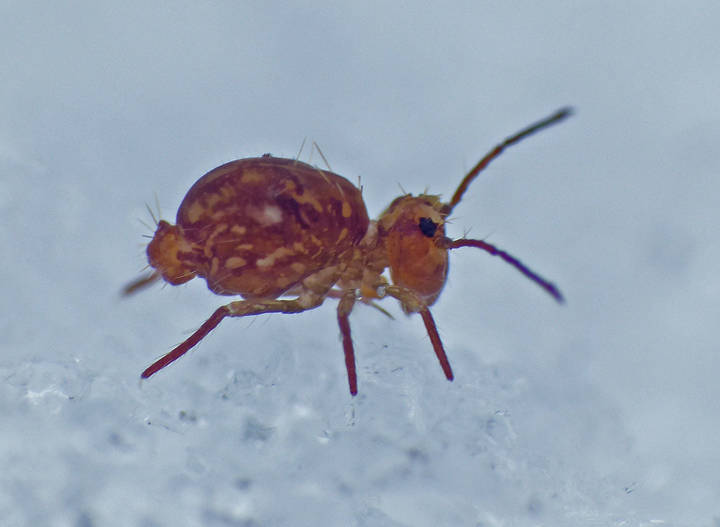
And then there are the springtails, non-insect arthropods, most of which can hop about using a forked appendage on the abdomen. Several kinds can be found hopping or crawling over the snow, looking for microscopic bits of food or dispersing to new places. Their predators are out too, including spiders, beetle larvae and danceflies (see photos). A study of one kind of dancefly found that males swarmed near selected landmarks on sunny, windless days in winter, at temperatures as low as eight degrees centigrade. The males carried captured insects to lure females to the swarm, presumably eventually using the prey as a courtship gift.
Thanks to Bob Armstrong and John Hudson for guidance about winter arthropods.
• Mary F. Willson is a retired professor of ecology.“On The Trails” appears in the Juneau Empire every Wednesday.
