
By Mary F. Willson
For the Juneau Empire
In early November, I walked along a gravel road in the company of frost-decorated branches. A mat of old leaves lined the roadway, each leaf fringed with crystals, making a pretty mosaic in tones of russet, old-gold, and brown. In an open area, I found a collection of more old leaves, not matted down, each one with a distinctive cover of frost crystals. Quite aside from the interesting physics that presumably accounted for the variety of crystals, every leaf was a thing of beauty. As the poet (John Keats) said: “A thing of beauty is a joy forever…”
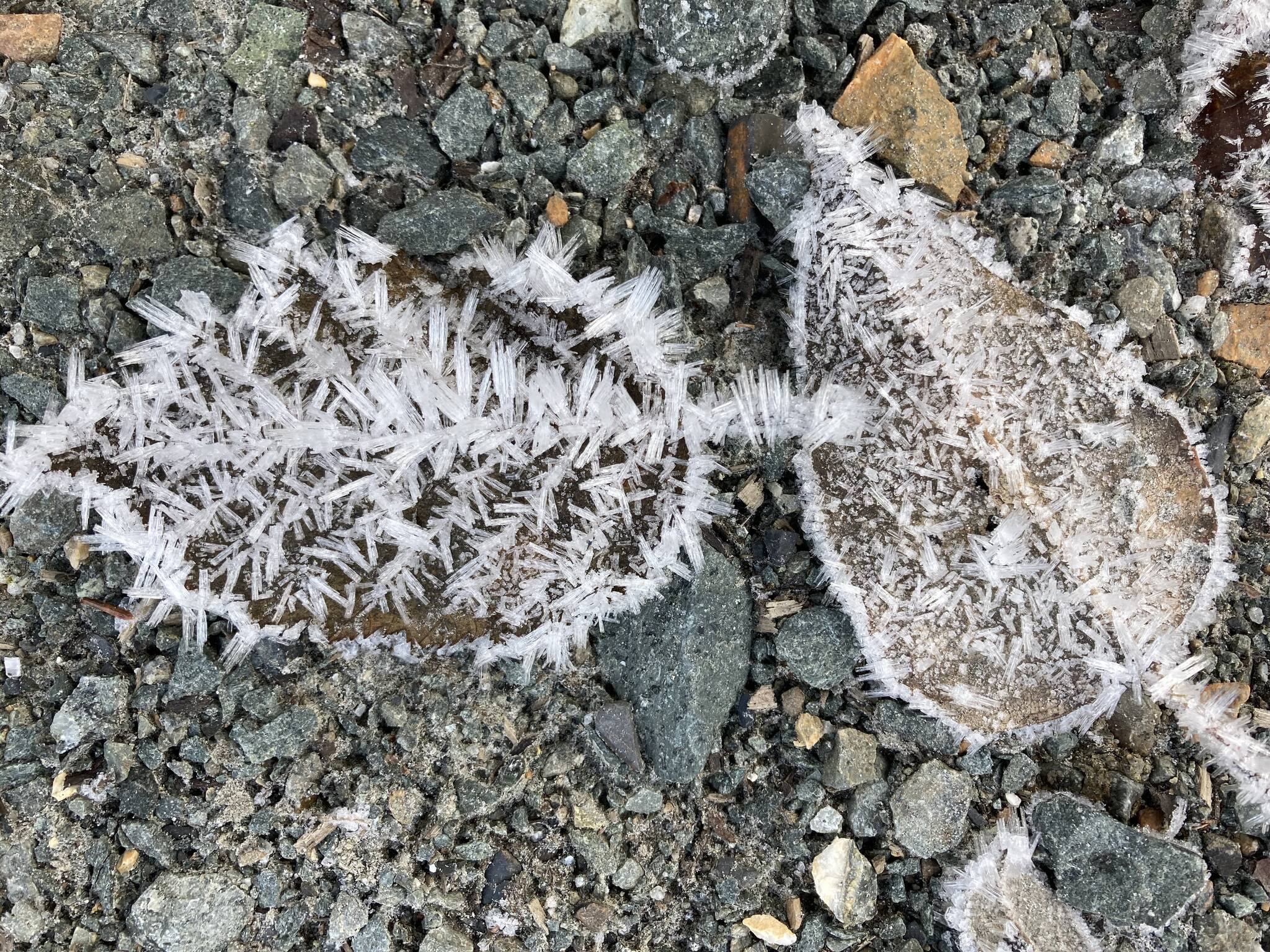
Frosty leaves show varied patterns of ice crystals—natural art works! (Mary F. Willson / For the Juneau Empire)
The Lower Loop at Eaglecrest in early-mid-November was a fine place for a walk. A bit of fresh snow lay on the meadows, and above the white blanket the tops of old seed heads and Labrador tea plants poked up — as individuals rather than part of a mass of faded greenery. Tawny-gold grasses stood tall and colorful on that background. Dainty little grasses draped their dangling seeds artistically. Tufty pine branches bore small caps of snow.
Conditions for finding evidence of several local denizens were perfect. Porcupines had traipsed hither and yon, exploring endlessly, it seemed. Every few yards, one of their trackways crossed the path, sometimes running parallel to the path for a while. One of them left a long, orange-yellow dribble as a mark of its passage.
Squirrels had made their well-beaten routes from tree to tree and across the path. A small bird, probably a junco, had hopped out of brushy area into the open. Voles had scampered about; one made a nice tunnel under the snow, revealed only in spots where the snow-roof had collapsed. A shrew left a narrow groove on top of the snow and then dove into a tiny hole under a clump of grass. Another trackway suggested that a deer mouse had been active, making quite long leaps with its sizeable hind feet.
A few days after that Lower Loop stroll, in hopes that sea-level rains meant snow had fallen at Eaglecrest, I went back up there. But even the Lower Loop had lost much of that earlier snow. So I trudged up the road, circled the Hilda Dam Cabin, and came back down the Trickster run, and had some fun there. There was a thin layer of fluffy snow on top of a very thin crust. Snow covered the moss mats, but groves of moss sporophytes stood up above the snow. As usual, porcupines had wandered about, and squirrels had dared to cross some open spaces. In a little damp drainage, a shrew had scurried over the surface, supported by that thin crust. A deer had run downhill, covering dozens of yards before jumping a log and going back into the woods.
I found a trampled cluster of indecipherable smudgy tracks near a few seed heads that had been demolished, leaving scattered fragments on the snow. On the top of the smudges, I saw what looked like ermine footprints. But, despite some hints, the smudges were a puzzle. A few minutes later, however, I found a long trackway going from one weed patch to another and noted that Smudgy was bipedal and big enough to break through the thin crust, disturbing the snow layer and disguising any toe marks. Ha! The prime suspect was probably a grouse.
Some days after that, I went with a friend to Eagle Beach State Park, to have a look at the vegetated sand flats in the river. A thin film of soft snow covered the ground. On the way, we saw that squirrels had been busy, crossing the path in several places. Along the river shore, rather recent flood waters had piled up great stacks of fallen trees and combed the herbaceous vegetation into orderly lines. A mink had run on the edge of the riverbank, but there were no bird tracks to be seen out there. Looping back through the campground, we found the trackway of a vole, scuttling across an opening and under some grasses. Near the parking lot, a raven had strolled over the lawn, but no ravens came to mooch any part of our lunches as we sat on the bench near the river.
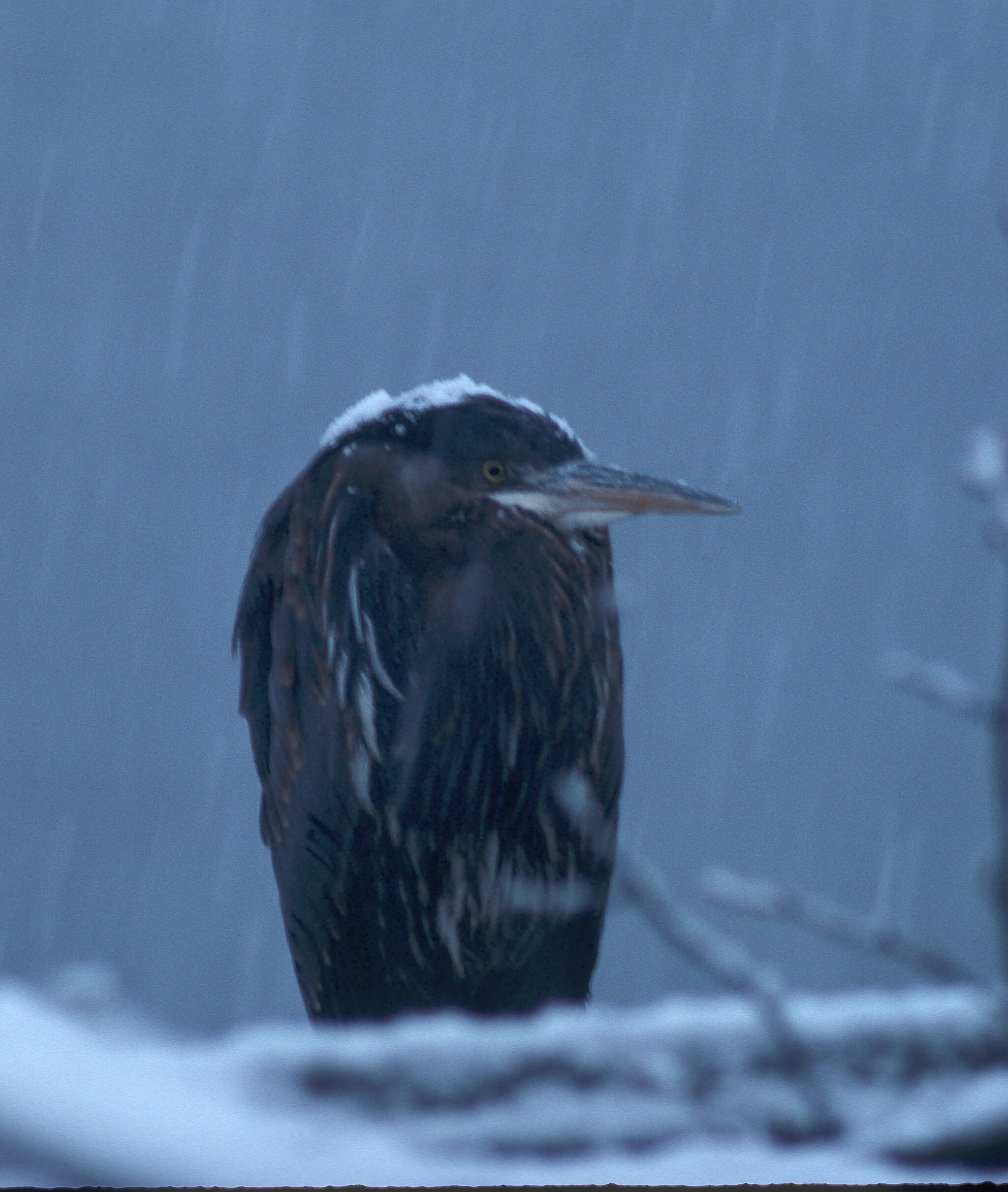
This photo shows a great blue heron in the snow. (Courtesy Photo / Bob Armstrong)
Some nice big white flakes were falling, but they soon changed to rain (of course). Then we waited to see if the forecast snowfall actually happened…and it did! By Thanksgiving time, there had been several good snowfalls, although the streams were not yet iced-over. One day on Douglas, I saw several tiny, delicate flies flitting about and resting on the snow. According to a local expert, they were probably snow midges, whose larvae like cold-water streams and typically emerge as adults in winter. They are quite tolerant of cold temperature and may survive for many days, as they search for mates.
• Mary F. Willson is a retired professor of ecology. “On the Trails” appears every Wednesday in the Juneau Empire.
