
By Mary F. Willson
It’s not an imaginary thing, even though it sometimes pops up in pulp fiction. There is experimental evidence that scared humans can produce volatile chemical signals of distress that can be perceived subconsciously by other humans. That sort of chemical communication in humans shouldn’t be a surprise (although lots more research is needed), given the prevalence of chemical distress signals in other organisms.
There’s even a word for it (at least in fishes) — in German it was called ‘schreckstoff’ (fear-stuff) by the Austrian scientist who discovered it in fish, back in the 1930s. Best known for his work with bees, Karl von Frisch also discovered that an injured European common minnow somehow induced nearby minnows to behave as if they were at risk of predation. The alarmed minnows became agitated, swimming frantically to and fro, then ‘freezing’ in place; they also tended to avoid areas that had clues of predator presence. Later work showed that this reaction is more likely in simple environments that lack habitat complexity, which offers the possibility of hiding quietly behind habitat features. The reaction was fine-tuned in other ways too, being contingent upon seasonal differences, age of fish, experience, and other factors.
Further research has shown that many other fishes have similar reactions to signs of injury and distress of other individuals. The chemical signals of distress are released from specialized cells in the skin of the distressed individual, when the skin is punctured. So, in addition to injury from predation or attempted predation, the skin damage due to skin-penetrating parasites and pathogens and even UV radiation can lead to the production of schreckstoff. It is possible that the original function of schreckstoff was a response to parasites and pathogens, and that the predator-alarm response evolved later. The chemistry of schreckstoff in fish has been deciphered, but I’ll omit those details here.
Animals of many other kinds show avoidance and escape reactions to injured individuals of the same or closely related species. The list is long: corals, flatworms, snails, some clams, larval mosquitoes and mayflies, aquatic arthropods and polychaete worms, brittle stars, sea urchins, larval frogs and salamanders, and so on. In the case of colonial animals such as ants and bees, the alarm signal may also call in reinforcements, to help repel possible danger.
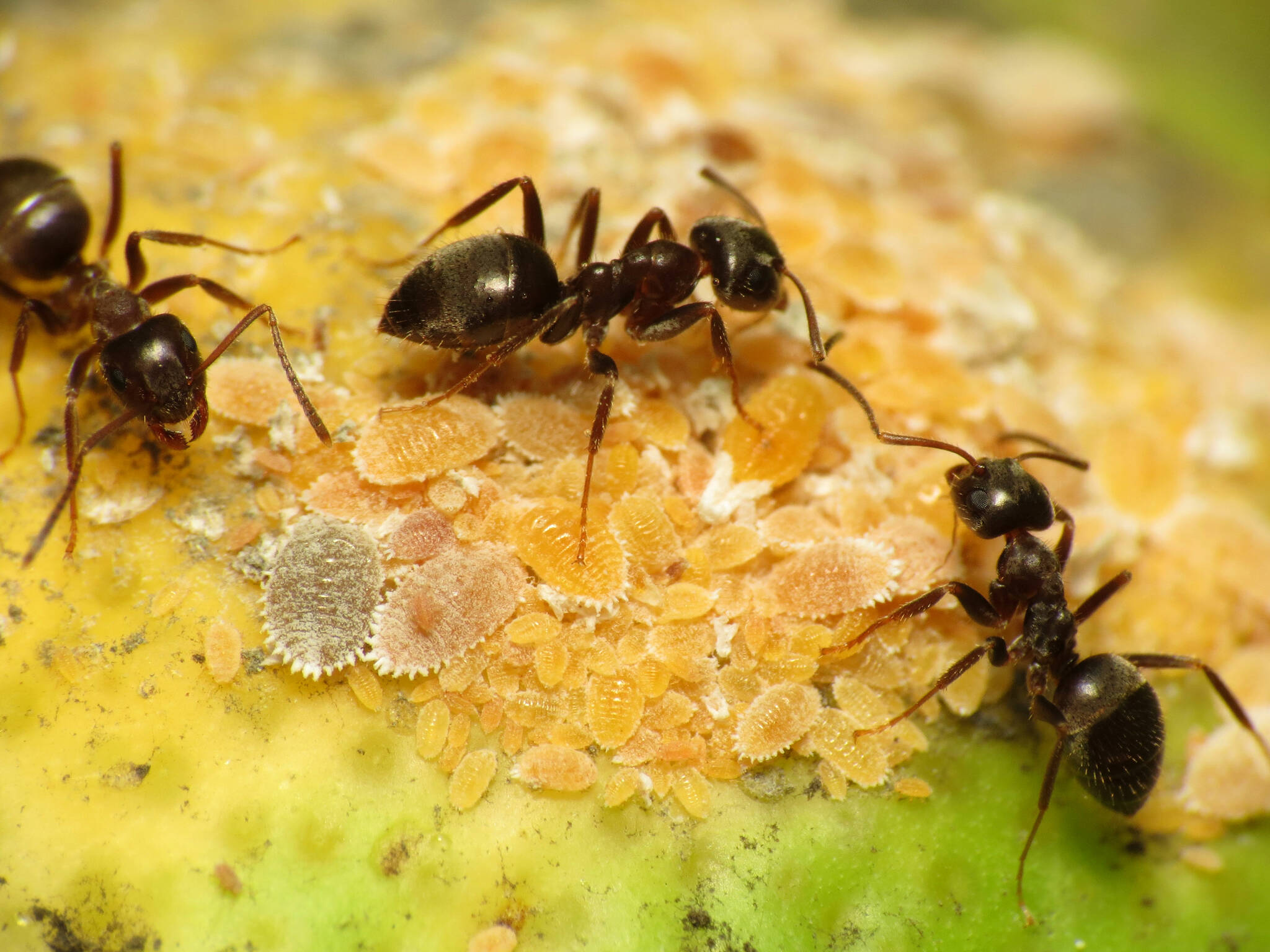
This photo shows black garden ants tending citrus mealybug. When injured, colonial animals such as ants and bees, may emit a type of alarm signal that also calls in reinforcements, to help repel possible danger.(Courtesy Photo / Katja Schulz from Washington, D. C)
In many of these examples, it is not known if these critters emit special alarm-signal compounds that would qualify as schreckstoff or if the reactions are simply a response to the release of blood and other body fluids from the injury.
Plants, too, are known to emit chemical signs of distress. Some alarm signals are transmitted through root and fungal connections, but others are airborne. The idea of airborne chemical signals of distress was sparked by two studies in 1983, which showed that leaf damage in willows, alders, maples, and poplars led to increased production of defensive phenolic compounds, not only in the injured individuals but also in their uninjured neighbors. That suggested that the neighbors could perceive and respond to airborne alarm signals. Of course, this idea was rejected out-of-hand by the scientific establishment, and years passed before a few brave investigators undertook studies of this unpopular idea. A few reports appeared in the 1990s, but it wasn’t until the next decade that numerous studies on many plant species showed that airborne alarm signals (and increased defensiveness of neighbors) are common.
One study even showed that distress signals from one individual are perceived especially by related individuals, so kin benefit more than unrelated individuals. But increased defense even by a group of unrelated neighbors might lead herbivores to avoid that patch of individuals.
Airborne signals don’t usually travel very far (e.g., less than a meter in some herbaceous species, less than five meters for a tree). One major function is likely to be a message to other parts of the same plant, to gear up defenses, more quickly or more effectively transmitted than via internal circulation. Self-communication may be the only function where airborne distress
signals did not elicit increased defenses of neighbors. The chemical signal may also function to deter herbivores directly; the predators of insect herbivores have, in some cases, figured out how to eavesdrop on the signal, providing biocontrol of the herbivores.
There are many unanswered questions, as usual, but at least the concept of airborne communication in plants is well-established. It will be interesting to learn more, in years to come, about the no-doubt many ecological variations that occur—why some species use it one way, and others do it differently, and how that might vary with conditions.
• Mary F. Willson is a retired professor of ecology. “On the Trails” appears every Wednesday in the Juneau Empire.
